Cruising Past Seventy: The Inner Journeys: Laos
Showing posts with label Laos. Show all posts

Tuesday, March 19, 2024

Traveling with Girlfriends vs. Traveling with Your Partner


Southeast Asia is the part of the world my husband wants to visit most, but he could not join me on a tour of Malaysia, Laos, Thailand, and Brunei. Fortunately, my girlfriends were ready to go. During this trip, I realized that traveling with your girlfriends (or sisters or daughters) is different from traveling with your partner.

Difference #1: Fast vs. Slow Travel

Fast travel squeezes many stops into one trip, planning to return to the place you could not get enough of later. Slow travel means taking the time to experience the local culture. Bill thinks it’s just insane to do the former. But not me and my girlfriends. We can get our photos taken at a famous landmark. Then, next!

We started with an overnight layover at the Kuala Lumpur Airport Hotel for a much-missed authentic Hainanese chicken dinner. The following day, we arrived in Vientiane, the Laotian capital. A day and a half got us to the top six attractions. We even had time for a Laotian Catholic mass. Then, off to Brunei!

We also had an overnight layover at the Dom Mueang International Airport. Even if there was a Wat just around the corner, we hired a car to see downtown Bangkok. We got awesome night views of the Grand Palace, the iconic Wats, and the home of the father of the King. The next day we were ready for our day and a half in Brunei where we visited eight top attractions.

Difference #2:  Fast vs. Slow Shopping

Women take their time before buying (huge understatement). We scour a shopping area to survey what things are available for women. When we find something we just must have, we bargain for the best value. Men don’t have the patience to do this; they would rather read a newspaper with a favorite cup at a cafe. They go to the specific store where they always like to get an item. Full stop.

At the Malaysian airport, we shopped for souvenir items. In Laos, we squeezed in a trip to a Night Market near our Ibis Vientiane Hotel. We even made it to Chatuchak, the biggest Night Market in downtown Bangkok, to buy $1 scarves. Never mind how much the car ride to get there cost us! In Brunei we got stuck in the mall asrain poured. We were able to get lovely scarves (again) for a “steal.”

Girlfriends invariably find something; then the rest of us would say, “Me, too!” Or there is a real answer when I ask, “Does this look good on me?” Shopping with them is quite synergistic. The only drawback is, Bill’s not there to pay for the item(s). The solution: have an extension of his credit card!

But there are similarities, too.

Similarity #1: Culture, History,, and Landmarks

Both love culture, history, and landmarks. Bill would also have gone to the same attractions with a big difference: it would have taken a couple more days. He would also add a visit to war memorials or play in bodies…of water. He would also not spend any time taking photos except to humor his wife.

Similarity #2: Local Food

We loved the most popular Malaysian Hainanese Chicken Rice chain in the KL International Airport food court. In Laos, we spent big bucks to savor a Laotian meal at a 5-star hotel. In Bangkok, we had a sumptuous seafood dinner at the popular Kuang Seafood Center. Finally, in Brunei, we splurged on a full-course meal at the 6-star Empire Resort. Bill would have loved and paid for them!

You are lucky if you can have both!


Thursday, November 16, 2017

6 Gems in the Old-Fashioned Euro-Asian City of Vientiane, Laos


Pha That Luang, the Golden Stupa

chicken rice
My trip to the Philippines from Australia before going back to the US was dedicated to my friend Jingjing who was recovering from breast cancer. Her goal was to complete 65 countries when she turns 65 in January 2018. In 2015, we traveled together to 8 European countries in 14 days. This time, we scheduled 4 in 5 days in Asia! Two of them were layovers, the first one, overnight at the KL International Airport, Malaysia's main international airport, the world's 24th-busiest by total passenger traffic.

Two other friends, Ann and Tess, joined us. We booked at the Sama-Sama Express Hotel at the airport’s modern Transit Center. Each room was big enough for two, so conveniently located among the gates! The Center had all the shopping and food we wanted…durian products, other Malaysian goodies, and a branch of Chicken Rice, the chain of the Hainanese chicken rice fame, one of my and Jingjing’s favorite dishes. Who needs to go out into the city when you can get it right there at the Food Court?

 
Buddha Park


The next day we were in Vientiane, the capital and largest city of Laos. Actually, Jingjing wanted to go to Luang Prabang, the Laotian cultural capital. But I chose Vientiane because the name sounded classier! The capital since 1563, the city was the administrative center when the French ruled the country and is now Laos’ economic core with an estimated population of 760,000. Still spared from tourist industry commercialization, it lies between mountains and the low lands of Mekong River and is refreshing to visit with touches of both European and Asian cultures. We contracted a taxi driver to drive all four of us for a day.

Xieng Khuan

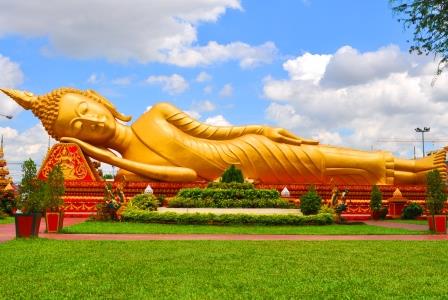
First stop was the Buddha Park (aka Xieng Khuan) with more than 200 religious statues including a huge over 131-feet high reclining Buddha, about 30 minutes from the city center. The best spot for photography was on top of the giant pumpkin, standing about three stories high, whose entrance is a demon’s mouth that leads to an internal stone ladder to the top with a bird's eye view of the Park.

In 1958, it was built by a monk who studied both Buddhism and Hinduism, the park has Buddha images, Hindu gods, and demons and animals from both beliefs. The most outstanding ones include Indra, the king of Hindu gods, riding a three-headed elephant, a four-armed deity sitting on a horse, and an artistic god with 12 faces and many hands. They are all impressive because of their size and interesting details. It was a great first stop.          

Pha That Luang
also found on the grounds of Pha That Luang
Patuxai

But it was the next stop that left us deeply amazed. Pha That Luang is beautiful to behold. A historic gold stupa, it is over 144 feet high with multiple levels, a walled enclosure, and a green grassy courtyard. This Great Stupa is the most sacred monument in the country. Every November, the Boun That Luang Festival, the most important Buddhist celebration, is held there with thousands of Laotians congregating there from all over the country.

Looking more like a fortress surrounded by high walls from the outside, Built by King Setthathirat in 1566 on the site of a 13th century Khmer ruin, it was greatly damaged during the Burmese, Chinese and Thai invasions in the 18th and 19th centuries but was restored by the French in 1900 and 1930. It features two temples with the main stupa’s top covered with gold leaf. The architecture is Lao in style, finely-gilded with red-lacquer doors, pointed lesser stupas, many Buddha, flower and animal images.

Patuxai

Our taxi driver brought us next to the Patuxai Victory Monument that is the centerpiece of Patuxai Park at the end of the capital’s grand avenue. The Park is a popular place to stroll around in the afternoons with the palm trees, lotus ponds, a musical fountain donated by China, and the peace gong given by Indonesia when Laos was named the world’s most peaceful country.

Wat Si Saket

Dedicated to the Laotians killed in the fight to gain independence from France, as well as from its earlier occupiers, Thailand and Japan, Patuxai is the best example of European influence, reminiscent of the Arc de Triomphe in Paris. But its exterior embellishments and interior decorations are of Laotian style. At the top, you will enjoy a panoramic view of Vientiane. Built between 1957 and 1968 using funds from the U.S. government, it features 4 arches, facing North, South, East, and West. The 5 towers symbolize the Buddhist principles of amiability, flexibility, honesty, honor, and prosperity.

Wat Si Saket

Near our hotel, we spent a lot of time at Wat Si Saket, famous for a cloister wall housing more than 6,800 tiny Buddha images and seated Buddhas that date from the 16th and 19th centuries. They come in all sizes and are made of wood, stone, and bronze. In beautiful Lao architecture, it is the country’s oldest Buddhist monastery, right across the Presidential Palace, with vast grounds filled with structures.

Wat Ho Phra Keo

Across the street and beside the Presidential Palace is Wat Ho Phra Keo, originally constructed in 1565 as the royal family’s personal chapel. It was the home of the Emerald Buddha after it was snatched from northern Thailand (reclaimed by the Thai in 1778 and now in Wat Phra Kaew in Bangkok). The temple is now a museum, richly adorned with a 16th century lacquered door with Hindu carvings. 

Wat Ho Phra Keo
Presidential Palace

The Presidential Palace was started in 1973 on the former royal grounds. Because of the takeover by the communist Pathet Lao in 1975, the building was not completed until it finally opened its doors in 1986 for government functions and ceremonies (the President resides elsewhere). Closed to the public, the beau arts-style architecture features tall colonnades and shaded balconies. Well-manicured lawns and gardens surround the palace, fenced off by tall walls and a wrought iron gate.

Presidential Palace

This is the 65th country Jingjing visited. To celebrate, we all heard mass at the Catholic place of worship in this Buddhist and Hindu nation. We also feasted at a 5-star hotel a few blocks from our cute Ibis Hotel. A Laotian dish, meat with lots of vegetables and fragrant herbs, caught our fancy because, just like Vietnamese cuisine, we relished its French influence. We were absolutely charmed by old-fashioned Euro-Asian Vientiane. But we still have to visit Luang Prabang!