Cruising Past Seventy: The Inner Journeys: Tennessee
Showing posts with label Tennessee. Show all posts

Friday, January 28, 2022

TRAVEL AWAITS: THE SECRETS OF THE MANHATTAN PROJECT


The complete article was published in Travel Awaits in September 2020

The Manhattan Project produced Little Boy and Fat Man, the first and only atomic bombs ever dropped, destroying the Japanese cities of Hiroshima and Nagasaki, respectively, killing more than 200,000 people. It put an end to WWII which had already killed 1.2 million Americans at the time.

It has become the model for large-scale, highly technical, hazardous wartime projects that have to be carried out in utmost secrecy. It was led by the U.S. with support from the UK (which initiated the original Tube Alloys project) and Canada. 

Because we were RVing across North America, in the span of three years, we saw the sites that contributed to its successful outcome: Oak Ridge, Tennessee; Hanford Reach, Washington; and Los Alamos, New Mexico. They comprise the Manhattan Project National Historical Park, created in 2015.

Oak Ridge Production Facility

Oak Ridge, Tennessee

We saw the full extent of the facilities at an overlook up a hill near the town. The total footprint at the time it was operational was 43-hectares, with five million square feet of working space on four floors. 

The Manhattan Project developed two types of atomic bombs: a simple gun-type fission weapon using enriched uranium, and a more complex implosion-type atomic bomb using plutonium. This Oak Ridge site, codenamed “Site X,” produced the enriched uranium using three enrichment methods.

We also toured the historic part of town and the visitor center. We learned about how the whole town buzzed with activity during the time. We also watched the documentary film The Secret City. Everyone was sworn to secrecy by Public Proclamation Number Two declaring no entry without military permission. The Oak Ridge population expanded well beyond the initial plans and peaked at 75,000 in May 1945. 

Hanford Reach National Monument

Hanford Reach, Washington

Just two months later, we were in Washington, waiting for my Seattle appointment in connection with my application for citizenship, and made it to the Hanford Reach National Monument, created in 2000. It had been untouched by development or agriculture since 1943 because of the Manhattan Project activities conducted there. As a matter of fact, it has been considered an involuntary park like Chernobyl.

This national monument preserves the seven reactors built to produce plutonium for the more complex implosion bomb. The site was chosen because the location had to be as far as possible from Oak Ridge. Codenamed “Site W,” by July 1944, some 1,200 buildings had been erected and nearly 51,000 people were living in the construction camp. It contains the B Reactor National Historic Landmark, the reactor that produced the plutonium for Fat Man. 

Bathtub Row in Low Alamos

Los Alamos, New Mexico

Two years later, when we were exploring the Bandelier National Monument in New Mexico, we found out that the Manhattan Project in Los Alamos was just 20 minutes away. So we took a little detour to explore the third unit. It was the central design and production facility, codenamed “Site Y.” Again, it was decided that this integral facility should be in a remote but midway between  Oak Ridge and Hanford Reach. 

The team of scientists who worked here, which included Enrico Fermi and was led by Robert Oppenheimer, built both atom bombs. We delighted in seeing the cottages on Bathtub Row where they lived, the only homes in the facility with bathtubs. The Bradbury Science Museum tells the whole story and houses what remains of the two bombs.

The Two Bombs

Testing and detonation was done at Trinity Site, southwest of Albuquerque, at New Mexico’s Alamogordo Bombing and Gunnery Range. Today, visits to the site are sponsored by the Alamogordo Chamber of Commerce on the first Saturdays of April and October. The rest of the year, it is closed because it lies within a missile impact zone.


Today, there are 17 laboratoies in the forefront of scientific research and development, some of which are conducted nowhere else in the world. The Los Alamos National Laboratory that designed and finally assembled the bombs still operates as part of the network. The U.S. has continued to be at the forefront of science to meet the challenges of the world.

FOR THOSE ON MOBILE, SHARE BUTTONS APPEAR WHEN YOU CLICK WEB VERSION AT THE VERY END AFTER COMMENTS.

PREVIOUS POST


Friday, December 31, 2021

TRAVEL AWAITS: Must-See Sites Along The Natchez Trace Parkway


The complete article was published in Travel Awaits in July 2020

We loved our drive through the Blue Ridge Parkway in North Carolina the previous year, so we decided to do the only other parkway in the U.S.: the Natchez Trace Parkway. It winds among the low hills south of Nashville, then there is a small section that crosses Alabama’s northwestern tip before ending in  Mississippi.

The Parkway became obsolete when improved transportation infrastructure — steamboats, stagecoach lines, and railroads — and ports developed along nearby rivers. As a result, no major population centers grew along the parkway. Today, it is "almost completely unspoiled, a quiet forest lane with the look and feel of the past, especially in its sections in Tennessee and Alabama."


"We saw many hiking trails, clear streams, little falls, shallow swamps, gentle meadows, pretty trees, and wild turkeys. We even chanced upon a gravesite of 13 unknown Confederate soldiers. At Donivan Slough, I was fascinated by the cotton fields that almost looked like acres of pock-marked snow. It was my first time seeing those fields where many slaves and their descendants toiled. Then there were the Native American burial mounds, even bigger and higher (though not in special shapes) than the ones we saw at the Effigy Mounds National Monument in Iowa. Here are some of the significant stops we made."

1. Natchez Trace Wilderness Preserve in Hohenwald, Tennessee


We camped here, an 830-acre forested campground. A true wooded oasis, there was a three-mile-long lake with excellent fishing. It is just a little over an hour from the northern terminus of the Parkway, a perfect base for exploring the northern half, an hour and a half from Nashville.

2. Natchez Trace Parkway Bridge near Milepost 444 (please see headline photo)

The northern terminus in Franklin, Tennessee is the concrete double-arched Natchez Trace Parkway Bridge. "At 145 feet high, it commands the intersection of the Parkway and State Route 96 at Birdsong Hollow. At 1,572 feet long and 37 feet wide, it was the first segmentally constructed concrete arch bridge in the U.S...This is called a cathedral arch bridge, and the weight is concentrated at the crown of the arch, giving the bridge a clean appearance.

3. James Polk Home near Milepost 416

Columbia, Tennessee is just an hour from this milepost. It is where the simple home of James Polk, 11th president of the U.S., is located. "Polk only served for one term and died just three months after leaving office. He won the Mexican-American War for the Union, and his legacy became the annexation of the rest of the West after the Lewis and Clark Expedition. He was sickly from the start, but, being a workaholic, it is believed that the hard work he put in may have cost him his life. At the home/museum, you will find two photos next to each other, one taken just before he died, showing how he had changed in only a year."

4. Jack Daniel’s Distillery in Lynchburg, Tennessee


"It was just an hour more after Columbia, Tennessee, so we also visited the Jack Daniel Distillery in the town of Lynchburg. It produces the top-selling American whiskey in the world in Moore County, a dry county. Thus, the liquor they produce cannot be sold nor consumed there. Quite ironic. The company now has over 500 employees in a town with a population of 6,000 and produces 16 million cases, or over 31 million gallons, of bourbon for domestic use and export annually.

5. Old Trace Drive at Milepost 397.4 (In Tennessee)


"The Old Trace was established in 1801, while the parkway began in 1930. Old Trace Drive commemorates the original route following the “traces” of bison and other game. In essence, it was the original path of the earliest Americans on the move. Parts of the Old Trace are still preserved, letting the travelers of today feel how it was to traverse the road in the 1800s. In addition, it was our tremendous luck that we were there during fall because the colors were spectacular."

6. Meriweather Lewis Monument at Milepost 385.9

Very near where we were camped in the town of Hohenwald, this is where, at the age of 55,  Meriwether Lewis died under very mysterious circumstances. "Syphilis, suicide, and even murder were suspected. Together with William Clark, he headed the Lewis and Clark Expedition, the three-year (1803 to 1806), 8,000-mile exploration which resulted in the doubling of the size of the U.S. with the Louisiana Purchase. The monument is incomplete and stands above Lewis’s burial site, near the roadhouse where he died. It symbolizes a life that was cut short, a life that could have been so much greater, given what he had accomplished in his years."

7. Ivy Green in Tuscumbia, Alabama


Ivy Green, Helen Keller’s birthplace and childhood home in Tuscumbia, Alabama was a two-hour diversion from the Natchez Trace Parkway but I wanted to see the home of the major inspiration in the life of my mother, a teacher of the deaf. "Despite being rendered blind and deaf from a high fever at the early age of 19 months, Helen Keller graduated from Radcliff, now part of Harvard University, cum laude thanks in part to the dedication of her beloved teacher Anne Sullivan. She even went on to write 14 books and was a sought-after inspirational speaker until she died at the age of 88."

 8. Elvis Presley Birthplace near Milepost 259.7


We also went to the Elvis Presley Birthplace in Tupelo, Mississippi, just 45 minutes from this milepost. "Having been to Graceland the previous year when we visited Memphis, it was a great opportunity to see his home from the time he was born to the time he headed for Memphis and stardom. Gospel singing influenced Elvis’s music so much that the church which he attended as a boy and teenager was relocated to the site of his very humble home, one block from its original location."


"Had we gone farther south, we would have also seen — aside from the bustling city of Jackson — the Windsor Ruins, the patches of red clover, and yellow wildflowers on the river bend." 

FOR THOSE ON MOBILE, SHARE BUTTONS APPEAR WHEN YOU CLICK WEB VERSION AT THE VERY END AFTER COMMENTS.

PREVIOUS POST

Friday, May 8, 2020

These Lovely Homes Are Where the 8 Best US Presidents Lived

George Washington/s Mount Vernon in Virginia, courtesy of Wikipedia

My husband and I have been to thirty of the forty-five American Presidents’ homes, tombs, and/or presidential libraries. We always sought them out while we RVed across the US. It’s too bad we didn’t get to all of them. In this post, I focus on the eight presidential homes which made the greatest impression on us. When I completed the list, I found out they also represent great times in our history.  And the Presidents that lived there are the Top 8 of the ranking of presidents from C-SPAN'S Presidential Historians Survey of 2017 where nearly 100 historians measured them according to 10 qualities of presidential leadership. 

Our Early Years

The first president of the US is George Washington (1789-1797). He was the general who led the country to victory in America’s War for Independence. Mt. Vernon is his historic home and estate. The land had been owned by his family since 1674 and the original house was built by his father in 1754. George Washington expanded it into a one and a half story mansion in the 1750s and 1770s.  A typical southern plantation with servants’ homes, carriage sheds, storage buildings, gardens, and a family tomb, it is now a National Historic Landmark, just 13 miles south of Washington DC. The back of the mansion dramatically looks out to the historic Potomac River.

Thomas Jefferson's Monticello in Charlottesville, Virginia, courtesy of Wikipedia

Our third president is Thomas Jefferson (1801-1809). He is remembered as a Founding Father and principal author of the Declaration of Independence. He inherited this estate in Charlottesville, Virginia when he was just 26 when he immediately started designing the plantation house in neoclassical design. He further improved it with French elements while he served as the nation’s MInister to France. This most impressive estate displays his brilliance in influencing a new architectural style with new and highly functional elements. Designated a National Historic Landmark, it is also a UNESCO World Heritage Site together with the University of Virginia which he also designed. Located on an 850-ft high summit of Southwest Mountains, Monticello means “little mountain.”

The Civil War Years

the Lincoln family welcoming us into the Lincoln home in Springfield, Illinois

Our 16th President, Abraham Lincoln (1861-1865), is frequently cited as the best president we have ever had because he ably led the country during its worst crisis. He was able to preserve the union and abolished slavery and his untimely assassination further glorified his presidency. His Greek revival style modest home is great to visit because it is he and his wife, Mary, played by actors, who welcome you to the tour in downtown Springfield, Illinois. Actually, we also visited the Lincoln Birthplace National Historical Park in Hodgenville, Kentucky. It exhibits his humble beginnings with the tiny cabin where he was born and the 56 steps representing his short life leading to it. But it is the Lincoln Presidential Library in the city that is the testament to his greatness. To me, it is the best presidential library and museum we have visited because he comes alive in holograms, in the Douglas-Lincoln debates using multiple TVs and other innovations.


The Conservation Years


the Maltese Cross Cabin at the Theodore Roosevelt National Park, courtesy of the NPS

Our 26th President (1901-1909) is the youngest president we have ever had. He rose to the presidency at 42 after President McKinley was assassinated. But he made such a significant contribution to the country. He is known for his Square Deal and the start of the construction of the Panama Canal but he made conservation a top priority, establishing national parks, forests, and monuments to preserve the nations's natural resources. We were not able to visit his Sagamore Hill National Historic Site in New York but we were able to visit his birthplace in New York City. But it was seeing the Maltese Cross Cabin now on display at the Theodore Roosevelt National Park that gave us a better view of the man whose cabin experiences in North Dakota gave him his great interest in the outdoors. that shaped his conservationist views.

The WWII Years

Bill at Franklin Roosevelt's Springwood Estate in Hyde Park, New York

Franklin Roosevelt was our 32nd President (1933-1945). He won a record four presidential elections, led the nation through the Great Depression and through WWII. His home, the Springwood Estate, in Hyde Park, New York is a National Historic Site. The last renovation he made doubled the size of the mansion and made it in Colonial revival style. Since it was owned by his mother, he built Top Cottage in Hyde Park as his own private home. His wife, Eleanor Roosevelt, redefined the role of the First Lady and became ninth of the Top 10 Most Widely Admired People of the 20th Century. Her home, Val-Kill Cottage, just two miles from Springwood, has also been named a National Historic Site.


Harry Truman's Little White House in Key West, Florida, courtesy of Wikipedia

When Roosevelt died, his vice-president, Harry Truman became our 33rd president. He authorized the first and only use of nuclear weapons that ended WWII, led the rebuilding of Europe after WWII through the Marshall Plan, and established the Truman doctrine and NATO. He also established the Little White House in Key West, Florida where he spent the winters when his doctor ordered him to stay in warmer places. It was originally the first officers’ quarters of a submarine naval station later converted into the base commandant’s home. The House would later be the site of many historic agreements and meetings.

Post-WWII Years

Dwight Eisenhower's Boyhood Home and Presidential Library in Abilene, Kansas 

Dwight Eisenhower became our 34th president (1953-1961). A 5-star general, he was the Supreme Commander of the Allied Forces in Europe and was directly responsible for the success of Operation Normandy that led to the end of WWII. He authorized the creation of NASA, contributed to the end of McCarthyism, and built the Interstate Highway System. His terms saw widespread economic prosperity. The Eisenhower National Historic Site is near Gettysburg in Pennsylvania but it was his boyhood home in Abilene, Kansas which we visited, my husband being a native of Kansas, too. It is a two-story wood-frame house in an acre of land. It also houses his Presidential Library and Museum and his final resting place. 


John Kennedy's Hyannis Memorial and Museum in Hyannis, Massachusetts

After Eisenhower, John Kennedy was elected to become our 35th president (1961-1963). It may have been a short presidency but it was a beloved one. The majority of his work was done during the height of the Cold War and his speeches inspired the nation. The whole world mourned his assassination. We visited the Kennedy Compound in Hyannis Port, Massachusetts. Kennedy used it as a base for his presidential campaign and later as a summer White House. There are three buildings: the Main House owned by the patriarch Joseph Kennedy and where Edward Kennedy lived until his death, John Kennedy’s smaller home on Irving Avenue, and Robert Kennedy’s home on Marchant Avenue. None of these places are open to the public. Instead, we visited the JFK Hyannis Museum nearby.

We are still hoping to see the other fifteen homes of the presidents we were not able to see. Visiting presidential homes has been truly instructive for us. They show us how great men were influenced to be the men they eventually became and how, in turn, they influenced the country by the way they lived and governed.

FOR THOSE ON MOBILE, SHARE BUTTONS APPEAR WHEN YOU CLICK WEB VERSION AT THE VERY END AFTER COMMENTS.


CLICK THIS TO PIN THE IMAGE BELOW

Tuesday, October 18, 2011

OLA: Driving the Natchez Trace Parkway

Fall colors at the New Trace
Not only Bill drove. I drove 10% of the Natchez Trace Parkway!

Fall colors at the Old Trace
We were in Tennessee last year, making our way back to the Northwest from our first winter in Florida. We only visited its largest cities: Knoxville, Nashville and Memphis. This time around, we passed through in the opposite direction….towards Florida for our second winter! We found the drive through the Blue Ridge Parkway in North Carolina so memorable (and the blog post is one of the most popular) that this year, we chose to drive the Parkway. Besides we wanted to cover Mississippi and it leads there!
Falll colors at the lake in Natchez Trace RV Resort
                                        
The Natchez Trace Parkway (the Old was started in 1801 while the New began in 1930) gently winds among low hills from Natchez, Mississippi to Nashville, Tennessee, crossing Alabama at its northwestern tip.  This All-American Road, like its sister Blue Ridge, is maintained by the National Park Service, to commemorate the original route following the ’traces’ of bison and other game. In essence, it was the original path of the earliest Americans on the move (much like us)! Parts of the Old Trace is preserved and an added bonus was the fall colors draping its sides (my favorite season!).

them ol' cotton fields back at Donnivan Slough
Improved communications (steam boats, stagecoach lines, and railroads) and the development of ports along nearby rivers made the route obsolete as a means of commerce. As a result, no major population centers were born or developed along it. Thus the Trace and its alignment between Nashville and Natchez come down to us today almost completely undeveloped and unspoiled as an unhurried forest lane, with the exception of the cities of Tupelo and Jackson, Mississippi which developed later.

native-American ceremonial mound at the Trace
                                                                       There are many hiking trails in this quiet forest lane. Clear streams, little falls, shallow swamps, gentle meadows, pretty trees, and wild turkey are abundant. At Donivan Slough, I was fascinated by the cotton fields that almost look like acres of pock-marked snow.  Then there were the native-American burial mounds, bigger and higher (though not in special shapes) than the ones we saw at the Mounds National Monument in Iowa.  There was even a grave site of 13 unknown Confederate soldiers.  And near the Northern Terminus at milepost 444, a 155-ft. double arch bridge commands the intersection of the Parkway and Tennessee 100 at Birdsong Hollow.

155-ft. double-arch bridge over Tennessee 100
Tuscumbia, Alabama
Despite being rendered blind and deaf from a high fever at the early age of 19 months, Helen Keller, through the dedication of her beloved teacher Anne Sullivan, was able to graduate from Radcliff, cum laude. She went on to write 14 books and was a sought after inspirational speaker until she died at age 88 in 1968. A moon tree, from a seed carried in the Apollo 14 space flight to the moon, is growing well on the grounds of Ivy Green, her birthplace and childhood home in Tuscumbia, Alabama, a short diversion from the Trace.

Helen Keller's birthplace and childhood home in Alabama
 My mother was the Principal of the Philippine School for the Deaf and the Blind for years, having been sent by the government as its scholar to the Central Institute for the Deaf in Missouri. As a matter of fact, my sister Julie is now Executive Director of a nonprofit school called the Philippine Institute for the Deaf which we founded in her honor.  Thus I was so interested to make the short diversion to the Museum of the First Lady of Courage. She was my mother’s heroine. And my mom was mine!

Elvis Presley's birthplace and boyhood home in Mississippi
Tupelo, Mississippi
Another draw to the Trace is Tupelo, Mississippi which is the birthplace and home of Elvis before he headed for Memphis and stardom. Gospel singing influenced the star’s music so much that the church which he attended as a boy and teenager was relocated to the site of the home and museum, only one block from its original location. We were surprised that the Elvis landmark had so many more visitors than Ivy Green. I guess pop music and rock n’ roll has a wider appeal than rising above one’s handicap! But I enjoyed holding young Elvis’ hand for a photo!

flock of wild turkey fleeing from Bill's camera
We were not able to complete the Trace. But we promised ourselves that when we cross the Gulf States again, plying between California/Arizona and Florida for snow birding, we will complete the southern portion around Jackson, Mississippi most especially to see the unique Windsor Ruins, the patches of red clover, and yellow wildflowers on a river bend!

Jack Daniel’s Distillery 
the natural spring from where Jack Daniels comes from 
Two weeks ago, I wrote that 95% of bourbon-making is in Kentucky. Well, a day when I was not feeling well, Bill went to Lynchburg, Tennessee to tour the only Jack Daniels Distillery. Daniels started working at the general store owned by the man that owned the still when he was only 7 years old. He bought it for $25 when he was only 13!  One morning he went to work early. Not able to remember the combination to the safe, he kicked it in frustration, breaking his big toe.  Gangrene set in and eventually resulted in his death.  (The lesson is: ‘Don’t go to work too early!’ ) The company now has 400 employees in a town of 500 in a dry county in Tennessee!   
13 gravesites of unknown Confederates on the Old Trace
                                                                          Next Stop: Atlanta and Macon, Georgia

Sunday, September 25, 2011

OLA: Riding Kentucky's Unbridled Spirit


an RV  flat tire on I 71, just 30 miles north of Louisville, Kentucky
I looked up the meaning of ‘unbridled’ (from this state slogan) in dictionary.com; it has two. The second meaning says: free from restraint.

As soon as we left Cincinnati and, as we were approaching Louisville, the right front tires of M’A ‘turn blew out (she has 8 in all, 2 in front and 6 at the rear, on 2 rear axles!)   It was such an unfamiliar booming loud noise and I got really scared (for once?).  Luckily, Bill was able to steer the 20,000-pound rig to the shoulder of Interstate 71.   In about an hour, our Good Sam road assistance was there to ‘unbridle’ us and we continued on to Diamond Caverns Golf and RV Resort further down in Park City.  

The original meaning is: horse bridles removed. Kentucky is where majestic horses run 'unbridled' in fertile pastures.
grass with a tinge of blue...

Churchill Downs, where the annual Kentucky Derby is held,
shown on its 360 degree screen
It is known as the ‘Bluegrass State’, literally because of bluegrass that is great for livestock especially thoroughbreds native to the state (saddle bred) who run ‘unbridled’ on the fields. Bluegrass is a perennial species native to Europe, north Asia and Africa, but not North America. Colonists brought the seeds with them and native Americans call it white man’s grass..  I spent many hours foolishly looking for grass that’s blue (so what else is new?). The name derives from both its dark green blades and blue flower heads which appear only when the plant is allowed to grow to its natural height of 2 to 3 feet.

the entry to Churchill Downs guarded by Barbaro a Kentucy Derby Winner 
This land makes the breeding of high-quality racing horses possible.   Churchill Downs, now a World Heritage Site, is in Louisville and is North America’s longest operating horse racing track. The famous Kentucky Derby is held there first weekend of every May and this year saw its 137th. We toured the grounds and imagined Derby Day when 120,000 people spill out of its 54,000 seat grandstand, with its famous twin spires and millionaires’ row, onto the grass lawn inside the mile long dirt track.  $150M is wagered through its 3,000 windows. We toured the back barns where 1,500 future champions are being trained and stood in awe at the many testaments to past and current champions and the sublime walkway of those who have passed on. A showcase miniature horse named Winston and a retired champion named Risen Warrior bid us goodbye.
Winston, the miniature horse, and Risen Warrior, retired champ

Frozen Niagara in Mammoth Cave National Park,
longest cave system in the world
North central Kentucky is famous for the Downs, the Derby, and many horse farms. But in the south central part of the state is the world’s longest cave system in over 50,000 acres of the Mammoth Cave National Park. 394 miles of connected underground passageways were formed by the ‘unbridled’ waters of the Green River.  If you remember, in Rapid City we saw the second longest, Jewel Cave National Monument (154 miles), and the fifth longest, Wind Cave National Park (135 miles). The third longest is Optymistychna in the Ukraine (144 miles) and the fourth is Sistema Ox Bel Ha (139 miles) in Mexico.

Carol sanitizing her shoes on 'foam-ations'
The System was formed about millions of  years ago under a ridge of sandstone and shale, making it very stable and dry, though not as gorgeous in formations. We took the easy (I can’t do strenuous tours anymore!) Frozen Niagara  tour, so named for the waterfall that comes through a hole on the cave roof and alternates between a trickle and a downpour depending on water activity above. A huge flowstone with draperies looks like frozen falls. Unfortunately, I was singled out (not for being pretty, sigh) but for having been in another cave system only 2 months earlier, wearing the same pair of shoes! White nose syndrome has killed millions of bats and I had to be sanitized through the ‘foam-ations’.  At the end, all of us had to go through it.

one of the one=car river ferries
Driving through the scenic byways of Kentucky was also pleasant. The Cordell Hull Scenic Byway goes down to the border of Tennessee at Tompkinsville where we found an Old Meeting House that was built in 1773 during the religious upheavals. Every day the old game of rock marbles is still played at a unique ‘Marble Dome’ in town. The Duncan Hines Scenic Byway goes around and inside the Mammoth Cave National Park, crossing the Green River on 3 points via small ferries, through pretty treed landscapes, many historic cemeteries of families who once lived on the park, and antique stores full of treasures.

the old Marble Club Super Dome, still in daily use today
Next: Riding Kentucky's Unbridled Spirit, Part 2

Sunday, June 27, 2010

Visiting Elvis in Memphis

It rhymes!  And Memphis rocks! We went to Graceland, Sun Studio, Beale St. , the Gibson Guitar Factory, the FedEx Forum, the Hernando de Soto bridge, the Pyramid Arena, and the Elvis Presley and B.B. King Welcome Center.  We had planned on going to Tupelo, about 1 ½ hours away, Elvis’s birthplace and where he stayed for 13 years before moving to Memphis. However, M’A ‘turn’s front air conditioner failed in the blistering 97 degree heat and we had to proceed quickly to Camping World at Little Rock.

At an estimated population of over 670,000, Memphis is the largest city in the state of Tennessee and the nineteenth in the United States. So, despite the RV problem, we still had a lot of fun taking pictures of places, especially those around Graceland:  Elvis’s plane named Lisa Marie, his blue El Dorado convertible, The Elvis Presley Boulevard sign, and Heartbreak Hotel.  We did not take the tour of the mansion though since I had been there before and we had time for only one tour.

We took the tour of Sun Studio where the blending of Blues and Country music came together in the big bang of Rock N' Roll. We actually preferred the Gibson Guitar Factory Tour but they cancelled the last tour of the day.  Our tour literally rocked.  The tour guide, El Dorado, told the stories while playing outtakes from sessions.  We saw loads of memorabilia and heard the story behind the launching of the careers of Johnny Cash, Carl Perkins, Jerry Lee Lewis, & Elvis Presley. 

El Dorado told us how the highlight of the studio’s history was made one December night when the four stars chanced upon each other and jammed together for the first time without knowing that the microphones were live.  He played for us part of their horsing around that that night.  This historic event is memorialized in the rollicking play, Million Dollar Quartet which Bill and I saw in Seattle some two and a half years ago (everybody danced on the aisles and atop seats). Finally, we were allowed to have our pictures taken with the original microphone Elvis used!

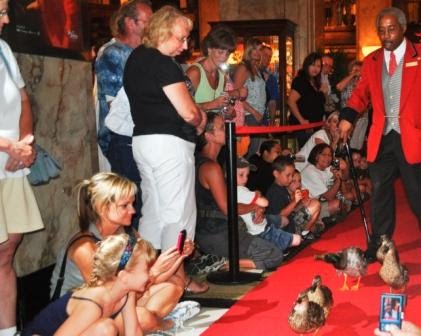
The Beale St. district is the place to be at night.  After being disappointed at the Gibson Guitar Factory Showroom, we took a photo of the FedEx Forum, home of the Memphis Grizzlies.  Then we had beer and chicken tenders at the B.B. King Blues Club. You see, we were waiting for 5 PM when the famous Peabody ducks walked the red carpet at the lobby of The Peabody (a famous hotel in the district) every day from their home at the rooftop.

Then we went to see the Elvis Presley and B.B. King Welcome Center where a huge colorful egg adorned the entry. Larger than life statues of the two Memphis sons stood inside.  From the Welcome Center you can see the graceful Hernando De Soto Bridge, a through arch bridge carrying Interstate 40 across the Mississippi River between Arkansas and Tennessee.  It is named for the 16th century Spanish explorer who explored this stretch of the River where his body is believed to have been buried.
Next to the Welcome Center and bridge is the 20,142 seat Pyramid Arena.  Standing at 321 feet (98m, about 32 stories) tall and with base sides of 591 ft, it is the sixth largest pyramid in the world behind the Great Pyramid of Giza (456 ft), Khafre's Pyramid (448 ft), etc. It is also 16 feet taller than the Statue of Liberty. Although originally built for the Grizzlies, the team abandoned it in 2004.  Since that time, the Arena has not been used for sports.
But we had to proceed quickly to Little Rock because more hot nights will make me lose more beauty sleep.  And that, definitely, cannot be!
Next Stop:  Little Rock, Arkansas