Cruising Past Seventy: The Inner Journeys: national parks
Showing posts with label national parks. Show all posts

Tuesday, July 2, 2024

Becoming an American without Losing My Roots, Part 1

where the "shot heard round the world" was fired: Lexington, Massachusetts

This story began way back when I was born. My father was a soldier who fought alongside Americans against the Japanese on Philippine soil in WWII.  My mother was sent to America on a Philippine government scholarship to study the latest in deaf education and to bring it back to the Philippines. Both infected me with their love for America.

Getting a high school scholarship to the American School fueled the addiction. Training by American multinationals after college further stirred the pot. I almost relocated to the US when Philippine democracy and economy were in tatters during the fall of Marcos. It was, therefore, no accident that I came to America to retire. On Valentine’s Day 2011, I became a US citizen.

Early in our RV cruising days, I unequivocally saw America's beauty. I was mesmerized by spectacular national parks like Glacier Bay, Denali, Mt. Rainier, Yosemite, Sequoia, Joshua Tree, Grand Canyon, Rocky Mountain, Badlands, Everglades, Smokey Mountain, Acadia, etc. I began to sing the song, "America, the Beautiful."

When we drove up the East Coast from Florida, I lingered in the solemn halls of Washington DC, Baltimore in Maryland, Philadelphia in Pennsylvania, and Boston and Concord in Massachusetts. These cities played significant roles in the birth of this great nation. I began to hum "The Star-Spangled Banner." 

In no uncertain terms, I was starting to feel like an American. I felt sad as I walked along the Civil War battlegrounds, proud when I gazed at awesome NASA rockets, inspired among the ancient ruins and great houses of American Indians, and more. I knew the conversion was final when I began to take pride.

The technical difference between a US permanent resident and a naturalized citizen is that the latter can vote (or run for an elected post office). I cast my vote for the first time in the 2012 presidential elections. It was amazing to watch as more than 300 million people accepted the results broadcast by the press with polling centers in Hawaii and Alaska still open.

There are other systems to love. They say that there are more libraries than McDonald’s stores in America. Every county issued library cards to us even if we would only be in the area for a few weeks. The largest national highway system in the world made road trips so easy. Through Bill’s $10 Senior Golden Pass, we have visited, for free, 31 National Parks, 92 National Monuments and National Historic Sites, and both national parkways.

I have visited 31 of the forty-six American Presidents’ homes, tombs, and/or presidential libraries; even the homes of their first ladies. We came across larger-than-life heroes, brave pioneers, cultural icons, and lay and church leaders. I was inspired by Americans who came and fulfilled their dreams. Visits to the homes and tombs of literary greats gave me the final nudge to start writing.

We have been to the largest and the smallest of towns, the poorest of counties and the wealthiest of states, and everything in between. Some of America’s man-made structures and natural formations are among the tallest, the biggest, or the longest in the world. There are those that you cannot find anywhere else. We visited factories of products made in America and headquarters of noble institutions that serve the world. It was cool to discover that we had been to half of the suggested places in the July 2014 article in Readers’ Digest, “A Quirky Tour of the US.”

My American education was an intravenous transfusion, not just an injection. I am no longer a Filipino tourist or a permanent resident. I am not even just a US citizen. I am an American. But to be a US citizen, I had to surrender my Philippine citizenship. Did this mean I ceased to be a Filipino? The answer is in Part 2.

PINNABLE

Tuesday, May 7, 2024

Chasing a Photograph


Once my second daughter needed help and sent tickets for Bill and me to fly to Calgary and babysit her three boys ages 10, 3, and 1. It was our chance to complete the four breathtaking parks that together form a UNESCO World Heritage Site. We visited the more popular two, Banff and Jasper, the better-known parks on the Alberta side, years before. Kootenay and Yoho National Parks on the British Columbia side of the Canadian Rockies are only 3 ½ hours away from their home.

They are all connected to Calgary through a section of the Trans-Canada Highway, one of the longest national highways in the world at 5,000 miles through ten provinces from the Atlantic to the Pacific. We visited Kootenay and Yoho on separate weekends.  On the third weekend, we revisited Banff and Lake Louise, just 1 ½ hours away. We reserved the newly opened Glacier Skywalk on the Columbia Icefields between Banff and Jasper for the last weekend.

Having negotiated this highway many times, I expected each drive to be uneventful. On the first drive, however, I caught a glimpse of a scene that would haunt me through all eight drives to and from Calgary. There was this lone red car, rising on the road, driving straight into an enormous white mountain.  Sigh. I could not get to my Nikon fast enough; the strap was curled around my foot.

I resolved to be more alert, constantly looking for another chance. Bill welcomed the change; I was no longer the disinterested passenger. A little while later, another chance came but it wasn’t as magical. The car was black, and the road was flat. The following Saturday, we were back on the same road and got another chance! The mountain was more majestic, but the car was white, disappearing into the mist.

Frustrated, I wished we could just stage the scene! My husband reminded me that there were plenty of other beauties all around. I was thrilled to see an enormous yellow truck blazoned against the gray mountains. White fluffy clouds cavorted with the snowy peaks for a mystical effect. A colorfully painted train ruffled against the Rockies’ skirts. Curvy pedestrian bridges punctuated the highway humdrum. There was the ubiquitous RV, in all shapes and sizes. Occasionally, a red-roofed log cabin enlivened the greens. The Canadian Rockies are such a special place. But I felt empty-handed when I got home.

On the last weekend, a snowstorm was forecasted. But we still went and stayed at Canmore, the town before Banff, for the night, hoping the weather would clear. It didn’t. I hated the cold, but it was our last weekend. The way to the Glacier Skywalk through the Icefields yielded zero results. When we reached the highest elevation, more than 6,000 feet, endless rows of frosty evergreens gave me a wonderful Christmas…in June! Was that going to be my saving grace?

But on our final drive home, the gods granted my wish. Although the car was not red and low-lying clouds covered the mountain, the road had a slight rise that recreated the magic I saw the first time. On the rest of the road back home, we tried to outdo each other with the titles I could use when I entered the photo in Viewpoint's Photo Show: Into the Mist, Into the Clouds, Into the Unknown. I was sure my photo would get a lot of nods because it evokes all sorts of feelings: why we drive beyond the mountains, beyond the ordinary, beyond the obvious.


It doesn’t matter how many times I go back to the same place. It doesn’t matter if I drive the same old road. Something else will catch my fancy. I am free to listen to whatever my heart whispers. Even if it’s just chasing a photograph.


PREVIOUS POST

Tuesday, October 10, 2023

TRAVEL AWAITS: 6 Quaint Small Towns To Visit While Exploring Kenai Peninsula in Alaska


This article was first published in Travel Awaits on Aug. 14, 2023.

As America’s last frontier, Alaska is well-known for spectacularly wide-open spaces teeming with amazing wildlife, ideal for both cool and cold outdoor fun.  Half of Alaskans live in Anchorage but it’s the quaint small towns that can give you the true Alaskan experience. North of the city are interior towns born out of its mining history. To its south, however, are communities rich in Russian cultural heritage with abundant fishing waters, glacial fields, and beach ports for Inside Passage cruises.

There are 36 such towns located on the Kenai Peninsula in the south-central part of the state. It has been called Alaska’s playground, “where mountains, ice, and ocean meet.” Bounded to the west by the Cook Inlet and to the east by the Gulf of Alaska, the Kenai Mountains lie on its western side, creating the natural bounty called the Kenai Fjords National Park. The jewel of the park is the famous Hardings Ice Fields. There are also six great rivers and over 50 lakes. At its southern tip, Kachemak Bay State Park  was Alaska’s first legislated state park. Together with the Kachemak Wilderness Park , they comprise 400,000 acres around the pristine waters of Kachemak Bay.

My husband’s daughter and my sister both lived in Anchorage, and visits to each of their homes have blessed us with opportunities to explore this incredible state. Our first visit to Kenai was so much fun that we went back for more the following year. In the following paragraphs, we share Cooper Landing and Homer from the first visit; then Kenai, Soldotna, and Seward from the second. But first, Whittier.

1.  Whittier


The 14-mile isthmus that connects Anchorage to the Kenai Peninsula is called Portage Valley. It is on a waterway called Turnagain Arm. The Portage Glacier once sat here and its remnants can still be seen today. The ghost town of Portage, about 47 miles south of Anchorage, is what remained after the 1964 Alaska earthquake.

An alternating railroad and road passageway was built here linking Seward Highway and Alaska Railroad to the Portage Glacier Park and the town of Whittier. It was quite an experience to pass through this Anton Anderson Memorial Tunnel.

Only about 60 miles southeast of Anchorage, the small town of Whittier is technically not part of the Kenai Borough. It sits on the northeast shore of the peninsula at the head of the Passage Canal, a port for the Alaska Marine Highway. Off-season, 272 people make it home, doubling in summer. Nestled between glacier-draped mountains, the town is the charming gateway to Prince William Sound on the Gulf of Alaska. Several cruise lines use it as a departure port for their famous four-hour Inland Passage cruises.

Pro-Tip: Our cruise took us up close to 26 glaciers on Resurrection Bay and the College Fjords. The high-speed catamaran had huge picture windows inside and extensive outside viewing decks. This is the less expensive way to explore these glaciers (rather than to cruise all the way from Seattle) and it gives you the chance to explore the peninsula.

2.  Cooper Landing


Straight south on Seward Highway about 100 miles from Anchorage, you will come across a centrally located census-designated place about the same size as Whittier: Cooper Landing. Because of its scenic location at the outlet of Kenai Lake into the Kenai River, it has become a popular tourist destination and a fisherman’s playground near the area’s salmon fishery.  

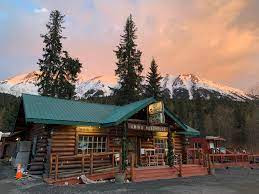
Pro Tip: You can get great fish and chips and the best-smoked salmon chowder you will ever find (just $10 a bowl) at historic Gwin’s Lodge, established in 1952 (even before Alaska became a state). You can find this oldest surviving roadside lodge on the peninsula at the confluence of the Kenai and Russian Rivers.

3.  Homer


My husband, his daughter, her son, and I continued to the southern tip of the peninsula just two hours away, to the quaint town of Homer, fondly called the “halibut fishing capital of the world.” Over 5,000 people reside on the foothills of the southern Kenai Mountains, overlooking a beautiful spit jutting out into the cold blue waters of Kachemak Bay. There the grandfather and grandson fished to their hearts’ content while I lost track of time taking photos of them and the wondrous seascape. At night we let the Inn’s chef turn their catch into a fish fest.

Perched in colorful huts above the waters along the spit shore were quaint shops and restaurants. It made a very lovely place for souvenir hunting and snacking. I could not resist having my photo taken with the largest halibut (almost 200 pounds) caught in a derby that day.

Pro Tip: Here we found the iconic Salty Dawg Saloon, perfect for drinks and dinner. The place is famous for its ceiling and walls covered with currency. I posted my Philippine Peso 100 bill, and the rest of the group, a U.S. Dollar. We hoped they would both still be there when we go back!

4. Kenai and 5. Soldotna


My husband’s daughter met somebody wonderful so the following year, we were back in Alaska for her wedding! When the brand-new couple went on their honeymoon, the grandpa, grandson, and I tried to replicate the previous year’s fun times and drove for three hours just slightly off the same road to Homer the previous year. They wanted to fish again, this time at the coastal capital town of Kenai (population 7,000) and its twin town Soldotna (5,000) at the western mouth of the Kenai River leading into the Cook Inlet.

Being late in the summer though, it was already colder, wetter, darker, and windier. There was not much fishing to do in this, Alaska’s renowned fishing area. The snow-capped mountains seemed farther away, hidden by haze. Even my photos turned out less bright.

But at Old Kenai Town, our disappointment suddenly went away. We were entranced by the historic church, built at the turn of the 19th century when the land was still under Russian rule. Alaska only became a state in 1959 (Russia sold it to the US in 1867 for $7.2 million). At the gilded Holy Assumption Russian Orthodox Church, we even found a set of wedding crowns we wore for a souvenir picture.

Pro-Tip: In Soldotna, we rejoiced at finding a local Fred Meyer which had complimentary dump and potable water stations. We loved camping there for the night and shopping for provisions in the morning.

6.  Seward


Sensing my disappointment in the weather, instead of going back to Anchorage my husband headed off to the eastern side of the peninsula. Less than two hours away is the small quaint town of Seward (population 3,000), sitting at the mouth of the Kenai Fjords National Park. It is another lovely cruise ship town nestled between the mountains and the fjords. It was already off-season, however, so there was hardly a soul on the waterfront. But the boats were all still moored in the marina; the shops were still open; and tours to the Kenai Fjords were still running!

Soon I would be treated to one of the great experiences of my lifetime. A sign led us to the Exit Glacier only eight and a half miles west of town. Considered the toe of the 500-square-mile Harding Ice Fields, it is so named because it has been receding slowly since the earliest recorded terminus in 1815. There were recordings all along the way, the last about two miles from the present one. You can imagine the former size of the glacier from the marshland being created at its feet.

On that massive ice, I got a second chance to walk on a glacial ridge. The previous year I had chickened out when we came upon the Worthington Glacier en route to Valdez. This time, I summoned enough courage to experience the thrill. But it was so cold, it felt like I was inside a freezer. I turned back after one quick photo op!

Such are the charming discoveries we made all over this beautiful peninsula. It’s a place where disappointments don’t last long. An abundance of small quaint towns collectively makes it an unforgettable vibrant playground.

FOR THOSE ON MOBILE, THE SHARE BUTTONS APPEAR WHEN YOU CLICK WEB VERSION AT THE VERY END AFTER COMMENTS.

PREVIOUS POST 

IN HAWAII: Renewal of Vows on Oahu and 2nd Honeymoon on the Big Island


Tuesday, February 14, 2023

TRAVEL AWAITS: Beyond Banff: 12 Other Amazing Places in the Canadian Rockies


The original article was published in Travel Awaits on June 11, 2022.

My daughter lives in Calgary, Alberta, and that means that I have left no stone unturned, so to speak, in exploring the Canadian Rockies. The area is often called the Alps of North America and is more beautiful, some say, than the American Rockies. Just an hour from my daughter’s home, Banff National Park is the oldest and most visited park in all of Canada. But Banff is actually just the beginning of the wonderland; beyond is an area replete with beauty to behold and adventures to be had.

Three other adjacent national parks — Kootenay, Yoho, and Jasper — and three British Columbia provincial parks — Hamber, Mount Assiniboine, and Mount Robson — have collectively been designated, together with Banff, as the Canadian Rocky Mountain Parks of the UNESCO World Heritage Sites. And all around the parks are not only a host of beautiful towns but also natural and man-made attractions.


1. Visit Kootenay National Park, Just Beside Banff

From Banff en route to Kootenay National Park, we were welcomed by the old Continental Divide sign. I was thrilled it was all in yellow but unhappy the letters didn’t register well on my camera. It said: “This is the continental spine of western North America. At this location, it separates two watersheds, two provinces, and two national parks.”

Kootenay is not a big park, but Highway 93 South runs through it as an alternate route to the Trans-Canada Highway through the Rockies. It offers a 60-minute scenic drive with lovely stops like Marble Canyon and then Paint Pots, similar to Yellowstone. Unfortunately, the bridge had collapsed at Numa Falls, so we could not get the correct angle to appreciate the scene. But right after we spotted the sign for Radium Hot Springs, we knew we had arrived at Sinclair Canyon which provides a breathtaking scene, a romantic peek of the village below.

Pro Tip: If you don’t have a lot of time, don’t miss the Kootenay Valley Viewpoint.

2. After Kootenay, Descend Upon Columbia Valley


Only a few minutes later, we reached our hotel in the Columbia Valley, the western foothills of the Canadian Rockies (lovingly called the warmer side of Canada) just 2 and a half hours from Calgary. At the Visitor Information Center close by, we were welcomed by some of the bighorn sheep that have made Radium home, waiting to be photographed by two excited new visitors.

3. Radium, A Town In The Columbia Valley

Radium Hot Springs was very near our hotel. It was named after the radioactive element when an analysis of its water showed that it contained small traces of radon, a decay product of radium. Radiation from bathing in the pools is inconsequential for a half-hour soak, so that was how long we stayed at the hot pool. Even if its curative powers have been disproven, a hot spring in Canada (or anywhere cold) is usually a good idea.

4. Invermere, The Central Hub Of Columbia Valley


The central hub of the valley is the town of Invermere, 13 kilometers south of Radium on the beautiful Windermere Lake, popular for boating in summer and ice skating in winter. The road to the town offered many interesting scenes to be photographed: mountain goats, quaint red-trimmed churches, and fields of dandelions.

5. Golden, The Western Entrance To Yoho

Just 105 kilometers (65 miles) north of Radium is the town of Golden. The Canadian Pacific Railway and the logging industry are both tied to the history of this town that grew at the confluence of the Columbia and Kicking Horse Rivers. Two other mountain ranges surround it, besides the Rockies.


Pro Tip: Right in the middle of Golden is the striking Kicking Horse Pedestrian Bridge, the longest freestanding timber frame bridge in Canada, 150 feet long and 210,000 pounds heavy in beautiful Burr Arch design. As a community project of the Timber Framers Guild, volunteers from Golden were joined by timber framers from the U.S. and Europe. It was completed in September 2001.

6. Be Amazed At The Yoho National Park

Golden leads you to Yoho National Park. In Cree, “yoho” means awe and wonder. The smallest of the four contiguous national parks, the park’s visitor center is in the small unincorporated community of Field, British Columbia, within the confines of the park along the Trans-Canada Highway cutting through it. Just before reaching Field, Emerald Lake Road leads to two major points of interest in the park.

7. Natural Bridge, An Impressive Rock Formation

The first is the Natural Bridge, an impressive natural rock formation that spans the flow of the Kicking Horse River where the slower-moving waters from Field begin their descent through a canyon. Rushing water over what once had been a waterfall contributed to the sculpting of the natural formation where the softer rock below its hard limestone band eroded more quickly in widening fissures.

8. The Largest And Most Beautiful, Emerald Lake


At the end of the road is Emerald Lake, the largest of Yoho’s 61 lakes and ponds, so named because of its vivid turquoise color coming from powdered limestone. Emerald Lake Lodge provides high-end local accommodation amid the three mountains that surround the lake. A 3.2-mile hiking trail circles the lake, half of which is accessible to wheelchairs and strollers. In summer, wildflowers abound and canoe rentals are available; in winter, cross-country skiing is the sport.

Pro Tip: If you have the time, try to stop at the Big Hill on the Canadian Pacific Railway main line. It was the railroad’s most difficult section until it was replaced in 1909 by the only Spiral Tunnel in North America (there are about 70 in the world, mostly in Europe). From the road, you may be able to witness one end of the train coming out of one tunnel opening while the other enters another.

9. Icefields Parkway Connects Banff To Jasper


From Banff to Jasper you will drive along the Icefields Parkway, also called Highway 93 North, running for 142 miles and paralleling the Continental Divide. National Geographic named it one of the “20 drives of a lifetime.” This is where interconnected, boundless glaciers dominate the scene. You can experience them much better by riding those huge buses that ply the Columbia Glacial Fields.

The Columbia Icefields Visitor Center offers a warm refuge inside, fun shopping at the busy gift shop, and a comforting bowl of hot soup at the cafeteria. Stepping onto the observation deck, you can take in the whole vista of the famous Athabasca Glacier, the icefield’s biggest. Sadly, it is said to be receding 5 meters (16 feet) a year, so it would be good to visit the parkway now.

Pro Tip: Take the shuttle to the Columbia Fields Skywalk, a narrow walkway built 1,000 feet high into the sky on a cliff’s edge. It is the largest cantilevered platform in America with a massive, H-shaped polygonal steel support holding an all-glass curved tension bridge. It loops approximately 150 degrees around the outside edge of the cliff. This overlook is part of an interpretive trail about 400 meters long.

10. Farthest, Second Most Visited, And The Largest: Jasper National Park


The farthest away, the second most visited, and the largest of all, Jasper National Park, is only 3 and a half hours from my daughter’s home. But it is such a landmark of beauty with elegant lakes in glacial waters of a milky greenish hue. And there were lakes galore and we saw three: Medicine Lake, Maligne Lake, and Patricia Lake. Even with the many tourists around, it feels like you are alone amid the serenity of the lakes and snow-covered mountains that protect them in varying hues of blue and purple. Each photo we took seemed to emerge as another painting. We also saw elk cavorting by the road, and we took so many photos.

Pro Tip: Don’t forget to try the aerial trams to get an even better view of the beautiful landscape.

11. Mt. Robson Provincial Park, the Highest Peak Of The Canadian Rockies


We also took a trip to the border of Alberta and British Columbia. There was another Continental Divide sign. And soon we reached the highest summit of the Canadian Rockies, at over 14,000 feet high. I don’t know why, but the peaks of Mt. Robson stood as imposing as Mt. Rainier’s peak, even though they rested on a base already thousands of feet above sea level!

Pro Tip: Unfortunately, we did not have the time to visit the other two provincial parks. If you want to complete your exploration of the World Heritage Site, find the time for Hamber and Mount Assiniboine Provincial Parks.

12. The Overflow Town Of Banff: Canmore


Lastly, I have to tell you about the town of Canmore, an overflow destination of tourists from the town of Banff, and picture-perfect Lake Louise in the Banff National Park. It is even closer to Calgary at the southeast boundary of the park. Since it was chosen to host the Nordic events of the 1988 Winter Olympics, its population has risen to 12,000, exceeding Banff’s 9,000. But the latter is still larger in area and has more establishments. Canmore gives much the same feel while you shop and stroll amid towering glacier-capped mountains.

The Canadian Rockies is one of those special spots on earth, and UNESCO recognized that when it was named a World Heritage Site. We covered it in several trips from my daughter’s home, but if you want to take in everything including Banff in one trip, you probably need at least two weeks, better if three.

FOR THOSE ON MOBILE, THE SHARE BUTTONS APPEAR WHEN YOU CLICK WEB VERSION AT THE VERY END AFTER COMMENTS.

PREVIOUS POST

Friday, July 15, 2022

TRAVEL AWAITS: Six Unique Dining Experiences In and Around Calgary


The full article first appeared in Travel Awaits on Dec. 7, 2021.

I previously wrote about dining experiences to celebrate significant occasions around Arizona. I considered them unique because they were not only fine dining but had a special ambiance. We visit my children a lot so we have also collected such experiences in Calgary, Alberta where my second daughter lives. Later I will also share those I found in San Francisco and Melbourne where two other daughters make a home.

River Café on Prince Island in the Middle of Bow River, Calgary


Calgary reopened right before our 13th anniversary and we hurried to go because we had missed our family there for two years. Luckily, we found
River Cafe in the middle of Prince Island on the Bow River next to downtown Calgary. You could not drive there; the only way to reach it was to walk. Fortunately, we started from the southern Bow River Pathway at the end of the beautiful Peace Bridge. And that takes you all the way to a park concession building in the middle of the lovely Prince Island Park.

It was an amazing setting and the menu was upscale, composed of dishes made from fine locally sourced vegetables, meats, and seafood. My husband had fire-grilled Springbank bison striploin cooked medium rare accompanied by grilled Sudo Farms baby cabbage, wilted Ark Farms Swiss chard, and juicy Saskatoon berry jus gras. I chose the Haida Gwaii halibut with flavorful Canadian dashi, spongy shiitake mushrooms, and Sudo Farms wilted bok choy oozing with scallion oil. And the sweetened old-fashioned rice pudding was a great finish.

Afternoon Tea at the Prince of Wales, Waterton Lakes National Park, Alberta


During our lone weekend, we also camped at
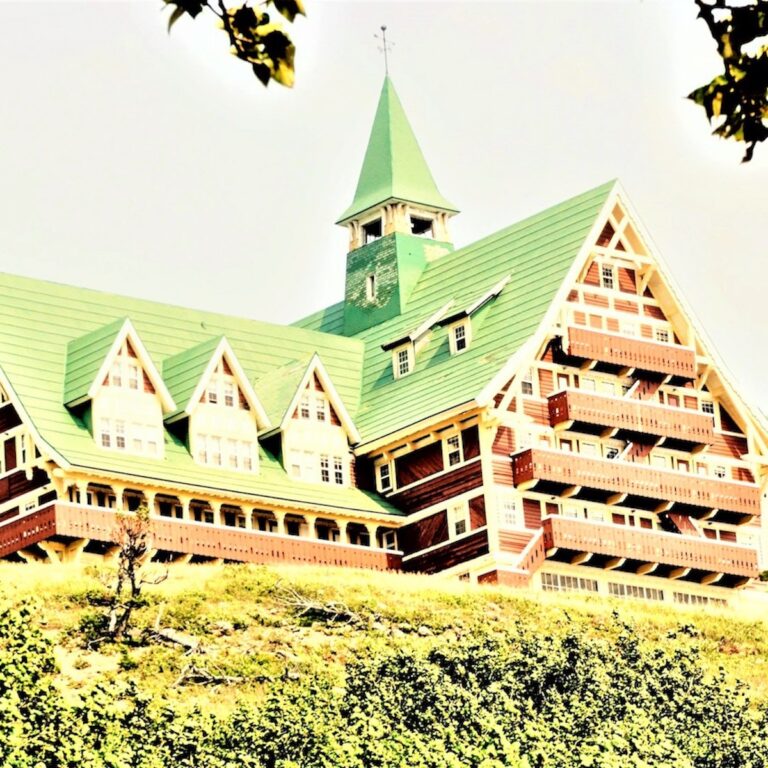
Waterton Lakes National Park, two and a half hours from the city. Its upper Waterton Lake lies partly in the US and that is why it is partnered with Glacier National Park as an International Peace Park. And we made sure we experienced the Afternoon Tea at the colorful Prince of Wales Hotel perched atop a bluff in the middle of the park.

It could have been just the same as other ones we had tried like “the most expensive” at the Ritz-Carlton in London and “the best in the world” at the Empress Hotel in Victoria, British Columbia. But what made this one different is that there were special treats for the little ones. Of course, they do not care for fruit scones with clotted cream or delicate finger sandwiches of salmon or crispy cucumber. They were given small plates of fine little chicken nuggets, small brownie bites, and craft flowers fashioned with sweets.

Devonian Gardens Inside the CORE Shopping Center, Downtown Calgary


When we got back to the city, my daughter took me to the
CORE Shopping Center on 7 Ave SW in downtown Calgary. Imagine my delight when I discovered The Devonian Gardens inside! It’s a one-hectare botanical garden and urban oasis on the fourth floor, with at least 500 trees, 50 plant varieties, a living wall, several fountains, a few fish ponds, and a playground for kids.  

And the Food Court is wisely situated right next to it. So we all ordered Pad Thai for under CA$7 (US$5) at her favorite Thai kiosk and happily brought along our little noodle baskets and chopsticks to an empty nook at the center of all the busy-ness. We had an inexpensive delectable lunch amid the Garden’s greens.


Sky 360 at the Calgary Tower, Downtown Calgary

Also in downtown Calgary, no one will miss the iconic city landmark called the Calgary Tower. As a rule, we thought such places emphasize location and view, but do not necessarily have great food. However, my daughter gifted us with a dinner for two at the Tower’s Sky 360 for another anniversary.  We were happily surprised to find that our hypothesis was not correct. The food upheld the Alberta tradition of great beef, grilled to the exact doneness, with just a little pink for me.

And the sweeping 360-degree views of the city contributed to making our anniversary special. After this positive experience, we also tried The Loupe Lounge in Seattle’s Space Needle and The Top of the World Restaurant at the STRAT Hotel in Las Vegas. I also learned not to leave my drink on the ledge because I did not want to wait for the floor to turn 360 degrees before I could take the next sip!

Lakeview Lounge, Fairmont Chateau Lake Louise (headline photo)


A few years ago, my husband drove me to
Lake Louise, that postcard-pretty place about 30 minutes from Banff and two hours from my daughter’s home. I had been there twice before, once in late spring so the glacier was still in its full glory and at another time during summer when it was not so impressive. This time he led me to the Fairmont Chateau Lake Louise where he had reserved a table at the Lakeview Lounge. I thought that the place was way too expensive for us. But, as we sat in front of a huge picture window looking out to the perfect “Lake Louise” scene for a Mother’s Day lunch, the basic burger I ordered tasted like the premium steak for the Queen! 

Rundle Lounge, Fairmont Banff Springs Hotel


After lunch, we checked in at the
Fairmont Banff Springs Hotel where my children had gifted me a suite. The hotel is a large, castle-like building built in 1888 during the time of railway tourism. For dinner, my husband had reservations at the elegant Rundle Lounge. We again had the famed Alberta beef as we shared the Prairie Heritage house dry-aged New York striploin accompanied by succulent Canadian lobster tails in garlic butter. And the views were again spectacular from the wide balcony off our table. The hotel is set off on its own in a wooded area so we looked out to the Bow River tumbling over a magical cliff-like rise.  

FOR THOSE ON MOBILE, SHARE BUTTONS APPEAR WHEN YOU CLICK WEB VERSION AT THE VERY END AFTER COMMENTS.

PREVIOUS POST 

My 7 Favorite Stops from California to Montana on I-15


Friday, January 28, 2022

TRAVEL AWAITS: THE SECRETS OF THE MANHATTAN PROJECT


The complete article was published in Travel Awaits in September 2020

The Manhattan Project produced Little Boy and Fat Man, the first and only atomic bombs ever dropped, destroying the Japanese cities of Hiroshima and Nagasaki, respectively, killing more than 200,000 people. It put an end to WWII which had already killed 1.2 million Americans at the time.

It has become the model for large-scale, highly technical, hazardous wartime projects that have to be carried out in utmost secrecy. It was led by the U.S. with support from the UK (which initiated the original Tube Alloys project) and Canada. 

Because we were RVing across North America, in the span of three years, we saw the sites that contributed to its successful outcome: Oak Ridge, Tennessee; Hanford Reach, Washington; and Los Alamos, New Mexico. They comprise the Manhattan Project National Historical Park, created in 2015.

Oak Ridge Production Facility

Oak Ridge, Tennessee

We saw the full extent of the facilities at an overlook up a hill near the town. The total footprint at the time it was operational was 43-hectares, with five million square feet of working space on four floors. 

The Manhattan Project developed two types of atomic bombs: a simple gun-type fission weapon using enriched uranium, and a more complex implosion-type atomic bomb using plutonium. This Oak Ridge site, codenamed “Site X,” produced the enriched uranium using three enrichment methods.

We also toured the historic part of town and the visitor center. We learned about how the whole town buzzed with activity during the time. We also watched the documentary film The Secret City. Everyone was sworn to secrecy by Public Proclamation Number Two declaring no entry without military permission. The Oak Ridge population expanded well beyond the initial plans and peaked at 75,000 in May 1945. 

Hanford Reach National Monument

Hanford Reach, Washington

Just two months later, we were in Washington, waiting for my Seattle appointment in connection with my application for citizenship, and made it to the Hanford Reach National Monument, created in 2000. It had been untouched by development or agriculture since 1943 because of the Manhattan Project activities conducted there. As a matter of fact, it has been considered an involuntary park like Chernobyl.

This national monument preserves the seven reactors built to produce plutonium for the more complex implosion bomb. The site was chosen because the location had to be as far as possible from Oak Ridge. Codenamed “Site W,” by July 1944, some 1,200 buildings had been erected and nearly 51,000 people were living in the construction camp. It contains the B Reactor National Historic Landmark, the reactor that produced the plutonium for Fat Man. 

Bathtub Row in Low Alamos

Los Alamos, New Mexico

Two years later, when we were exploring the Bandelier National Monument in New Mexico, we found out that the Manhattan Project in Los Alamos was just 20 minutes away. So we took a little detour to explore the third unit. It was the central design and production facility, codenamed “Site Y.” Again, it was decided that this integral facility should be in a remote but midway between  Oak Ridge and Hanford Reach. 

The team of scientists who worked here, which included Enrico Fermi and was led by Robert Oppenheimer, built both atom bombs. We delighted in seeing the cottages on Bathtub Row where they lived, the only homes in the facility with bathtubs. The Bradbury Science Museum tells the whole story and houses what remains of the two bombs.

The Two Bombs

Testing and detonation was done at Trinity Site, southwest of Albuquerque, at New Mexico’s Alamogordo Bombing and Gunnery Range. Today, visits to the site are sponsored by the Alamogordo Chamber of Commerce on the first Saturdays of April and October. The rest of the year, it is closed because it lies within a missile impact zone.


Today, there are 17 laboratoies in the forefront of scientific research and development, some of which are conducted nowhere else in the world. The Los Alamos National Laboratory that designed and finally assembled the bombs still operates as part of the network. The U.S. has continued to be at the forefront of science to meet the challenges of the world.

FOR THOSE ON MOBILE, SHARE BUTTONS APPEAR WHEN YOU CLICK WEB VERSION AT THE VERY END AFTER COMMENTS.

PREVIOUS POST