Cruising Past Seventy: The Inner Journeys: campgrounds
Showing posts with label campgrounds. Show all posts

Tuesday, November 21, 2023

How to Choose the Best RV and Campground for How You Want to RV


This article was first published in TravelAwaits on March 25, 2020, and has been updated here.

We RVed full-time for eight years and thoroughly enjoyed every minute of it. We experienced three ways of RVing and I learned about two basic types of RVs you can use, and four kinds of campgrounds where you can stay. This will introduce you to all of them and help you match the best RV and campground for the way you want to RV.

3 WAYS TO RV

The first way is what people tied to a home base need. You want to take a short trip to be renewed and get the benefits of RVing: the open road, the outdoors, and no unpacking. It’s escaping from everyday life. I was not able to do this when I was younger for the obvious reason that there was no RVing infrastructure in the Philippines. America, however, has the best RVing infrastructure, and Bill, my husband, took weekend RV trips with his family regularly before we met.

We RVed the second way for the eight months right after our wedding. We tried it out for our honeymoon. We wanted a longer trip, but we still thought of returning home at the end of it. This is snowbirding — for three to six months — to move away from the cold (or heat) of their home base. They seek a warmer (or cooler) place and stay there until the weather back home eases. It is what farmers (mostly from the northern U.S.) do when their farms are idle in the winter. It’s what educators do during long summer breaks. Some people do this while working at seasonal jobs, using their RV as a temporary home away from home.  The goal is to be in the north during summer and in the south during winter.

The third and final way is what Bill and I eventually chose to do. After our first eight months on the road, we wanted to extend our honeymoon, so we bought a bigger RV and became members of a nationwide campground network. We shifted into full-time RVing. We made the RV our home and drove all over North America for five years. Then we went back to the second way for three years. We stayed in Arizona during the winters; the rest of the time we traveled the world and visited our children. Now we are back to the first way

2 GENERAL RV TYPES

There are two general classifications of recreational vehicles (RVs): motorized and non-motorized. Motorized RVs combine the living area and the engine and drivetrain in one vehicular unit. Non-motorized RVs are complete housing units that can be pulled or towed by a motor vehicle (like a truck) powerful enough to do just that. We chose a motorized RV because it was easier to set up and we planned on staying weeks, not months in a given place.

There are four kinds of motorized RVs, from the smallest camper vans to the biggest Class As. Camper vans are vans retrofitted to create a small, walkable area in the back that houses a sleeping area at a minimum, popular in Europe where the roads are very narrow. Class B and C motor homes are bigger and can be up to almost 30 feet in length. In Class C, the sleeping area is on top of the driver’s compartment while for Class B, it is at the back. Both are typically complete with a kitchen, a dinette, and a bathroom. We chose a 24-foot Class B for snowbirding. When we went full-time RVing, we traded it in for a Class A. These are usually upward of 30 feet long (ours was 37.5 feet long). They are also usually fitted with slide-outs — as many as five, but we had only one — that make the living areas much bigger when parked. They can tow a dinghy — ours was a Saturn compact car. With our Class B, we were limited to a scooter.

Then there are two kinds of non-motorized RVs: travel trailers and fifth wheels. . They must be towed by vehicles with enough power for their size. Travel trailers are towable housing units of various sizes, from the lighter pop-ups and teardrop campers to the bigger Airstreams and even larger units On the other hand, fifth wheels are usually larger and feature big noses that house the bedroom. Those noses are attached to the beds of pick-up trucks, making the attachment more secure and stable. They are usually as big as Class A motor homes and can also have slide-outs that expand the living areas.

Like camper vans, small pop-ups or teardrop campers are ideal for shorter weekend escapes. Like Class B and C motor homes, medium-size travel trailers are great for longer seasonal stays. And like Class A motor homes, large travel trailers and fifth wheels make the best full-time homes, especially if you’re planning to stay in one place for several months or longer. You do not have to buy any of these RVs. Many RV rental companies have all these types of RVs available at reasonable prices. But it is best to buy your RV if you plan to use it as your home.

4 KINDS OF CAMPGROUNDS

There are four kinds of campgrounds. They can best be illustrated by imagining a grid divided into four quadrants. As you go higher vertically, you go from urban to rural; as you move from left to right, you go from absolutely no amenities/activities to those with a ton of them. Those with many amenities/activities I call resorts and those with few, parks. Those that are in rural areas I call nature campgrounds and in urban areas, city campgrounds. Here’s more on each of the kinds of RV campgrounds you’ll have to choose from.

We chose a nature RV resort in North Carolina when we explored the Blue Ridge Parkway. It was a great place to go home to each day. Each space had a sizable deck looking out over a fresh spring, and we were surrounded by large trees. The campground had hiking trails, a lake for fishing and boating, a clubhouse with billiards and table tennis, and tennis, volleyball, and a golf course.

What immediately comes to mind as a city RV resort is just six miles from Disney World and within walking distance of a strip mall and a big grocery chain. The large clubhouse was filled with game tables, billiards, table tennis, a large TV room, a gift shop, and even a diner. Guests also had access to a fitness center, hot tubs, pools, tennis courts, horseshoe pits, volleyball courts, and a mini-golf course. The resort hosted dances with live bands, concerts, and craft/hobby events.

You’ll check into a city RV park primarily to be near family or friends or as a base from which to explore a city. We found one on the outskirts of Boston, which we explored daily by taking the train and subway.

My favorite example of a nature RV park is the National Forest Service’s Kirk Creek Campground on Highway 1 through Big Sur, considered to be one of the most scenic driving routes in the U.S. It is in the sparsely populated area where the Santa Lucia Mountains rise sharply out of the Pacific Ocean. We loved the trail that led down to the largest sand beach in the area.

To escape, go to a nature resort or nature park. A city resort could also be good if you want the RV experience and additional recreation options. For longer vacations, you can go to faraway nature resorts or nature parks. City parks are best for visiting family and friends or exploring an urban destination while staying in your RV. For full-time RVers, nature or city resorts are best as bases. 

PREVIOUS POST

The Best Gifts of Travel: Lessons Learned, Changes Made, Insights Gained

Thursday, August 15, 2019

How to Look at RVing, Objectively


My husband and I met late in life and jumped right into fulltime RV cruising after the wedding, inspired by the idea of a never-ending honeymoon. We made the RV our home and lived all over North America for five years, visiting forty-nine American states, nine Canadian provinces and territories, and six Mexican states. I even wrote a book about it, Carolina: Cruising to an American Dream. Now I recall the debate that raged in my head before we plunged into our great adventure.

at a campground in North Carolina

There are pros and cons to the fulltime RV cruising lifestyle. I wrote about them in this post. Today, I update that previous post with a better perspective, with the experience of all the RVing we have done, in hindsight. It is an objective look at this particular kind of travel to help those of you who are unsure of taking the plunge.

The following benefits are undeniable:

at the Arctic Circle in the Yukon

Experiencing new things-to-do
Seeing new places and sights
Meeting lots of new people
Being close to nature and the outdoors
Growing with a larger, refreshing view of life
Reducing negative stress

Because of the first three, boredom never had the chance to set in. The ability to boondock brought us closer to the mountains, the streams, the lakes, and the ocean. We had to adapt more easily to the nuances in daily living, becoming more aware of universal themes and larger concerns in the process.

at a Washington campground

Our lifestyles were quite driven before we married and fully retired. My husband was keeping a small business alive in a flagging economy after years of navigating the corporate jungle. In turn; I was juggling teaching at three institutions of higher learning while babysitting my grandson after years of pioneering in information technology in the Philippines.

Our RV cruising lifestyle was renewing, exhilarating and reinvigorating.

going into the Alaska Highway

And, though there was some stress looking for campgrounds, hooking-up and unhooking, planning itineraries, and choosing activities to do, it was the positive kind of stress; it wasn’t the kind where you earnestly pray that your situation will change or even wish you were somewhere else.  It was the kind that allowed you to sleep soundly at night with this: "That was an awesome day well spent!"

But we can also not deny the following disadvantages:

at a Monroe, Washington campground

Many unfamiliar situations
Loss of stability
Distance from family and friends
No involvement with worthwhile causes
Loss of income
Uncertainties in healthcare


The very benefit of having something new all the time also brought the disadvantage of instability. It was a preponderance of unfamiliar situations, especially in the beginning with our smaller 24-foot RV. The sad part was the increased distance with family and friends and the inability to work for causes we used to love.  Technology has definitely helped but the thing called “propinquity” was actually lost.


at a campground in Alaska

Since we moved to a new parish every other week, we could not participate in a regular ministry. What younger people would find most disturbing, however, is the loss of income, unless you can find portable jobs or work at campgrounds or even Amazon distribution centers. What finally made us settle down is to have better healthcare. 

at a campground in Mexico

But now we realize that all these disadvantages came about because we chose the full-time RV cruising lifestyle. We traveled in an unrelenting pace and covered the North American continent in less than five years. If you look at the benefits, they are the same whether you do it full-time or piecemeal. When you find a free week or two, escape to an RV adventure. There are ways to do this. You can buy a small camper, rent an RV or borrow a friend’s unit. At least try it and see for yourself.

parked at the side of a highway in Alaska

After ten years, we have modified our conclusion to the debate. We still believe RVing is something everyone should experience. Yes, we fully recommend you succumb to the lure of the open road. No other kind of travel will give you that absolute sense of freedom. But you don’t have to do it full-time like we did. Get the benefits. Skip the disadvantages. Escape the ordinariness of life. Go somewhere in an RV!

PREVIOUS POST
An Eventful Road Trip through the Canadian Rockies.

FOR MOBILES, click "View Web Version at the end of the post past comments and share buttons will appear.


CLICK THIS TO PIN THE IMAGE


CLICK THIS TO PIN THIS IMAGE


Thursday, December 6, 2018

4 Small Towns in Germany, Switzerland, and Lichtenstein that Are Truly Off-the-Beaten-Path


What makes a place off-the-beaten-path? Is it the small population, a less developed economy, little infrastructure or all of these combined, rendering it unattractive to the general tourist? Or, because of all these things, the relative inaccessibility makes it literally off-the-beaten-path? The most fitting description, I think, is that it is a place whose true worth is yet to be discovered by many. Such is the secret behind these three towns we visited from our base that is also off-the-beaten-path.

Oberstaufen, Germany

cemetery at Steilbus in Oberstaufen

the church in downtown Oberstaufen
We chose Oberstaufen because it is one of the resorts offered by Diamond Resorts International, one of our timeshares, midway between Innsbruck and Paris. A haven for hikers in summer and skiers in winter, Oberstaufen is only 2,595 feet in average elevation but it has the unique topography of undulating hills that create bowls of lush greenery punctuated by clusters of homes and a small and quaint downtown area for just over 7,000 residents.

We stayed in a Mondi-Holiday Hotel, a frequently awarded resort chain. Our chalet is a one-bedroom unit that felt very much like home so, unlike Innsbruck, I was motivated to shop at the local grocer and cook some hot meals. We also spent a lot of time at the Wellness Center for fitness routines, spa therapies (dry or infrared sauna, steam or dampfbath), and swims at heated pools and tubs. There are also table tennis, billiards, and bowling facilities. We loved the great Italian restaurant on site, too. From this lovely base, we discovered three other off-the-beaten-path towns in three day-trips.

St. Gallen, Switzerland

all red at the Red Square in St. Gallen
balconies in St. Gallen

It took us about two hours on the train to get to St. Gallen, Switzerland, close to the border. We had very low expectations. Basically, we just wanted to tick off Switzerland as another country we had visited together. On the way to the Old Town, a few blocks that were all carpeted red greeted us. It was called Red Square!

At the Old Town Center, the Tourist Information Center told us that there are 111 balconies that adorn the buildings around the city of over 75,000. We chanced upon six of them just around the Old Town. And then they told us the entire Abbey of St. Gallen is a UNESCO World Heritage Site.

The Abbey's Cathedral is gorgeous but it is the Abbey Library that will take your breath away. It put us back in pre-medieval times when books were treated like gold. The ceiling is one of a kind, not just painted, but a three-dimensional work of art. The shelves are of heavy wood and they open up to reveal more secrets behind. And the lovely old floor had to be protected by soft cloth booties we had to wear!  St. Gallen was from Ireland, a true cultural and spiritual leader in the 900s. He was credited with spreading his influence into the heathen Germany of the time.

the great Abbey Library of St. Gallen

sculptures at the Old Town Walk in Vaduz
Vaduz, Lichtenstein

The capital of Lichentenstein has just under 6,000 in population. In fact, the whole country has only 35,000 people! It is the 6th smallest country in the world. Vaduz has a lively tourist industry, however, despite being one of the very few capital cities in the world without an airport or railway station. We reached it by boarding a train to Feldkirch, Austria and then getting on Bus 11 to Vaduz totaling two and a half hours travel time.

The Old Town Square is a pedestrian area walkable in just a couple of hours, from the Cathedral on one end to the Government Building, the gorgeous Parliament edifice, and the Rathaus (City Hall) at the other end. The whole walk is strewn with interesting sculptures that will capture your fancy, including giant ladies’ strappy shoes. The ruler of the country, a young prince, lives up in the castle on the hill that looks over the entire city. Just outside the tourist area, we found an excellent restaurant patronized by Lichtensteiners. We found out that their cuisine is a great mix of German and French.

Uberlingen, Germany

windows of Hotel Ludwig


many views of Bodensee
On our return trip from Vaduz, we missed the bus going to Mondi-Holiday and got stranded at the bus station for an hour. That’s where we met Dieter and Inge. The following day we saw them again when we went to Steibus, a cluster of homes up the hill across from downtown. The windows of the Hotel Ludwig in town are quite artsy and unique. Just behind the hotel is a Wonmobile (RV) campground. Well, it turned out that the couple owned a unit at the building across from the park. They invited us in for drinks and pretzels. During the merriment that ensued, despite Bill’s broken German and Dieter’s broken English, and Inge’s and my inability to participate often, they invited us to their home in Uberlingen.

The next day was our last in Germany and we had planned on packing and going to the Wellness Center again. Instead, we accepted the invitation and took a two-hour train ride to where Dieter and Inge live.  Uberlingen is on the northern shore of Lake Constance or Bodensee (see headline photo). With a population of 22,000, it is the second largest, after Friedrichshafen, in the Bodensee district. The lake is huge and the city is a resort town that has attracted many retirees and tourists. A lot of preparations are being done for the 2020 Garden Show.

part of the Old Wall of Uberlingen


the basilica among the vineyards on Bodensee
Dieter and Inge treated us to brunch of German sausages, liverwurst, several kinds of cheese, and bread at their lovely maisonette overlooking the lake. Then they walked us through the City Garden up to the Gazebo where we had a great view of the city and the lake. We continued walking to see the oldest section of town, including parts of the Wall that protected the city when the Swedish invaded. It is a good thing that much of the city was spared during those wars. Then Dieter took one of his Jaguars and drove us up a hill to the beautiful Basilica among the vineyards. And that was not the end of it because he drove us up another hill to the Meersburg Castle. From both these vantage points there are even more beautiful views of Bodensee, the grand lake. 

There are many treasures one can find in places that are truly off-the-beaten-path. And sometimes those gems even include lovely people with whom language barriers cannot pose even the tiniest hindrance. 

pinnable image
pinnable image
pinnable image


pinnable image
pinnable image


Thursday, April 26, 2018

There Are No Hidden Costs, Only Hidden Benefits, in Full-time RVing


In my previous post, I talked about the three kinds of RV cruising one might choose as part of his lifestyle.  The common feedback I got was “We want to RV but it’s too expensive.” I wrote a piece about the subject of The Economics of the RV Cruising Lifestyle in 2011 but it was mainly to justify our upgrade to a Class A from our Class C. Fortunately, it also compared full-time RV cruising to living in a home base and using a car for road trips. Here’s my update on the topic to see if, in hindsight, we still arrive at the same conclusion-that RVing full-time is cheaper! 

Fuel Expenses

It was shocking to see that our fuel expenses were so high when we galloped around the country every three or four days using our Class C motorhome. Clearly, we had to stay at a campground longer, like two or three weeks at a time. This is logical because we were covering a lot more miles in shorter periods of time. Besides, driving around an area using the smaller RV costs a lot. This eased a little when we got the scooter but I found it a very inconvenient way to go for longer trips. I was surprised to find out that a bigger RV, with an even lower mpg, plus a car for driving around, was a cheaper way of full-time RVing. And I was ecstatic about the bonanza of a 350-sq.ft. living space! Obviously, keeping a home base and using a car for road trips is the cheapest option, however.

Vehicle Ownership and Maintenance

Unlike houses, RVs do not appreciate in value. They are homes on wheels that are regularly subjected to the rigors of the road.  Like cars, their values take a deep dive in the first year or two. Buying a brand-new RV, therefore, does not make sense. Bill thought it would be smarter to let other people take that hit. We bought a 10-year old Newmar Mountain Aire, one of the better quality brands. Besides, owning an RV at late in life also made perfect sense because investing in properties was, and still is, no longer high on our agenda.

All in all, our monthly cost of ownership (depreciation + maintenance) for a used home on wheels was around $500 per month, computing the life of our motorhome to be ten years. Not bad for a space of about 350 square feet, translating to less than $1.50 per month per square feet, just slightly above the cost of rented living space in Kent, Washington, from where we came, at the time. However, the condos that we own and are rented out will be there even after we pass on while the rig will most probably last only as long as we live or even shorter (we actually sold it after 8 years).

Campsite Fees/Utilities

When we started RVing, we joined groups that gave 50 percent off for camping fees, which ranged anywhere from $10 a night for parks to $70 for resorts. Camping this way, we averaged $450 a month. When we committed more to the fulltime RV cruising lifestyle and bought the Class A, we also bought a Thousand Trails membership. This allowed us to use their network of campgrounds around the US.  The membership resulted in camping expenses of a little over $6 a day or $200 per month over the more than four years we used it. It was a smart move. We saved on campground fees. 

Furthermore, included in the membership were power, water, and sewer. Sometimes even cable and wifi were included. Thus, the major expense for utilities turned out to be just for mobile phones. You may also need to maintain lawns when you own homes, stuff nonexistent with RVs. Plus association dues can be as high as $350 a month for homes. These are all included in campground fees.

Taxes and Insurance

An RV is a second home, or if you are full-timing, it is the primary home. Sales/excise tax on the purchase of the RV and interest on future payments are just like those on a traditional home or second home. However, since an RV is not real property, property tax is nil. Insurance on the trailer/fifth wheel is lower than on home insurance; but, since a motorhome is a motorized vehicle, insurance expense is higher and may equal that of a home.

Recreation and Entertainment

Entertainment and recreational expenses are not huge while RV cruising because cruising takes you to new places and new things to do all the time. Thus, this type of expenses while living in a home would be a lot more. There would be more out-of-town trips which would mean fuel costs for the car (or even airfare), lodging costs, and other charges associated with the place.

Food and Household Supplies

Food and household supplies can be considered the same for all the columns. Although, of course, food may be more for living in a home base because you may tend to eat out more often. In an RV, you actually feel like you are eating out all the time because grilling outdoors is so much fun and picture windows create a great ambiance. Household supplies may be less in an RV if it is compared to a larger footprint for a home base.

Health Maintenance

Although costs can be considered the same for health maintenance, it is definitely better, however, if you are at home, and more preventive in nature. You tend to postpone visits to doctors, dentists, or ophthalmologists when you travel so costs may be higher when serious health issues arise. This is the main reason we shifted to snow birding first, then getting back to a home base.

If cost were not an option, the best is to have a home base and escape with an RV. But, for most people, the cost is a major consideration. If you do not gallop around the country every three or four days, use a second-hand RV, and join a network of campgrounds, then full-time RV cruising is cheaper than living in a home and using a car for road trips. We have arrived at the same conclusion. We carved out several years from our life to cruising fulltime in an RV. We ended up having a home (the RV), financing our adventure with the rental of our condos, and getting to discover all of North America as a bonus. 

Here's a pinnable image:


Thursday, April 19, 2018

Camping around America, the Beautiful

camping in North Carolina

Excerpts from Appendices 4 and 6 of Carolina: Cruising to an American Dream

Glamping, a recent trend coined from the phrase glamorous camping, technically refers to luxury cabins and tents.  I like to think that it all started with camping in an RV, something we did for eight years of our lives, in different campgrounds all over America. Doing so exposed us to different cities and towns around the country. And it allowed us to meet many “neighbors” along the way.  As a late-age immigrant, I am proud to have completed a fun discovery of America. I hope everyone who seeks citizenship can do so before becoming one.

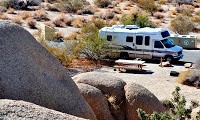
camping in Joshua Tree National Park

In hindsight, we found four different kinds of campgrounds. They can best be illustrated with a grid having an x and y-axes. If we assign Location as the y-axis and Amenities/Activities as the x-axis, then four quadrants are created.  As you go higher on the y-axis, you go from urban to rural; as you move from left to right on the x-axis, you go from one with absolutely no amenities or activities to one with a ton of them. I call those with many amenities and activities, "resorts," and the ones with little or none, "parks." Then I use the term "nature" to differentiate the rural campgrounds from those that are nearer urban centers for which, in turn, I use the term "city."

We stumbled into the Nature RV Resort in Lenoir, North Carolina when we looked for a spot from which we could explore the Blue Ridge Parkway. We loved going home to the Green Mountain RV Resort. Our site had a sizable deck, looking out to a fresh spring.  Bill loved the large trees, went hiking in the many trails and dreamed of fishing and boating in the lake. We frequented a clubhouse with billiard tables, ping pong tables, and other games. Bill started his golf career with the nine-hole golf course in the resort. But the tennis and volleyball courts were left untouched. As for me, I learned the East Coast Swing from a family that was vacationing for a weekend at a Saturday dance!

camping in Orlando Thousand Trails

What immediately comes to mind as a City RV Resort is the Thousand Trails-Orlando in Florida. It’s just six miles from Disney World and within walking distance of strip malls and big grocery and other chains. My entire family staged a reunion there that Christmas. We loved going to the large clubhouse which was full of game kiosks, billiard tables, ping pong tables, a large TV, a gift shop, and even a diner. We began lots of things there: our religious observance of fitness center visitations, lazy afternoon lounging in the hot tubs and pools and energetic dancing to live bands with neighbors during the Friday night dances. Tennis courts, horseshoe pits, volleyball courts, and a mini-golf course remained unvisited though, as well as the craft and hobby clubs. I will never forget this Resort. It is where Bill suffered a heart attack the day we arrived. But it is also where we met Dan and Beverly who helped me through that episode. Another person I met was Roberta, a struggling writer. who published her book the year before I published mine.

The City RV Park is used primarily to be near family or friends whom we would like to visit or as a base from which to explore a famous large city. I remember how we religiously went out every day to take the train and subway link to Boston. We did not meet a lot of people because everybody was busy, like us, visiting the sights in this city that is synonymous with the start of the American Revolution. It became part of my inner journey to becoming an American, where I started to hum the Star-Spangled Banner all day, to Bill's delight.

camping at Kirk Creek Campground in Big Sur

Last but not least, the Nature RV Park is probably what you need when you want to get away from it all. State and national parks, as well as parts of our national forests, Corps of Engineers’ land preserves, beach enclaves, etc., are of this type.  Some national parks, such as the Joshua Tree National Park, qualify; bigger national parks with plenty of facilities, such as Yosemite and Yellowstone, are more like Nature RV Resorts. The best one that comes to mind is the Kirk Creek Campground along Big Sur, overlooking the Pacific Ocean. It has a trail that led down to the largest sand beach in the area. It has no water hook-ups, so when young campers ran out, Bill graciously donated some of our supply. I spent many a night by a warm crackling fire under a soft moonlight
chatting with an author, eager to learn about his roller-coaster ride to getting published.
But we also realized that there are available resources for fun other than what the campground offers. We have been amazed at all the possible things you can do, at what living in America offers. My post on Maximizing RVing Resources, Part 2 details things from: public centers like libraries, Visitor, Community, and Senior Centers (if you can already admit that you are a senior!); colleges and universities that make the campus a public center for enlightened living; commercial establishments that compete for our dollars; local governments/non-government associations that sponsor a variety of events; and churches that go beyond religious services. Treasures are also available in all the state and national parks that preserve America’s beauty for everyone to enjoy.

inside the RV when camped

There is a range of things to see and activities to do in and around where you park your RV. You will enjoy whole new notions of fun and meet people who can teach you simple joys or take you to life-changing directions. Camping around the country gave me the confidence not only to receive my naturalization papers but also, more importantly, to become a true American. Now I can say that those eight years were well spent. I came to know and appreciate all of America, the Beautiful.


Friday, April 7, 2017

Hope I Don't Get Lost: from 350 to 1,200 Sq. Ft.

the new Fitness and Leisure Complex at Viewpoint
In 2004, after a full career in the Philippines as a jet-setting computer executive, I flew to the US to stay. Three years later, I met Bill on the Net and, after more than a year of dating, we married on board Champagne Lady cruising the Lake Union in Washington. He sold his business, and we embarked on a 4 1/2-year honeymoon in an RV that took us to 49 American states, 9 Canadian provinces, and 6 Mexican states. In 2015 I published the book, Carolina: Cruising in an American Dream, about that phase of my life.

Three years ago, we inched into a second phase. We parked our motorhome during winter at Viewpoint Tennis and Golf Resort in Mesa, Arizona. From that base, we went on some America road trips and flew to other countries in Asia, Central America, Europe, and Africa. The number of countries we have visited together quickly rose to 16. I went to 7 other European countries without him. It was incredible experiencing other cultures and traveling farther distances. Our travel lifestyle stepped up a notch.

Viewpoint view from the second floor, the Fitness Center, and the pool complex
Last November, as I turned 68 (Bill turned 73 this March), tired from an eight-month epic journey, we took a meaningful pause. As a result, we canceled Christmas gifts for each other and instead bought a home base at Viewpoint around its new clubhouse/pool/fitness center complex. The Resort not only has 4 clubhouses, 4 pools, 7 hot tubs, 2 golf courses, 10 tennis courts, 2 ballrooms, a dance studio, a billiard room, a pub/bar grille, a beauty salon, a computer lab, a library, and many other hobby and meeting rooms, plus horseshoe and shuffleboard areas, etc. It also has many clubs one can join. I found my home in 6: Karaoke, Word Games, Writing/Editing, Computer, Photography, and Gym. A frustrated tennis fanatic, I keep score for tennis matches, too.
from the installation, deliveries, and the housewarming party!
Yes, it’s official. We are 100% on to the second phase of our travel life! Our trips will consist of visits to our children. Bill’s kids are in different states: Alaska, Idaho, and Colorado. Mine are in three countries: San Francisco, USA, Calgary, Canada, and Melbourne, Australia. We also plan to use up the eight timeshare weeks we own elsewhere around the world. Thus, this phase will be Resort R&R months between trips. It was 4:8 last year; this year, 6:6; next year, 8:4. It is an admission we have grown older!

from top left, counterclockwise: living room, kitchen, dining, bedroom, Bill's study and my study, also guest rooms 
The past months have been dizzying and exhilarating. This is truly our first “home” together, aside from the RV. We briefly spent time at my condo in Seattle right after getting married, and he had his condo-duplex rented out. But as we left for our epic travels, we also rented mine out. Buying and furnishing a home together is a brand new experience. It was fun, and sometimes argumentative, choosing furniture, appliances, accessories and décor that all fit together into a look we BOTH like. But, yes, he carried me over the threshold. What an experience at this age!

goodbye to our RV, our home for the last 8 years!
I must admit though that, as we packed our down-sized belongings and prepared the RV for selling, we were enveloped by a certain kind of sadness. It dawned on me that the RV period of my life is rare not just for an American, but more especially for a Filipino in America. My book tells of this transformation. I “not only learned to be a wife without losing my identity but also to be an American without losing her roots." From a single parent and retired CEO, I became wanderer, writer, and wife!

Finally, I am tucking that experience literally in the bookshelf. It was a pleasant surprise that we sold the RV at noon of the day we put out the ad on Craigslist. Now we look forward to the travel we will have in the remaining months of 2017. None of our children live near each other, and we both love too many other places in the world to stay put. But, first, allow me to enjoy a month and a half of living in a home not propped up on wheels. With 8 good-sized rooms, we have moved from 350 to 1,200 square feet of space. I hope I don’t get lost!

Thursday, October 27, 2016

We Tried and Failed but Found 13 Others in Fairbanks, Alaska!

an abandoned railcar on the road to Fairbanks, Alaska

On September 11, we flew to Alaska to visit Bill’s youngest child Cristine, who has been living in Anchorage for eight years, and my sister Cherry, who moved to the city last year. This Alaska trip is my third (Bill’s fifth). I had hoped finally to see the Aurora Borealis! Some sites say that one of the best times to see them are in the dead of winter or around the September and March Equinoxes.

Healy, Alaska
Healy, Alaska and 
Denali National Park

Upon arrival at the Ted Stevens International Airport, we drove to Healy, Alaska, 4 hours away.  This town of about 1,000 is outside Denali National Park. On our first trip to Alaska in 2009, we stayed at a campground inside the Park in our first RV. We were disappointed that Mt. McKinley was hiding under thick cloud cover even as we rode the Denali shuttle bus to Eielson Point. But we did get to see grizzlies, Dall sheep, a wolf, and even had a photo-op with Iditarod sled dogs in training.

Denali National Park
It was mid-August then. This time, in mid-September, the weather was worse. There were about 30 mph winds, temperatures in the low 40s, and a heavily overcast sky. We quickly hunkered down in our cabin room at the Denali RV Park and Motel. The next morning, we wandered around Healy, but it rained. We still sampled some of the shops. An Italian lunch at Prospectors’ Pizzeria and Alehouse shook off some of the blues, but a visit to Denali had to wait for when we drive back to Anchorage.


Pioneer Park


Fairbanks, Alaska

In two hours, we reached Fairbanks, the second most populous city in Alaska, after Anchorage. First stop was the Visitor Information Center. We wanted to know if we had a chance to see the Lights. The staff referred us to the Geophysical Institute at the University of Alaska Fairbanks. On the phone, the lady said that night was our best chance, but we decided to wait.

Murphy Dome
Almost in front of our hotel was the Pioneer Park, a 44-acre city park commemorating early Alaskan history with multiple museums and displays. We had visited it before but we include here pictures we took then. It is a great place for a quick look at the Alaskan way of life.

Museum of the North in University of Alaska-Fairbanks
The following day we drove to Murphy Dome, once home to an Air Force Station whose only remaining facility is a Long Range Radar Station. We marked on our GPS our chosen spot for watching the Aurora on our own (not with a commercial tour). The area is now a recreational site for hunters, ATV riders, hikers, and drone enthusiasts, at 1000 feet elevation 20 miles from Fairbanks.

On the way back to downtown we passed by the University of Alaska Fairbanks, the oldest of Alaska universities. We visited the Large Mammal Research Station and the Botanical Garden on our first trip. This time we visited the Museum of the North. It has a gallery of Alaskan history and animals including unique prehistoric Alaskan dinosaurs and another that displays Alaskan art, including “The Place Where You Go to Listen,” a unique environment that gives life to Alaskan sounds and lights.

the Vents in Downtown Fairbanks
Creamer Fields

Our last stop was Downtown Fairbanks. After perusing some of its artsy shops, we discovered colorful building air vents on street corners. A genial merchant jokingly told us they were put there so those under-the-city dwellers could breathe! Our afternoon turned into a hunt for all 12. Like the Cheyenne Big Boots, they were the work of artists. Unlike the Cheyenne boots, they serve a function!

Unfortunately, the second night was predicted not to have high aurora activity, AND the sky was still heavily overcast. Two nights down, two more chances left!

Chena Hot Springs Resort


The next day we drove to Creamer Fields, a 2,200-acre bird sanctuary that consists of sandhill cranes, mallards, and Canadian geese. The refuge surrounds the former farm of Charles Creamer (1889-1974), who established Creamer's Dairy. He gave birth to the sanctuary by saving waste grains from his barn to feed migrating birds. His former home is now a Museum.


We  proceeded to Chena Hot Springs Resort, a little over an hour from Fairbanks. After lunch at the Resort Restaurant in the Main Log Cabin, we walked around the facility. The jaunt yielded great photos of the massage therapy sod log cabins, the outdoor horse park, the Main Lodge, the outdoor hot spring pools, and an airplane, Adventure Cats,  ATVs, motorcycles, horses, and canoes for rent.

Aurora Ice Museum

There were two Resort tours we joined. The first was to the Aurora Ice Museum, the world’s largest such facility with some ice sculptures that are ten years old, crafted by a husband and wife team that won the World Ice Sculpting Contest five times. They keep the temperature inside at 25 degrees Fahrenheit. During summer, the Museum is kept cold by a pioneering chiller technology.

Power Plant and Greenhouse
The second tour was to the power plant that is the first low-temperature binary geothermal power plant built in Alaska. It is working on alternative energy projects, including production and use of waste vegetable oil for fuel! The second part of this tour was the Greenhouse where the Resort uses state-of-the-art technology to nurture plants for their vegetable and flower requirements.

Happily, it was predicted that there would be high aurora activity on the third night. It was too bad the sky still was overcast. Bad luck! Three down, one to go.

Santa Claus House in North Pole, Alaska


North Pole, Alaska

A little more than thirty minutes from Fairbanks is a small city (population about 2,000). Despite the name, the city is about 1,700 miles south of the Earth's true geographic North Pole. Before Christmas each year, the North Pole Post Office receives hundreds of thousands of letters to Santa Claus and thousands more from people wanting the town's postmark on their family greetings.

Christmas-themed streets include Santa Claus Lane, St. Nicholas Drive, Snowman Lane, Mistletoe Road, and Kris Kringle Drive. Street lights and many local businesses in the city are decorated in a candy cane motif. Its biggest attraction is a gift shop named Santa Claus House, the modern-day transformation of a trading post established in the early days by Con and Nellie Miller.

Santaland RV Park
Next to the Santa Claus House is the world's largest fiberglass statue of Santa Claus at 42 feet tall and weighing 900 pounds. Santa's reindeer, both real and not, reside in what used to be Santaland RV Park around Santa. We stayed there for a night in 2009 on our way to Canada’s Yukon. It is too bad the owners of the Park have closed it although its many reminders are still there.

Visitor Information Center of North Pole
Located at 2550 Mistletoe Drive, the Visitor Information Center is an old authentic rustic Alaskan log cabin. There are two Christmassy “Welcome to the North Pole” signs. The Center closes for the winter on Sept. 1 and reopens on May 1. Another landmark is The Pole of North Pole. This landmark is one of two poles created, the other one pushed out of a plane over the real North Pole.

It was just too bad that, on our last night, aurora activity was still low when the sky already partially cleared. That’s it, we failed!  On the way back to Anchorage after five days in Fairbanks and North Pole, the weather was better. We were able to make a two-hour stopover at Denali National Park and got a glimpse of the High One, a sign the next two weeks in Anchorage may give us better chances!