Cruising Past Seventy: The Inner Journeys: government
Showing posts with label government. Show all posts

Monday, October 10, 2022

TRAVEL AWAITS: My 12 Favorite Visits to Historic President’s Homes


The full article first appeared in Travel Awaits on Feb. 18, 2022.

When we first began RVing, I was not an American citizen yet. Actually, the trips across the country so educated me about America’s history that when I took my oath on Valentines’ Day 2011, I felt I had truly become an American. One of my best learning experiences was visiting former President’s homes: everything from small, simple cabins to large, luxurious mansions. Each gave me a view, not of how the President governed, but of the man: how he came to be and how he chose to live. Here are my favorite twelve.   

George Washington’s Mt. Vernon (1789-1797)


George Washington was our first president. He is the larger-than-life general who led the country to victory in America’s war for independence. His historic home and estate,
Mt. Vernon, is now a National Historic Landmark in Virginia 13 miles south of Washington DC. The original house was built by his father in 1754 on land they owned since 1674 and expanded by Washington in the 1770s. I distinctly remember the large patio at the back where I sat on one of the rocking chairs, looking over the wide, historic Potomac River which he probably often did.

Thomas Jefferson’ Monticello (1801-1809) (headline photo)

Thomas Jefferson, another Founding Father and principal author of the Declaration of Independence, became our third president. He inherited Monticello, meaning “little mountain,” when he was only 26. He designed it in neoclassical design and incorporated French elements while he was Minister to France. Monticello, together with his summer home Poplar Forest in Virginia, is architecturally brilliant and has been designated a National Historic Landmark and UNESCO World Heritage Site.

Andrew Jackson  (1829-1837)


Three presidents came from Tennessee: Andrew Jackson, James Polk, and Andrew Johnson.
The Hermitage is Jackson’s home and it ranks with Mt. Vernon and Monticello as the best presidential sites. Jackson, the seventh president, was credited with the annexation of Arkansas and Michigan. And part of his legacy is the home where there is a beautiful Greek-inspired tomb and memorial to the wife he lost, even before he claimed the presidency, because of the scandal of their marriage being done before her divorce was finalized.

James Polk (1845-49)

Columbia, Tennessee is where you will find the home of James Polk, our 11th president. Sickly from the start, he put in so much hard work that the presidency cost him his life. Two portraits in his modest home, taken only two years apart, show how much he’d aged. Polk led the US to win the Mexican-American War, and his legacy was the annexation of the rest of the West.

Abraham Lincoln (1861-1865)


Our 16th President was Abraham Lincoln, frequently cited as the best president we ever had. He led the country during its worst crisis, the Civil War, preserved the Union and abolished slavery. Such bold actions ultimately cost him his life. His
Presidential Library in Springfield, Illinois is, to me, the best of them all. There he comes alive with holograms. He and his wife Mary, played by actors, welcomed us to his nearby modest, Greek revival-style home. Fifty-six steps (representing his short life) lead to the Lincoln Birthplace National Historical Park in Hodgenville, Kentucky. It features the humble, tiny cabin where he was born.

Theodore Roosevelt (1901-1905)

Theodore Roosevelt became our youngest president at 42 after President McKinley was assassinated. Still, he accomplished much: the Square Deal, the Panama Canal, and conservation as a top national priority. Although we were not able to visit the Sagamore Hill National Historic Site in New York, we saw his birthplace in the city and the Maltese Cross Cabin at the Theodore Roosevelt National Park in North Dakota which showed me how he came to love the great outdoors.

William Howard Taft (1909-1913)


It was a stroke of luck! We came across the home of William Howard Taft, the 27th president, in front of the hospital where my husband had to have arthroscopic knee surgery in Ohio. That was especially meaningful since he did a good job laying the foundation of my home country’s public systems and infrastructure as the first Governor-General of the Philippines. In fact, that success catapulted him into the presidency. And then his strong judicial background led him to be the only president who later served as Chief Justice.

Franklin Delano Roosevelt (1933-1945)


Franklin Delano Roosevelt was our 32nd President for a record four terms, leading the nation through the Great Depression and WWII. His home, the
Springwood Estate in Hyde Park, New York, a National Historic Site, started the tradition of Presidential Libraries. He doubled the size of his mother’s mansion and transformed it into a Colonial revival style. He stayed at the Top Cottage while his wife Eleanor lived at her Val-Kill Cottage, two miles away, another National Historic Site. She redefined the role of First Lady and became ninth of the Top Ten Most Widely Admired People of the 20th Century.


Harry Truman (1945-1953)

When Roosevelt died, Harry Truman became our 33rd president. He is known for authorizing the first and only use of nuclear weapons ending WWII; rebuilding of Europe through the Marshall Plan; and establishing the Truman doctrine and NATO. We visited his birthplace in Lamar, Missouri, and his presidential library and men’s store “Wild About Harry” managed by my husband’s nephew are both in Independence. But later he had to spend his winters orders from his doctor at the Little White House in Key West, Florida, a former base commandant’s home that became the site of many historic agreements and meetings.

Dwight Eisenhower (1953-1961)


At the end of WWII, Dwight Eisenhower, Supreme Commander of the Allied Forces in Europe, became our 34th president. He was responsible for the success of the Normandy landings that ended the European war. He authorized the creation of NASA, contributed to the end of McCarthyism, and built the Interstate Highway System leading to widespread economic prosperity. We visited his  
Boyhood Home and Presidential Library in Abilene, Kansas (my husband is from Kansas), a simple two-story wood-frame house on an acre of land. It is also his final resting place.

John F. Kennedy (1961-1963)


John Kennedy was elected our 35th president. It was a short but beloved presidency. His eloquent speeches inspired not only the nation but the world. Together with the entire world, I mourned his assassination. My husband and I visited the
Kennedy Compound in Hyannis Port, Massachusetts which sits on six acres on the Cape Cod waterfront. The main home was the patriarch’s and Edward Kennedy, the smaller home on Irving Avenue became his summer White House, and Robert Kennedy’s was on Marchant Avenue. None of these is open to the public so we spent the time at the JFK Hyannis Museum nearby.

Jimmy Carter (1077-1981)


My staff and I built a home for the Philippine Chapter of Habitat for Humanity when I was GM of MegaLink, the ATM consortium of banks in the Philippines. I visited its
headquarters in Americus and Atlanta Georgia. The nonprofit organization built homes using volunteer labor and sold them at no profit for affordable monthly payments. The visit also gave me the chance to take a peek at Jimmy Carter’s modest two-bedroom home in Plains. Our 39th president may not have had a fully successful presidency but he has inspired many. Up to six years ago, he still went on a Carter-Habitat project every year.

There are ten other President’s homes we have seen that I could not include here. Visiting presidential homes has been truly instructive for me. So we are still hoping to see the other 24. 

FOR THOSE ON MOBILE, SHARE BUTTONS APPEAR WHEN YOU CLICK WEB VERSION AT THE VERY END AFTER COMMENTS.

PREVIOUS POST

The Living Ice-Age Discovery Right in the Heart of Los Angeles

Thursday, December 20, 2018

6 Things You Won't Forget about Brussels, A Cold but Cool City


We did not settle in Arizona because of the cold. So, when we found out that the weather forecast for Brussels would hover around the low 40s with light rain showers and some wind, we wanted to skip the city. If only our lodging voucher, train ticket, and flight back home were not nonrefundable, we probably would have! We thought It would be anticlimactic to go to this city of 2.1 million, after the high of romantic Paris. Little did we know, we would find six things in Brussels that will be hard to forget.
Mannekin Pis

A sense of the Comic and Independence

The location of our Hotels.com find was excellent. It was right at the edge of Old Town Brussels. Mannekin Pis, meaning "Lil' Piddler" in Dutch, a small bronze sculpture measuring 61 cm tall depicting a naked little boy urinating into a fountain's basin, was only two short blocks away. I photographed him from near and far. So were dozens of others crowding into the little plaza. The current statue is only a copy and it only dates from 1965 while the original, built in 1618/19, is at the City Museum. I thought, "What the fuss?" Nonetheless, they say it embodies the sense of comic and independence of the people. In fact, sculptures of a little girl and a little dog urinating have also appeared nearby. In addition, Tintin and the Smurfs which originated in Brussels are front and center at the Belgian Comic Strip Center.

Grand Place

Grand Place, daytime

Another two short blocks away in the opposite direction is the Grand Place or Groat Market. The central square of old Brussels is a glittering medieval square, surrounded on all sides by opulent guildhalls, the city's Town Hall, and the King's House now containing the City Museum and the Tourist Information Center. Considered one of the most beautiful squares in Europe, it is recognized as a UNESCO World Heritage Site. They say that the best time to be at Grand Place, measuring 68 by 110 meters, is in August when a carpet of flowers covers the entire ground. We went back at night when it turns Christmas-like with lights. We were so inspired we chose to have dinner at the Cave du Roi, the cellar of a guildhall dated 1698.

Belgian Food
@ Cave du Roi

And this started our love affair with Belgian food. Bill had Boef Carbonnade, Belgian beef stewed with Belgian brown ale, and I, Crème du Moule (mussels) Souppe (mussels are commonplace in Brussels; they even rhyme). All around the area, little shops displayed colorful tempting varieties of Belgian waffles, mouth-watering Belgian chocolate concoctions, and all kinds of fine-flavored Belgian beer, all three contributing to the city’s culinary fame.

Belgian waffles galore

fondue and raclette
Bill didn’t want to eat the richly topped waffles standing so we chose a restaurant that served them for breakfast one day. There are two kinds: the rectangular Belgian and the octagonal Liege. We both had the Belgian and I chose dark chocolate and Bill, strawberry and maple syrup, as toppings. I was frustrated because I know I can never reproduce the light and airy but crispy and crunchy waffles when I get back home. And the chocolates are yum! We chose the Leonidas variety. As for beer, Bill tried Duvel, the brand advised by our taxi driver.

But the highlight of our culinary tour of Brussels was another special dinner. We enjoyed a small beef fondue in Paris but we wanted the whole nine yards. The Tourist Information Center directed us to the La Fondue et La Raclette, only two blocks from our hotel. We found it closed, open only from 7-10:30 pm,d and require reservations. We asked the hotel to make them for us and we were given an 8pm slot. We arrived very hungry and quickly ordered Savoyard (cheese) Fondue and Le Boef Raclette. We must have devoured a pound of cheese that night. It was the best comfort food for a cold, cold night!
St. Michael Cathedral

St. Michael Cathedral

About four blocks away stands the Cathedral of St. Michael and St. Gudula, a Roman Catholic Church. What was different was that there was the young children’s choir practicing inside. The acoustics were awesome and the choir sounded divine.  The church was given cathedral status in 1962 and has since been the co-cathedral of the Archdiocese of Mechelen-Brussels. It is a beautiful house of worship upon a hill. There are so many others in Brussels. We just didn’t have the time.

European Parliament

Cinquantanerie Park in front of the European Commission

House of European History
The next day, even though it was again cold, damp, and windy, we ventured out and used the highly efficient and new subway system. I wanted to see the European Parliament, the directly elected parliamentary institution of the European Union. Together with the Council and the European Commission, it exercises the EU’s legislative function. Its 751 members comprise the second-largest democratic electorate in the world (after India). Although the European Parliament has three places of work – Brussels (Belgium), the city of Luxembourg (Luxembourg) and Strasbourg (France), Brussels is considered the capital of the EU.

Right after the subway exit, we found the Cinquantanerie Park, built to celebrate the 500 years of Belgium, in front of the European Commission. About three long blocks away, tucked in a quiet park, sits the European Parliament. In front of it is the House of European History, an ultra-modern six-floor museum with all the conveniences provided all visitors, free of charge. It described the history of Europe from its beginnings in the Greek, Roman and Ottoman times, to the industrialized and colonial ages, the revolutions that spawned the nation states, the world wars that tore the region apart, the resulting Cold War, and the beginnings of the Council of Europe. It ends with the current issues confronting the Union.  We spent a total of three hours there. We could have spent many more.

 Atomium

After the visit, we went to the other side of town to see the most unique building in the world, l’Atomium. It was originally built for the Brussels World Fair in 1958, but is now a museum, standing 102m tall. It has nine stainless steel spheres of 18 m diameter each, all connected. The design forms the shape of a unit cell of an iron crystal magnified 165 billion times. Tubes of 3 m diameter connect the spheres housing stairs, escalators, and a lift to allow access to the five habitable spheres which contain the exhibits. The top sphere is a restaurant with a panoramic city view.  It would have been nice to go inside, but there just wasn’t enough time!
the Aromium


We are so glad we didn’t skip Brussels! Despite the cold, the city is so very chic. It has the old and the modern, the comic and the sublime, the history of Europe all rolled into one, and a place where eating is sheer delight. Even as the bistro where I wanted to have foie gras was closed when I was ready for it, we found so many bottled ones for sale at the airport! Travel bloggers tell me that the fine things to remember about Brussels will become 7 when I experience its Christmas markets. A fine reason to go back!


pinnable image
pinnable image


Thursday, September 27, 2018

The Riviera Revival, ST Wine, and Value Shopping: Not Just Another Day in Ensenada, Mexico


For our second port of call on our Carnival Imagination Cruise, we had a hard time deciding which shore excursion to take. There were more than twenty options. At first, we wanted to see La Burfadora, a blowhole, but we had seen such things in our travels and dreaded the thought that the water does not blow or blows too short. The girl at the desk said it depends on the tide. Then we spotted “A Scenic Tour of the Gold Coast of Baja California” but we had seen a lot of gold coasts, too. We ended up with a City and Shopping Tour because we did not want to finish the tour and now know anything about Ensenada.

Riviera del Pacifico


from the top, clockwise: the imperfect tile, the wooden ceiling and chandelier,
the great corridors, and part  of the elegant bars
The first stop was the Riviera del Pacifico Cultural and Convention Center. The landmark was built and then opened in 1930 in response to the American Prohibition. North Americans needed a place south of the border for entertainment and alcohol (Tijuana, then Rosarito, and finally Ensenada). The end of the Prohibition spelled doom, however, after which it intermittently operated, and then was put to military use in WWII. At the end of the war, the only remaining owner fell in love with Marjorie Plant, an American, and gave the property to her. She ran it successfully for 15 years but legal troubles arose between Marjorie (and the man she finally married) and the original owner. The property was thereafter taken over, closed, and partly demolished by the government.

When it was going to be demolished, the townsfolk clamored to save its historical and architectural icon. Rebuilt in 1978, the hotel has reopened and includes a theater, a historical museum, and rooms for a variety of functions. The dome’s wooden ceiling and the largest of the chandeliers were thankfully preserved. It was interesting to note some imperfections such as the bizarre tile on the floor. But the large bar has retained its elegance. It is where margaritas were said to have been first served as a drink (Marjorie is Margarita in Spanish). And that’s what we were served at the tour's end!

Santo Tomas Winery wines and olive oils

The second stop was Santo Tomas Winery. The Santo Tomás Mission, founded by Jesuit priests in 1791, had reactivated large-scale production of wine in Mexico. In 1843, Dominican priests also began growing grapes at the nearby Guadalupe Valley, one of the few in the world, along with Napa Valley in California and Rhone Valley in France, for growing premium wine grapes. 

In 1888, the former lands of the Santo Tomás Mission were sold to a group that established the first large-scale commercial winery. Today, it is the earliest winery of its kind still in continuous operation in Mexico. It was then called Bodegas Santo Tomás and was producing low-quality wines. 

But today, its dessert wine just won in the 2017 San Francisco Wine Festival. In fact, Baja California now produces 90% of Mexican wine. The wine and a white, a rose, and a red plus six different olive oils with bread and cheese were served for us to taste. I liked the dessert wine so much, we brought one bottle home.

one of the wraps we considered

The third stop was what I had been waiting for. I had one big mission: to find a wrap I could wear over my swimsuit for the next day’s return voyage when we would have a whole day at sea. We were given about an hour and a half but that wasn’t enough time for getting a flavor of Mexico so we told the tour guides not to wait for us. 

Bill had a heyday, fending off the creative and insistent ways vendors tried to get us into their store to buy jewelry, clothing, and crafts. Actually, he played the good guy and I played the bad guy. He would always escape with “I am just following her.” And I would go on walking as if I was in earnest search of things other than what they were offering. Pretty soon, I found my wrap, pareos they call it, for $8.


one of the restaurants we considered

Satisfied with the bargain we found, we looked for a place to have our authentic Mexican lunch. My daughter, who was with the previous cruise at the beginning of the week, recommended the Taverna de Madrid. Unfortunately, it was closed. We finally chose the place to which a lot of the vendors told us to go. 

El Charro was on the ground floor of a beautiful old Spanish style building we had noticed early on. The chile rellenos and rez machaca were both great choices. But I couldn’t eat the Nacho chips. The salsa was oh-so-hot! But the best part is that my romantic husband got me a long-stemmed red rose for all of fifty cents!

And the day was complete. At around 3 pm, well before our ship’s departure time of 5:30 pm, we walked to where the public shuttle buses could be found. That’s when we realized the Riviera was just outside the dock. We didn’t have to pay for the $30 pp excursion fee charged by Carnival! We could have taken the shuttle, toured the Riviera, skipped the wine tour, walked to the shopping square, and eaten with gusto our Mexican lunch for just $2 each way pp or a total of $8! 

But, no, I like my souvenir wine, however expensive it turned out to be!


see the great Mexican food and the rose?

Thursday, March 22, 2018

Feeling Isolated in China

Guangzhou International Airport

China is the world’s most populous country, with 1.4 billion people. With the world’s population of 7.6 billion people, that means nearly one in every five individuals is Chinese. It is second only to the US as the world’s largest economy and just behind Russia and Canada in size. No traveler should overlook visiting this vast landscape of grassland, desert, mountains, lakes, rivers, and even a long coastline. Beijing is a magnet for history buffs with the imposing Forbidden City and the infamous Tiananmen Square. Shanghai, a modern global financial center with steep skyscrapers alongside its old sections, makes it the country’s largest city. Running majestically east-west across the country's north is the iconic Great Wall. And the third longest river in the world, the Yangtze, romantically connects inland cities and frontiers, including the home of the Great Panda and the site of the unparalleled Terracotta Warriors.

My first glimpses of China were of Hongkong, Macau, and Shanghai during my jet-setting business days. Last year, as a great bargain, China Southern Airlines offered Guangzhou as a layover city from Melbourne to Manila (7 hours) and Manila to Phoenix (12 hours). But it was in this city, that has recently overtaken Beijing as China’s second largest, that I felt a strange isolation from the world.

irregular flight service area

    
Chinese meal
 First Layover from Melbourne to Manila

I was going to use the first layover to figure out how I could take a short tour of the city on the second. There was little information I could get because of the language barrier, however, so I decided to hunker down and just get lost in my social media world. Sadly, with my laptop charge down to zero, I spent most of my time finding out how I could power it up with the gadgets thrown into my computer bag by my loving husband Bill. But, with a mechanical aptitude also near zero, I was ultimately unsuccessful.

Luckily, I did have a portable battery for my phone. Signs indicated that there was supposed to be free airport WiFi, but no luck, I could not get my phone to connect. A couple of millennials finally took pity and rescued me from my dire situation. With about half of my layover time already wasted, I sat down to another unwelcome shock. Facebook is banned in China! I turned to surfing but the last shock floored me: every search pointed me to sites totally foreign, totally unfamiliar, and totally Chinese!

My isolation was complete. With just two and a half hours to go before my flight departure to Manila, I consoled myself with a mouth-watering Chinese meal and musing about life. Only when I had to give a presentation on Social Media to the Viewpoint Technology Club in Phoenix did I learn why I could not get into my familiar world of social media. Of the top 10 websites in the world in 2017, 4 are Chinese! They have a Google equivalent, Baidu, Facebook/ Messenger equivalents, QQ, QZone and WeChat, and even an Amazon equivalent, Alibaba.

Oubon
Second Layover from Manila to Phoenix

On the way home from Manila to Phoenix, I dreaded the 12-hour layover in Guangzhou. You won’t believe my complete surprise when the immigration officer told me that I qualified for a complimentary shuttle and hotel in Guangzhou if I could find the counter that processed such things. I was on extremely high alert and found it. There they told me that I could get my vouchers at another counter if I could find it. Being of a certain level of travel intelligence, I found that, too! The only problem was that the hotels that were familiar to me were all out of rooms and I was left with one called the Oubon International Hotel. Feeling happily adventurous, I again took the challenge and soon I was off to my one lucky day.

just outside the airport
The road out of the airport was strewn with glitzy modern sculpture, and I prepared to be wowed. What followed was a disappointment with a capital D. The hotel was a two-star facility in an almost rundown suburb of Guangzhou far from the city. By the time maintenance staff was found to fix my room’s air conditioning unit, I had already lost a lot of time. They even had to get the Manager because no other staff spoke English. I decided not to take a chance on a short city tour and opted to get a feel for the hotel facilities. There were the standard restaurant and a fitness center. But I was surprised to find a red-themed mahjong room! But the hotel was mostly empty; I guess it is just really used as a rest stop for transients. I ventured out to the small shopping mall nearby. There I consoled myself with another flavorful Chinese meal and peeked and poked around the small department store.

small shopping mall
My twelve hours easily frittered away.  I truly felt isolated in China, but I also got to see why she has become a great power. About eleven years ago I was asked which, between China and India, did I feel would become the superpower. I hesitated to say China back then because I wrongly thought India had the advantage of being an English-speaking country. The language barrier is only real for us who are outside of China trying to look/get in. Internally, China has used her masses of people, her vast natural resources, and her long and rich heritage to develop technologies that rival ours. The policy of isolation, of attempting to make one’s economy self-reliant, and of seeking to devote its entire efforts to its own advancement has served China well throughout the years. She may be nowhere in the Top 50 of the Happiness Index of countries around the world, but she has risen to #21 in quality of life (#8 for the US).

department store
You can bet I was happy to be on the way back to my comfort zone; but I also resolved, on the plane to Phoenix, that China deserves to be visited properly.  Beijing, the Yangtze, and the Great Wall await me.

Thursday, February 15, 2018

Remembering Sacredness in Auckland

Mt. Eden, Te Ipu Kai, The Food Bowl

Imagine a time when many cracks of Mother Earth spewed hot molten lava on the land of tribes of terrified native peoples.  Those volcanoes were not only feared; they were revered. Now imagine modern cities having sprouted around their craters. Such is New Zealand's capital, Auckland, a city dotted with many dormant volcanic cones that have turned green. Some are marked with monuments; some built upon with magnificent edifices. Vehicles are already prohibited from driving up Mt. Eden, Auckland’s highest cone called Te Ipu Kai, the Food Bowl. But One Tree Hill, the second highest, is still drivable up to the top. But walking on the craters is a strict no-no. They are tapu, sacred grounds.

One Tree Hill

It was in this wondrous city that I came face-to-face with crippling fear.  I was happily snapping away photos of street art and curious buildings in downtown Auckland. We had just left St. Patrick’s Cathedral when Bill suddenly crumbled to the ground.

Harbor Bridge

Until that moment, I thought the day was going fine. After Mt. Eden and One Tree Hill, we went to Harbor Bridge. The “coathanger,” as it is fondly called, has become an embarrassment as a poor copy of the Sydney Harbor Bridge, I was told. I don’t know why really. It has its own charm. Walking many many steps to get the best shots, I did not know that Bill's fatigue was starting to set in.

Because it is just a short ride from the bridge, I convinced Bill to squeeze in a visit to MJ. Savage Memorial Park. Overlooking the great twin harbors of Waitemata and Manukau, you can see the islands of iconic Rangitoto and tropical Waiheke from the Park which was built in honor of the beloved Labor Prime Minister who founded New Zealand’s welfare state. He is beloved, having paved the way for the country to be the #10 most livable in the world.

What we thought would be a bit of rest turned out to be more walking up and around Auckland Domain, the city’s oldest and largest park. There the Auckland Museum is built upon the crater of another extinct volcano!  To get a good photo of the beautiful building, we had to go up and around. Feeling a bit tired, we proceeded down the hill where the Winter Garden, an oasis in the drab of winter, had two barrel-vaulted glasshouses of tropical and temperate plants. After an hour of photography, the aroma of freshly baked goods led us to the Cafe where scones with jellied fruits and clotted cream became our mid-day snack. The divine flavors of England we had sorely missed once again delighted us. But it was rest which we needed more.

Auckland Museum

Winter Garden
We were in Auckland for just two days, to get an extension of my Australian tourist visa because only 90 days are given per entry. The next day was already committed to touring Waiheke Island with a friend. Trying to get the most out of our only day in the city, we took the bus to the central business district and alighted at the Aotea Square, the large, paved public area for Auckland events of up to 20,000 people. An expressionist style traditional Maori archway at the Queen Street entrance gives the Square a sacred feel. From there we walked past the tallest structure of the city, not having the time or energy to explore the Sky Tower on the way to St. Patrick's Cathedral.

Aotea Square

It was just a few blocks but the roads had a gradual but steady incline.At the top of the hill, we came upon a neighborhood project, Griffiths Garden. I love it when city folks do this. No wonder Auckland is ranked #7 among the most livable cities in the world. I got so engrossed capturing the many images my eyes were feasting on, collecting candidates for the next Photo Show of the Viewpoint Golf Resort in Arizona where we live. I didn’t notice that Bill had to find a bench to sit on. When we got to St. Patrick’s Cathedral, he still walked the halls to admire its high ceiling, the wide nave, and large stained glass windows. We also learned the church had gone from wood to stone to brick.

Griffiths Gardens

But, as soon as we left St. Patrick's, Bill suddenly crumbled to the ground. As the other passers-by rushed to help us, I cried profusely and unashamedly for what seemed like an eternity. It was just a few seconds but I literally froze. I couldn't help but blame myself for squeezing nine landmarks in a day. Such pace of travel should only be for the young, especially after our a red-eye flight from Melbourne the night before. When Bill came to, he did not think of himself, as usual. Hewas so sorry to have caused me such a scare. He promised to take better care of his body.After all, it is a sacred temple that should be preserved and celebrated like Auckland's sacred landmarks. But it is I who has to listen to this wake-up call. The way I like to travel will have to change.


St. Patrick's Cathedral

Thursday, November 16, 2017

6 Gems in the Old-Fashioned Euro-Asian City of Vientiane, Laos


Pha That Luang, the Golden Stupa

chicken rice
My trip to the Philippines from Australia before going back to the US was dedicated to my friend Jingjing who was recovering from breast cancer. Her goal was to complete 65 countries when she turns 65 in January 2018. In 2015, we traveled together to 8 European countries in 14 days. This time, we scheduled 4 in 5 days in Asia! Two of them were layovers, the first one, overnight at the KL International Airport, Malaysia's main international airport, the world's 24th-busiest by total passenger traffic.

Two other friends, Ann and Tess, joined us. We booked at the Sama-Sama Express Hotel at the airport’s modern Transit Center. Each room was big enough for two, so conveniently located among the gates! The Center had all the shopping and food we wanted…durian products, other Malaysian goodies, and a branch of Chicken Rice, the chain of the Hainanese chicken rice fame, one of my and Jingjing’s favorite dishes. Who needs to go out into the city when you can get it right there at the Food Court?

 
Buddha Park


The next day we were in Vientiane, the capital and largest city of Laos. Actually, Jingjing wanted to go to Luang Prabang, the Laotian cultural capital. But I chose Vientiane because the name sounded classier! The capital since 1563, the city was the administrative center when the French ruled the country and is now Laos’ economic core with an estimated population of 760,000. Still spared from tourist industry commercialization, it lies between mountains and the low lands of Mekong River and is refreshing to visit with touches of both European and Asian cultures. We contracted a taxi driver to drive all four of us for a day.

Xieng Khuan

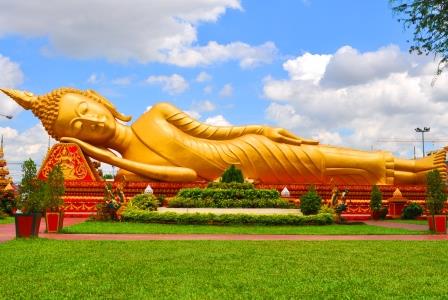
First stop was the Buddha Park (aka Xieng Khuan) with more than 200 religious statues including a huge over 131-feet high reclining Buddha, about 30 minutes from the city center. The best spot for photography was on top of the giant pumpkin, standing about three stories high, whose entrance is a demon’s mouth that leads to an internal stone ladder to the top with a bird's eye view of the Park.

In 1958, it was built by a monk who studied both Buddhism and Hinduism, the park has Buddha images, Hindu gods, and demons and animals from both beliefs. The most outstanding ones include Indra, the king of Hindu gods, riding a three-headed elephant, a four-armed deity sitting on a horse, and an artistic god with 12 faces and many hands. They are all impressive because of their size and interesting details. It was a great first stop.          

Pha That Luang
also found on the grounds of Pha That Luang
Patuxai

But it was the next stop that left us deeply amazed. Pha That Luang is beautiful to behold. A historic gold stupa, it is over 144 feet high with multiple levels, a walled enclosure, and a green grassy courtyard. This Great Stupa is the most sacred monument in the country. Every November, the Boun That Luang Festival, the most important Buddhist celebration, is held there with thousands of Laotians congregating there from all over the country.

Looking more like a fortress surrounded by high walls from the outside, Built by King Setthathirat in 1566 on the site of a 13th century Khmer ruin, it was greatly damaged during the Burmese, Chinese and Thai invasions in the 18th and 19th centuries but was restored by the French in 1900 and 1930. It features two temples with the main stupa’s top covered with gold leaf. The architecture is Lao in style, finely-gilded with red-lacquer doors, pointed lesser stupas, many Buddha, flower and animal images.

Patuxai

Our taxi driver brought us next to the Patuxai Victory Monument that is the centerpiece of Patuxai Park at the end of the capital’s grand avenue. The Park is a popular place to stroll around in the afternoons with the palm trees, lotus ponds, a musical fountain donated by China, and the peace gong given by Indonesia when Laos was named the world’s most peaceful country.

Wat Si Saket

Dedicated to the Laotians killed in the fight to gain independence from France, as well as from its earlier occupiers, Thailand and Japan, Patuxai is the best example of European influence, reminiscent of the Arc de Triomphe in Paris. But its exterior embellishments and interior decorations are of Laotian style. At the top, you will enjoy a panoramic view of Vientiane. Built between 1957 and 1968 using funds from the U.S. government, it features 4 arches, facing North, South, East, and West. The 5 towers symbolize the Buddhist principles of amiability, flexibility, honesty, honor, and prosperity.

Wat Si Saket

Near our hotel, we spent a lot of time at Wat Si Saket, famous for a cloister wall housing more than 6,800 tiny Buddha images and seated Buddhas that date from the 16th and 19th centuries. They come in all sizes and are made of wood, stone, and bronze. In beautiful Lao architecture, it is the country’s oldest Buddhist monastery, right across the Presidential Palace, with vast grounds filled with structures.

Wat Ho Phra Keo

Across the street and beside the Presidential Palace is Wat Ho Phra Keo, originally constructed in 1565 as the royal family’s personal chapel. It was the home of the Emerald Buddha after it was snatched from northern Thailand (reclaimed by the Thai in 1778 and now in Wat Phra Kaew in Bangkok). The temple is now a museum, richly adorned with a 16th century lacquered door with Hindu carvings. 

Wat Ho Phra Keo
Presidential Palace

The Presidential Palace was started in 1973 on the former royal grounds. Because of the takeover by the communist Pathet Lao in 1975, the building was not completed until it finally opened its doors in 1986 for government functions and ceremonies (the President resides elsewhere). Closed to the public, the beau arts-style architecture features tall colonnades and shaded balconies. Well-manicured lawns and gardens surround the palace, fenced off by tall walls and a wrought iron gate.

Presidential Palace

This is the 65th country Jingjing visited. To celebrate, we all heard mass at the Catholic place of worship in this Buddhist and Hindu nation. We also feasted at a 5-star hotel a few blocks from our cute Ibis Hotel. A Laotian dish, meat with lots of vegetables and fragrant herbs, caught our fancy because, just like Vietnamese cuisine, we relished its French influence. We were absolutely charmed by old-fashioned Euro-Asian Vientiane. But we still have to visit Luang Prabang!