Cruising Past Seventy: The Inner Journeys: North America
Showing posts with label North America. Show all posts

Tuesday, July 2, 2024

Becoming an American without Losing My Roots, Part 1

where the "shot heard round the world" was fired: Lexington, Massachusetts

This story began way back when I was born. My father was a soldier who fought alongside Americans against the Japanese on Philippine soil in WWII.  My mother was sent to America on a Philippine government scholarship to study the latest in deaf education and to bring it back to the Philippines. Both infected me with their love for America.

Getting a high school scholarship to the American School fueled the addiction. Training by American multinationals after college further stirred the pot. I almost relocated to the US when Philippine democracy and economy were in tatters during the fall of Marcos. It was, therefore, no accident that I came to America to retire. On Valentine’s Day 2011, I became a US citizen.

Early in our RV cruising days, I unequivocally saw America's beauty. I was mesmerized by spectacular national parks like Glacier Bay, Denali, Mt. Rainier, Yosemite, Sequoia, Joshua Tree, Grand Canyon, Rocky Mountain, Badlands, Everglades, Smokey Mountain, Acadia, etc. I began to sing the song, "America, the Beautiful."

When we drove up the East Coast from Florida, I lingered in the solemn halls of Washington DC, Baltimore in Maryland, Philadelphia in Pennsylvania, and Boston and Concord in Massachusetts. These cities played significant roles in the birth of this great nation. I began to hum "The Star-Spangled Banner." 

In no uncertain terms, I was starting to feel like an American. I felt sad as I walked along the Civil War battlegrounds, proud when I gazed at awesome NASA rockets, inspired among the ancient ruins and great houses of American Indians, and more. I knew the conversion was final when I began to take pride.

The technical difference between a US permanent resident and a naturalized citizen is that the latter can vote (or run for an elected post office). I cast my vote for the first time in the 2012 presidential elections. It was amazing to watch as more than 300 million people accepted the results broadcast by the press with polling centers in Hawaii and Alaska still open.

There are other systems to love. They say that there are more libraries than McDonald’s stores in America. Every county issued library cards to us even if we would only be in the area for a few weeks. The largest national highway system in the world made road trips so easy. Through Bill’s $10 Senior Golden Pass, we have visited, for free, 31 National Parks, 92 National Monuments and National Historic Sites, and both national parkways.

I have visited 31 of the forty-six American Presidents’ homes, tombs, and/or presidential libraries; even the homes of their first ladies. We came across larger-than-life heroes, brave pioneers, cultural icons, and lay and church leaders. I was inspired by Americans who came and fulfilled their dreams. Visits to the homes and tombs of literary greats gave me the final nudge to start writing.

We have been to the largest and the smallest of towns, the poorest of counties and the wealthiest of states, and everything in between. Some of America’s man-made structures and natural formations are among the tallest, the biggest, or the longest in the world. There are those that you cannot find anywhere else. We visited factories of products made in America and headquarters of noble institutions that serve the world. It was cool to discover that we had been to half of the suggested places in the July 2014 article in Readers’ Digest, “A Quirky Tour of the US.”

My American education was an intravenous transfusion, not just an injection. I am no longer a Filipino tourist or a permanent resident. I am not even just a US citizen. I am an American. But to be a US citizen, I had to surrender my Philippine citizenship. Did this mean I ceased to be a Filipino? The answer is in Part 2.

PINNABLE

Tuesday, June 25, 2024

Every Traveler Heavily Depends on Great Transportation Infrastructure


Born in the slums of Manila near the railroad tracks, my favorite mode of transportation had been the vintage jeepney that became popular after the war. Since I migrated to the US, RVed the continent, and traveled the world, I have experienced other transportation infrastructure that serves each traveler well. Here are the best and our favorites: the roads of America and the railways of Europe.

The Great North American Road Network

Our eight years of RVing full-time in the US, Canada, and Mexico gave us great experiences on the great North American road network. The largest component is the US highway system, the most extensive in the world. Today it constitutes about 165,000 miles of roads. 90% of US tourist traffic is carried in the system.

This is complemented north of the US by the Trans-Canada Highway, Canada’s transcontinental federal-provincial system that travels through all ten provinces of Canada from the Pacific Ocean in the west to the Atlantic in the east. The main road spans 4,860 miles across the country, one of the longest of its type in the world.

And, in the south, the roadway network in Mexico also does not disappoint, especially with the concretization of Hwy 15 that connects to Arizona. There are 72,577 paved miles, making it the largest paved network in Latin America, 6,508 miles of which are multi-lane expressways, including six-lane ones.

This great North American road system is complemented by a network of campgrounds and motels/hotels that provide lodging options with no equal in the world. Road travel in America is ultra-convenient. In addition, RV models range from small camper vans to huge luxury motorhomes. We also experienced the same satisfaction in the Australian road network.  

The Reliable European Railway System

The European Railway system consists of the following:

Tier One: Switzerland, Denmark, Finland, Germany, Austria, Sweden, and France.

Tier Two: Great Britain, the Netherlands, Luxembourg, Spain, the Czech Republic, Norway, Belgium, and Italy.


Tier Three: Lithuania, Slovenia, Ireland, Hungary, Latvia, Slovakia, Poland, Portugal, Romania, and Bulgaria.


We have used all seven in the Tier One systems, six of the eight Tier Two, and three of the ten Tier Three. We especially loved our train travels through Llubijana and Bled in Slovenia, Vienna, Salzburg, and Innsbruck in Austria, Munich and Oberstaufen in Germany, St. Gallen in Switzerland, Vaduz in Lichtenstein, Paris in France, and Brussels in Belgium. We covered all of that in four weeks and a half.

We have tried economy and first-class trains, taking us to small towns and big cities. The rail network is seamlessly interconnected to buses, taxis, and Ubers. Not a single train ride was late or canceled. The stations were sometimes airport-like in the big cities. In the small towns, quaint little shops are built around them as walking malls. I love train travel in Europe.

Bill did, too, because he did not have to worry about driving and enjoyed the scenic views of country and city life that unfolded before us: dwarf apple trees, tiny garden sheds, rolling hillsides, etc. Sometimes, the wide windows can even be opened for a better camera shot. We enjoyed the bars and dining cars, too. I even found comfort food for my upset tummy on a train ride between Innsbruck and Vienna.  Trains were certainly better than driving rental cars on the other lane and on narrow roads of the UK.  

The airline industry has successfully introduced more flights and even budget ones in Europe and the US. They are getting popular, too. But my husband and I will always prefer to travel across America by road and Europe by train!

I

FOR MOBILES, click "View Web Version" at the end of the post past comments and share buttons will appear.


CLICK THIS TO PIN THE IMAGE


ClLICK THIS TO PIN THE IMAGE

Tuesday, June 11, 2024

Another Wedding in Hawaii…at the Kualoa Ranch


Just nine months ago, we renewed our vows at the Paradise Cove in Kapolei, Hawaii on the island of Oahu. Last month we were back on the island for another wedding, this time at the verdant Kualoa Ranch in Kaneohe, Hawaii. It’s a 4,000-acre natural landmark of beaches, mountains, and valleys with historic sites and buildings. Best known as the movie film site for such cinematic greats as Jurassic Park and 79 other movies and shows, the Ranch offers many tours and ziplines for exploration.

My husband’s first grandchild and his bride chose the Paliku Gardens on the ranch as their wedding venue. It has spectacular views of Kaneohe Bay and Mokoli’I Island, otherwise known as the Chinaman’s Hat, as well as rolling pastures, and green gardens. The short and sweet ceremony was held at an Upper Garden with rustic steps leading to a lower open pavilion where we were served a farm-to-table experience of Kualoa-grown beef, fish, vegetables, and fruits.

Both the groom’s and the bride’s families were well represented as well as the couple’s friends, all coming from the islands and mainland USA. Everyone was booked in different hotels and resorts around Waikiki, 45 minutes away. We always got together with my husband’s three children and their spouses for a taste of Hawaii the day before and the two days after the wedding.

For brunch, we returned to Liliha Bakery at the International Marketplace, the restaurant and bakeshop that popularized the island’s cocoa puffs. Its signature butter bread served with all entrees was a standout. Another great discovery was Basalt, both a marketplace and a restaurant. I was extremely pleasantly surprised that they served an upscale version of Tapsilog, the popular Filipino breakfast, along with other classics.

For the evenings, we had three discoveries. The night before the wedding, we met at Moani Waikiki, a Bistro and Bar, one of the 13 eating places of the Garden Level on the third floor of the International Marketplace. The night after the wedding we returned to Doraku Sushi Waikiki at the Royal Hawaiian Center, a favorite restaurant of the new couple. We loved the grilled butterfish and tempura brownies aside from the vast array of sushis. The night before we all went home, we chose to do Italian and gathered at the Taormina Sicilian Cuisine. They had a truffle carbonara, the grilled monchang, a local fish, and the house-made tiramisu.

My husband and I were the first ones to arrive in Honolulu, closely followed by his youngest and the mother of the groom. While waiting for the others, we took the time to visit the Valley of the Temples, a beautiful sprawling memorial park nestled at the foot of the Koolau Mountains ten minutes from the town of Kaneohe and 12 minutes before the Kualoa Ranch.  There are sections for Buddhist, Shinto, Protestant, and Catholic burial sites.


The centerpiece of the park is the Byodo-In Temple, a replica of the historic Byodoin Temple of Uji in Japan’s Kyoto prefecture built in 1052. This 11,000 sqft landmark was built in 1963 and was dedicated in 1968 to commemorate the 100th anniversary of the arrival of the first Japanese in Hawaii.

Inside Byodo-In is an 18-ft. Lotus Buddha in gold and lacquer. On the grounds is a three-ton brass peace gong. A large two-acre pond abundantly filled with beautiful koi fish surrounds the temple as well as lush Japanese gardens with a Meditation Pavilion in the middle. All that beauty can be seen against the backdrop of the towering cliffs of the mountains.

At the gift shop, you can buy "wish" cards for a dollar and fifty. Tradition says you should keep it if you like what you find inside. Otherwise, ask the gods to improve it by tying it to any of the tree branches around. Secretly, I wished that I go back to Hawaii again soon. Every time I do, I find another version of beauty, another side of peace, and another level of happiness. 

Tuesday, May 7, 2024

Chasing a Photograph


Once my second daughter needed help and sent tickets for Bill and me to fly to Calgary and babysit her three boys ages 10, 3, and 1. It was our chance to complete the four breathtaking parks that together form a UNESCO World Heritage Site. We visited the more popular two, Banff and Jasper, the better-known parks on the Alberta side, years before. Kootenay and Yoho National Parks on the British Columbia side of the Canadian Rockies are only 3 ½ hours away from their home.

They are all connected to Calgary through a section of the Trans-Canada Highway, one of the longest national highways in the world at 5,000 miles through ten provinces from the Atlantic to the Pacific. We visited Kootenay and Yoho on separate weekends.  On the third weekend, we revisited Banff and Lake Louise, just 1 ½ hours away. We reserved the newly opened Glacier Skywalk on the Columbia Icefields between Banff and Jasper for the last weekend.

Having negotiated this highway many times, I expected each drive to be uneventful. On the first drive, however, I caught a glimpse of a scene that would haunt me through all eight drives to and from Calgary. There was this lone red car, rising on the road, driving straight into an enormous white mountain.  Sigh. I could not get to my Nikon fast enough; the strap was curled around my foot.

I resolved to be more alert, constantly looking for another chance. Bill welcomed the change; I was no longer the disinterested passenger. A little while later, another chance came but it wasn’t as magical. The car was black, and the road was flat. The following Saturday, we were back on the same road and got another chance! The mountain was more majestic, but the car was white, disappearing into the mist.

Frustrated, I wished we could just stage the scene! My husband reminded me that there were plenty of other beauties all around. I was thrilled to see an enormous yellow truck blazoned against the gray mountains. White fluffy clouds cavorted with the snowy peaks for a mystical effect. A colorfully painted train ruffled against the Rockies’ skirts. Curvy pedestrian bridges punctuated the highway humdrum. There was the ubiquitous RV, in all shapes and sizes. Occasionally, a red-roofed log cabin enlivened the greens. The Canadian Rockies are such a special place. But I felt empty-handed when I got home.

On the last weekend, a snowstorm was forecasted. But we still went and stayed at Canmore, the town before Banff, for the night, hoping the weather would clear. It didn’t. I hated the cold, but it was our last weekend. The way to the Glacier Skywalk through the Icefields yielded zero results. When we reached the highest elevation, more than 6,000 feet, endless rows of frosty evergreens gave me a wonderful Christmas…in June! Was that going to be my saving grace?

But on our final drive home, the gods granted my wish. Although the car was not red and low-lying clouds covered the mountain, the road had a slight rise that recreated the magic I saw the first time. On the rest of the road back home, we tried to outdo each other with the titles I could use when I entered the photo in Viewpoint's Photo Show: Into the Mist, Into the Clouds, Into the Unknown. I was sure my photo would get a lot of nods because it evokes all sorts of feelings: why we drive beyond the mountains, beyond the ordinary, beyond the obvious.


It doesn’t matter how many times I go back to the same place. It doesn’t matter if I drive the same old road. Something else will catch my fancy. I am free to listen to whatever my heart whispers. Even if it’s just chasing a photograph.


PREVIOUS POST

Tuesday, April 23, 2024

Adventures with Family in the Mile-High City

The Denver Skyline under the Rain from the Rocky Mountain Arsenal

From Temecula, we drove with my daughter and son-in-law to their home in Livermore to spend a few laid-back days before the next adventure. We were going to Denver, Colorado to spend a few weeks with my husband’s daughter and her family.

What was supposed to be an easy flight turned into a 4-airport misadventure. We left Oakland International at 10 am only to find our connecting flight in Portland International Airport missing in action! We were whisked to the Seattle/Tacoma International Airport for a make-up flight. Minutes before midnight, we finally arrived at Denver International Airport.

There were still remnants of winter snow on the ground, and soon we witnessed another snowfall. Spring weather in Colorado was just like that, according to Bill’s daughter. But we soon adapted to the altitude and the cold. We even had opportunities to visit a couple of interesting spots and a range of dining places around the Mile-High City.

The Butterfly Pavilion

First was the Butterfly Pavilion, Denver’s landmark attraction with 97% of the species on earth (bugs and butterflies and more). We visited it on a previous trip but this time we got special attention. My husband’s granddaughter, the younger of two children, is currently working there. She was the one who let me hold “Rosie, the Tarantula,” one of about 50 of the gentle species used for this thrill.

Rocky Mountain Arsenal National Wildlife Refuge

This also was not the first time we drove through the Rocky Mountain Arsenal National Wildlife Refuge, just ten miles northeast of downtown Denver. But unlike the first time, we saw all that the refuge had to offer: bison, deer, and eagles. Still, we were not able to visit the extensive arsenal exhibit because it was raining. And that’s how I got to snap the cool headline photo of this article.

Dim Sum in Denver

I have been missing dim sum for a couple of years now, so we looked for a place and found one with a 4.8 rating on the Net: Nana's Dim Sum and Dumplings located on a popular foodie street, Tejon. It’s not a traditional but an excellent modern take on those Chinese delicacies. The décor was blazing red with Chinese accents but the ambience, including the music playing, was aimed at the younger generation.

Ice Cream in Winter

After lunch, we walked to the end of Tejon St. to Little Man Ice Cream marked by the huge can: diameter of 16 feet, 28 feet tall, and 14,000 pounds. Named after the father/founder, its mission to donate a 3 oz scoop of rice/beans to developing countries for every scoop of ice cream sol has resulted in over one million scoops since 2008.  Its menu of special flavors includes Turbulence, Red Eye, and Flambéed Baked Alaska Pops.

Yak n Yeti

My husband’s first birthday celebration was with our neighbors in Viewpoint. It was followed by one with our friends in El Cid in Cancun. Then in Temecula, California, my family celebrated with him. This fourth one was held at Yak n Yeti, a Denver restaurant chain of  Tibetan, Nepalese, and Indian cuisine with my husband’s nephew and partner who flew in from Kansas City to join my husband’s daughter, her husband, two children, and their partners. For the birthday cake, we brought in the popular Chantilly Cake from Whole Foods.

Footnote

This article would not be complete if I didn’t mention a little neighborhood taqueria, La Torteria. On a day we didn’t want to cook or go out, Bill and I got to pick up the $1 tacos (every Tuesday) from the three-man operation. There was a long line for this yummy treat.

PREVIOUS POST
Are a Few Hours Enough to Enjoy a City


FOR MOBILES, click "View Web Version at the end of the post past comments and share buttons will appear.

Tuesday, April 9, 2024

Would You Rather Go On or Off the Beaten Path?


We have found ourselves amid droves of tourists, all excited about having arrived at a destination like the Eiffel Tower, albeit as older lovers. We have found signs, followed them, and come upon six large charcoal ovens near Ely, Nevada. What gives you more satisfaction: on or off the beaten path? 

A Sense of Accomplishment

Either way, arriving at a destination always gives us a feeling of accomplishment. It is an achievement to have finally reached that place so many others rave about. We may have waited so long to save the dollars we needed to get there, sacrificing plenty. On the other hand, think of the risks we had to take to go off-the-beaten path: driving through a dirt road for miles to reach the Arctic Circle on Canada’s Yukon, suffering temperatures well below zero to catch the Northern Lights, or even climbing Mount Everest at the peril of death.

The Feeling of Amazement

More than this sense of accomplishment, we get the undeniable feeling of amazement when we reach a destination. When I got a glimpse of the Roman Colosseum, I marveled at the engineering feat built to today’s standards 2,000 years ago. At the Arctic Circle, I could not explain the feeling any better than with these words I have that capture the moment: “Sometimes you find yourself in the middle of nowhere. And sometimes in the middle of nowhere, you find yourself.”

The Feeling of Disappointment

Other times, however, I was forced to sigh,” What’s all the fuss about?” When I laid eyes upon the Manneken Pis in Brussels, Belgium, that tiny statue of a little boy taking a pee into a pond below, I was utterly disappointed; even more so when I found out later it was just a replica! But I didn’t say anything aloud. The huge throng was seriously engaged in taking masterpieces of a souvenir photo.

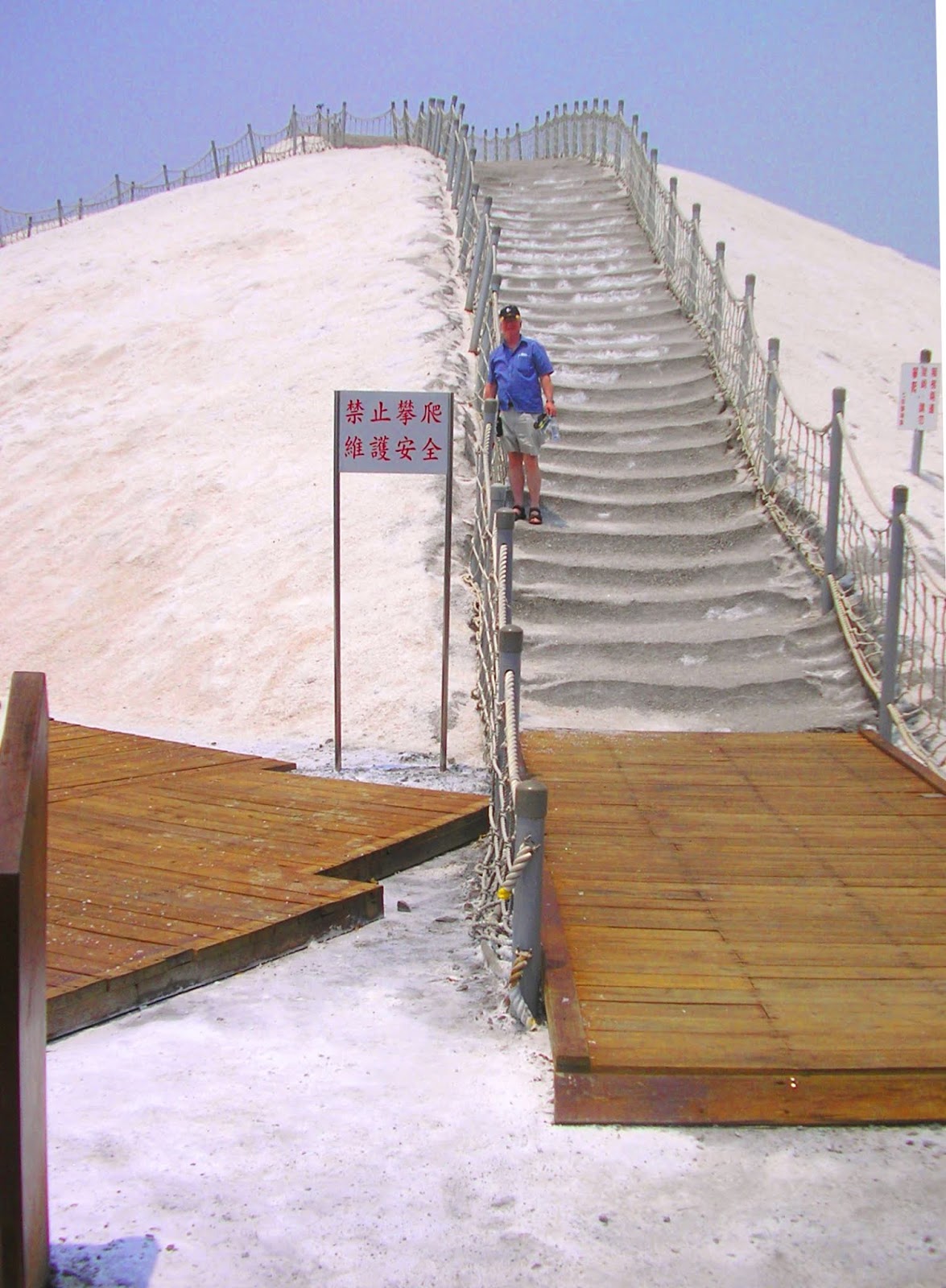
But the disappointment is even much bigger when I go through all the trouble and/or take many risks to reach somewhere off the beaten path. For example, to get to the Chigu Salt Mountain in Tainan City, Taiwan, we had to ride the expensive but fast bullet train from Taipei in the north and then take the only bus, where the driver, conductor, and passengers didn’t speak any English, to the outskirts of Tainan. This same bus went back only once, late in the afternoon.

Comments on its website like this more than express our disappointment: “Honestly! I had to spend 1 hour and 10 minutes on the bus to get there! And the last bus left at 18:10! What for? for a mountain of "salt" black of air pollution...nothing very amazing there! “

Finding a Saving Grace

We didn't want to wait four more hours for that one bus, so we called for a taxi. The driver, noticing we were hungry (the museum only had coffee), stopped, got out, took something out of the trunk, and gave us the most wonderful cookies we have ever tasted. Had we not gone to the Salt Mountain, we would not have met this extraordinary man! In Brussels, Bill’s saving grace was Belgian beer; mine, Belgian chocolates, and ours, waffles.

The question is not whether I would prefer to go on or off the beaten path. I will keep on doing both and you should, too. It doesn't matter how much expense or preparation we need to get to either. We can never guarantee anything in life. What matters most is to always have the right attitude when we get there. Then you may feel a sense of accomplishment, amazement, or a saving grace.

 
Bill climbing the Salt Mountain

PREVIOUS POST
Family Fun at a Farmhouse in Temecula Wine Valley

FOR MOBILES, click "View Web Version at the end of the post past comments and share buttons will appear.


Tuesday, April 2, 2024

Family Fun at a Farmhouse in Temecula Valley Wine Country


Four heartwarming events and a culinary competition got the family going to a one-of-a-kind four-night reunion in Temecula, California. We had two birthdays, a photo shoot of four generations of women, and a Filipino tradition: asking for a hand in marriage.

The Wine Valley

The valley is in southern California between Los Angeles and San Diego. With nearly 50 wineries, its microclimate produces high-quality grapes and award-winning wines. Farmhouses, spas, and views abound, as well as dining places. My husband’s 80th birthday dinner was at the Restaurant at the Ponte Winery. The Corbeaux Wine and Tea House was the site of the ladies' afternoon out for tea. My eldest celebrated her 50th birthday at Bolero’s with three different kinds of paella and other Spanish dishes. This also became the venue for the asking of my Second Apo’s (grandchild) hand in marriage! 

One afternoon was spent wine tasting at the Masia de la Vinya Vineyard together with my daughter’s best-loved baked macaroni, Filipino-style. Another day we walked Temecula Old Town. The ladies took home shabby chic maternity and other dresses from Under the Willow. They were perfect for the photo shoot of four generations of women, including my great-grandbaby still in my First Apo’s womb. The boys shopped for wine and did their walkabouts.

The Farmhouse

My daughter found this great farmhouse in a vineyard atop a hill with a 360⁰ view of the wine valley. The 4br ranch-style white home was perfect for the grandparents, the parents, and the siblings and partners. There was a spacious open area for Karaoke nights with a large living room set and an 85-inch TV above the stone fireplace.  Every boisterous meal was celebrated at the eight-seater dining table after spirited meal preparations around the white kitchen’s large white island. Tucked in a corner was a round table with four chairs which became the scene for happy mahjong sessions.

Just below the house, beneath the orange trees, was a large pool/hot tub area perfect for other gatherings.  There were lounge chairs on the deck right outside the large open area looking out into the valley. Right after the outdoor parking area, there was a huge living/dining area for outdoor meals and gatherings.

The Culinary Competition

My daughter had this brilliant idea of a culinary competition for those meals when we were not dining out. She did not want any mediocre meal and gave away prizes of $50 for first place, 30 for second, and 20 for third.

The 1st Prize went to the Corned Beef Kare-Kare dinner which my First Apo prepared for the first dinner as soon as everyone arrived late in the afternoon of our first night. Kare-kare is a Filipino classic stew with a thick savory peanut sauce usually prepared with beef oxtail.  Instead, they made corned beef patties served with the traditional veggies: eggplant, green beans, and bok choy.

2nd Place went to a breakfast of Purple Yam Biscuits with Longganisa Gravy and Chia Pudding with Mango and Pomelo Bits, a healthy and delicious morning meal, made by my Second Apo. 3rd Prize went to Miso Bulalo courtesy of their younger brother who rehashed the Beef Bulalo (beef shank stew), by adding the Japanese thick paste, served with plenty of bokchoy and yellow corn. 4th Place went to the father of the brood who fixed us “putosulot,” Filipino rice pudding with toppings: traditional, purple yam or pandan condensed milk, brown or white sugar, grated coconut, and optional salted eggs.

I came in last with a breakfast of hash brown casserole, scrambled eggs with cheese, sourdough bread, bacon and sausage, and store-bought “cowboy quiche.” I didn’t know there was a contest, and I had a Caucasian husband to please. Those are my excuses and I am sticking to them.


PREVIOUS POST
Choosing a Brand New Destination or a Familiar Favorite

FOR MOBILES, click "View Web Version" at the end of the post past comments and share buttons will appear.


Tuesday, March 12, 2024

Beyond Being Tourists


My husband and I have traveled together since the time we met in July 2007. We began as tourists, traveling for pleasure, visiting places out of curiosity.  We became more serious travelers when we bought an RV, rented out our condos, and cruised through forty-nine American states, nine Canadian provinces, and six Mexican states. It’s all chronicled in the book Carolina: Cruising to an American Dream. The RV gave us the wherewithal to become more than tourists. We became explorers, adventurers, and even pilgrims.

An Explorer is defined as a person who combs an area for discovery. When we became Elite Members of Thousand Trails (a nationwide network of campgrounds) and upgraded our RV to a 37.5-foot motorhome towing a dinghy, we stayed three to four weeks at a place. This gave us the chance to explore an area more completely. I would research the places nearby and schedule daily explorations of the areas within three hours of our base camp.

In Ontario, Canada, for example, we saw all four different faces of the province: a government hub in Ottawa, a bustling metropolitan center in Toronto, a famous tourist spot (Niagara), and the rural town where we were camped. In Europe, we got to go to three countries from our base in the small town of Oberstaufen in Germany. The trains allowed us to visit Switzerland (St. Gallen), Lichtenstein (Vaduz), and Innsbruck (Austria).

An Adventurer, on the other hand, is a person who has, or seeks, activities or places for excitement or an unusual experience, despite the risks they may entail. I must admit that Bill is more of an adventurer than I am. He used to scuba dive, ski, fly a plane, etc. I just play with my smartphone or laptop, an armchair sort of a girl.  I’ve tried playing tennis and pickleball, but they didn’t like me. Does riding the helicopter in Kauai or taking our RV to the Arctic Circle in the Yukon count?

When we stumbled upon the Worthington Glacier on the road to Valdez, Alaska, Bill went up to climb it while I stayed behind, scared I might hurt myself or be frozen. When we went with his high school friends for a reunion in Crested Butte, Colorado, he went wild river rafting with his friends while I stayed behind to write about the reunion instead. At Grandfather’s Mountain near the Blue Ridge Parkway, Bill negotiated the Mile-High Swinging Bridge while I took his photo.

A Pilgrim is another kind of traveler. This is a person who journeys, especially a long distance, to some sacred place as an act of devotion or even as an original settler. Once, being both Catholics, we diverted from our planned itinerary to Minnesota and turned west instead of north to visit the Grotto of the Redemption in the northeastern corner of Iowa. It was off the beaten path, but we wanted to see the complex of nine grottos made from forty-three different kinds of gems individually gathered and built entirely by the hands of three men.

A friend and I became accidental pilgrims in Eastern Europe. We were in Razlog, Bulgaria visiting a beautiful Eastern Orthodox Church in nearby Bansko when she suddenly had a yearning to find a Catholic Church. The nearest one was in Skopje, Macedonia, three and a half hours away, where Mother Teresa was born. We hired a taxi, prayed at the Chapel attached to her house, and visited the Church of the Black Madonna where she heard her calling at 18 in Letnice, Kosovo, an hour and a half away. The way home was through Nis, Serbia, birthplace of the first Christian Roman Emperor and Saint, Constantine the Great.

Indeed, we both had become explorers but I will not be the adventurer that Bill is. But we hope to be more of pilgrims. It is time for deepening our faith in this phase of our lives. Which of the three kinds of traveler do you want to be?


Tuesday, November 28, 2023

How We Chose to Settle in Phoenix After RVing For 8 Years


This article was first published in TravelAwaits on Dec. 12, 2021.

Almost immediately after our wedding ceremony, we embarked on what we thought would be a never-ending honeymoon. We had both led very career-driven lives and our hunger for travel had reached its peak. But after crisscrossing the North American continent for five years full-time in an RV,  we decided to settle in one location every winter to begin what real retirement should be for us “sexygenarians.” But many ask, "Why Phoenix?" Let me tell you how we reached the decision.

It started with our realization that we were not super-persons who did not need a team of physicians who could take care of us on a regular basis.  After my husband suffered a heart attack in Florida—fortunately near a heart hospital— and my host of many smaller health issues, we decided to stay put in a place for a few months to do the rounds of doctors. Besides, not getting any younger, we would have to wake up from the dream later, cut short our honeymoon, and really retire.

Before making a firm decision, we took our RV and proceeded to stay in the most likely areas where we could try semi-retirement to get a better feel of how it would be to live there, which is vastly different from simply visiting. We were sure it would be in the South because neither of us could handle the cold. My husband’s fingers turned blue at the Grand Canyon National Park…in spring; and, for 54 years, it was summer year-round for me. It would probably be somewhere in Florida, southern California, or Arizona. We embarked on a serious search.

SEEKING A BETTER TAX STRUCTURE AND LOWER COST OF LIVING

Even if San Diego is touted to have the best weather in the country all year round, it was easy to eliminate southern California; sad because that is where most Filipinos choose to live. Thus, there are Filipino groceries like Seafood City, many Filipino organizations to join, and many of my former classmates, co-workers, and other colleagues. However, the tax structure of the state and the consequent high cost of living are not good for retirees on fixed incomes like us. A case in point is the cost of gasoline. It is always highest in “SOCAL.”  Our dollars would buy so much less!

TO BE NEARER OUR CHILDREN

We turned our attention to Florida where the tax structure is better. And there are so many ready-made retirement havens for people like us. As a matter of fact, we thought we would be buying a property at The Villages, often cited as the best retirement “city” in the whole country. We loved the climate there, hot and humid like I was used to in the Philippines. But, alas, Florida is so far from where our children live. Road trips to visit any of them would never be practical, and plane flights would all end up being more expensive in the long run. These may prevent us from visiting them often; or, worse, discourage them from visiting us!

So we zeroed in on Arizona, where a road trip to San Francisco, California— where my eldest daughter lives—would take just 12 hours; to Denver, Colorado— which my husband’s daughter calls home— would almost be the same; and to Boise, Idaho— where his eldest and only son lives— would be longer by just an hour and a half.  So we took our RV to spend three weeks each in Flagstaff, Phoenix, Tucson, and Yuma, Arizona’s candidate cities.

A WARMER CLIMATE

The Grand Canyon National Park is only one and a half hours away from Flagstaff; only 45 minutes separates it from Sedona, that magical city of red rocks (photo). There are many other national monuments and state parks around the city: Walnut Canyon, Wupatki, Sunset Crater, Tuzigoot, and Montezuma, to name a few.  Yes, it’s Arizona’s prettiest corner. If we lived there, we would be visited by a lot of friends and family. And yet, it proved too cold for me and my husband since Flagstaff is in the northern part of the state, at elevations of almost 7,000 ft.  After three pleasant summer weeks, this Arizona city was nonetheless eliminated.

A MORE COSMOPOLITAN CHOICE

Let me explain here that I am a big-city girl, having lived in Metro Manila—a megacity with a  current population of 14 million, one of the densest cities in the world, much like Bangkok—until I retired. Given a choice, I prefer to have a wide range of facilities for cultural events, many options for shopping, extra choices for international culinary delights  (not a single El Pollo Loco), and a full complement of government and commercial services. So, even if Yuma has a population of 200,000 and is just 25 minutes walking distance to Los Algodones, Mexico, a mecca for inexpensive dental and medical services and supplies, it was also eliminated from the list. 

A BETTER GLOBAL REACH

In the end, it became a close contest between Tucson and Phoenix, Arizona’s biggest and best metropolitan areas. At first, we found it difficult to decide between the two.

The Tucson metropolitan area, population of almost a million, was the early front-runner. Temperatures are cooler by five degrees year-round because it is at a higher elevation. It is also closer to Mexico which we were looking at as a second home at best or a regular vacation spot at least. There are also many landmarks in and around the city like the Saguaro National Park and the Sabino Canyon National Recreation Area, aside from cool day trips to places like the Tumacacori National Historical Park, the site of the first-ever Spanish mission in the US. Actually, another mission, Xavier San Juan del Bac, is right in the city and is the best example of Spanish architecture in the US, still actively providing enchanting services. Tucson is decidedly more Spanish in character. It is also the site of the world-famous “International Gems and Jewelry Festival” in winter. Great for aspirational women, like me!

On the other hand, Phoenix is five times larger with a population of five million, the 11th ranked in the nation. Although it does not have national parks or Mexico at its backdoor, the Flagstaff area is just about three hours away, Yuma about the same, and Tucson, two. It is also home to more museums, entertainment options, venues for concerts and shows, and city, state, and regional parks. The latter were very useful for communing with nature when we were in forced lockdowns.  There will be no dearth of places to take our visitors and guests. The megacity is made up of a cluster of cities and municipalities like Mesa, Scottsdale, Glendale, Tempe, Chandler, Gilbert, Apache Junction, and 17 others. 

We stayed at the Viewpoint RV & Golf Resort in Mesa. With 1,900 sites, it is the biggest such resort of its kind in the Phoenix area. There was a similar resort called Voyager RV Resort and Hotel in Tucson. Although a little smaller with 1,500 sites, there was a hotel for guests attached to it. Both are part of Encore Resorts which also owned the network of campgrounds where we were members. And both had sections for homes when one finally decided to stay put.

We chose Viewpoint. The deciding factor was simple: Sky Harbor International Airport is a global hub, and therefore our travels around the world and visits to children in Anchorage, Alaska, Calgary, Alberta, Canada, and Melbourne, Australia would not only be less expensive but more convenient, with usually just one stop or even nonstop stop flight options.

Three years later, after we settled with a great family physician and a team of specialists to whom he referred us, we finally fully retired, sold our RV and bought a house in Viewpoint. I have fallen in love with the desert. Spring is a beautiful season to be here when the ubiquitous paloverdes, aside from all the wildflowers, are in full bloom with their delicate yellow flowers. Fall weather is also perfect.  These days, we stay home during these two seasons and travel when Phoenix sizzles in summer or chills in winter.

It was a blessing owning an RV. We were able to search the country thoroughly and when we were ready, choose from candidate cities by staying in each one for three weeks. And then we took all of three years wintering in Viewpoint before deciding to make the arrangement permanent. It was a rigorous and highly enjoyable process. And in the end, we made the best decision. 

PREVIOUS POST

How to Choose the Best RV and Campground for the Way You Want to RV   

Tuesday, November 21, 2023

How to Choose the Best RV and Campground for How You Want to RV


This article was first published in TravelAwaits on March 25, 2020, and has been updated here.

We RVed full-time for eight years and thoroughly enjoyed every minute of it. We experienced three ways of RVing and I learned about two basic types of RVs you can use, and four kinds of campgrounds where you can stay. This will introduce you to all of them and help you match the best RV and campground for the way you want to RV.

3 WAYS TO RV

The first way is what people tied to a home base need. You want to take a short trip to be renewed and get the benefits of RVing: the open road, the outdoors, and no unpacking. It’s escaping from everyday life. I was not able to do this when I was younger for the obvious reason that there was no RVing infrastructure in the Philippines. America, however, has the best RVing infrastructure, and Bill, my husband, took weekend RV trips with his family regularly before we met.

We RVed the second way for the eight months right after our wedding. We tried it out for our honeymoon. We wanted a longer trip, but we still thought of returning home at the end of it. This is snowbirding — for three to six months — to move away from the cold (or heat) of their home base. They seek a warmer (or cooler) place and stay there until the weather back home eases. It is what farmers (mostly from the northern U.S.) do when their farms are idle in the winter. It’s what educators do during long summer breaks. Some people do this while working at seasonal jobs, using their RV as a temporary home away from home.  The goal is to be in the north during summer and in the south during winter.

The third and final way is what Bill and I eventually chose to do. After our first eight months on the road, we wanted to extend our honeymoon, so we bought a bigger RV and became members of a nationwide campground network. We shifted into full-time RVing. We made the RV our home and drove all over North America for five years. Then we went back to the second way for three years. We stayed in Arizona during the winters; the rest of the time we traveled the world and visited our children. Now we are back to the first way

2 GENERAL RV TYPES

There are two general classifications of recreational vehicles (RVs): motorized and non-motorized. Motorized RVs combine the living area and the engine and drivetrain in one vehicular unit. Non-motorized RVs are complete housing units that can be pulled or towed by a motor vehicle (like a truck) powerful enough to do just that. We chose a motorized RV because it was easier to set up and we planned on staying weeks, not months in a given place.

There are four kinds of motorized RVs, from the smallest camper vans to the biggest Class As. Camper vans are vans retrofitted to create a small, walkable area in the back that houses a sleeping area at a minimum, popular in Europe where the roads are very narrow. Class B and C motor homes are bigger and can be up to almost 30 feet in length. In Class C, the sleeping area is on top of the driver’s compartment while for Class B, it is at the back. Both are typically complete with a kitchen, a dinette, and a bathroom. We chose a 24-foot Class B for snowbirding. When we went full-time RVing, we traded it in for a Class A. These are usually upward of 30 feet long (ours was 37.5 feet long). They are also usually fitted with slide-outs — as many as five, but we had only one — that make the living areas much bigger when parked. They can tow a dinghy — ours was a Saturn compact car. With our Class B, we were limited to a scooter.

Then there are two kinds of non-motorized RVs: travel trailers and fifth wheels. . They must be towed by vehicles with enough power for their size. Travel trailers are towable housing units of various sizes, from the lighter pop-ups and teardrop campers to the bigger Airstreams and even larger units On the other hand, fifth wheels are usually larger and feature big noses that house the bedroom. Those noses are attached to the beds of pick-up trucks, making the attachment more secure and stable. They are usually as big as Class A motor homes and can also have slide-outs that expand the living areas.

Like camper vans, small pop-ups or teardrop campers are ideal for shorter weekend escapes. Like Class B and C motor homes, medium-size travel trailers are great for longer seasonal stays. And like Class A motor homes, large travel trailers and fifth wheels make the best full-time homes, especially if you’re planning to stay in one place for several months or longer. You do not have to buy any of these RVs. Many RV rental companies have all these types of RVs available at reasonable prices. But it is best to buy your RV if you plan to use it as your home.

4 KINDS OF CAMPGROUNDS

There are four kinds of campgrounds. They can best be illustrated by imagining a grid divided into four quadrants. As you go higher vertically, you go from urban to rural; as you move from left to right, you go from absolutely no amenities/activities to those with a ton of them. Those with many amenities/activities I call resorts and those with few, parks. Those that are in rural areas I call nature campgrounds and in urban areas, city campgrounds. Here’s more on each of the kinds of RV campgrounds you’ll have to choose from.

We chose a nature RV resort in North Carolina when we explored the Blue Ridge Parkway. It was a great place to go home to each day. Each space had a sizable deck looking out over a fresh spring, and we were surrounded by large trees. The campground had hiking trails, a lake for fishing and boating, a clubhouse with billiards and table tennis, and tennis, volleyball, and a golf course.

What immediately comes to mind as a city RV resort is just six miles from Disney World and within walking distance of a strip mall and a big grocery chain. The large clubhouse was filled with game tables, billiards, table tennis, a large TV room, a gift shop, and even a diner. Guests also had access to a fitness center, hot tubs, pools, tennis courts, horseshoe pits, volleyball courts, and a mini-golf course. The resort hosted dances with live bands, concerts, and craft/hobby events.

You’ll check into a city RV park primarily to be near family or friends or as a base from which to explore a city. We found one on the outskirts of Boston, which we explored daily by taking the train and subway.

My favorite example of a nature RV park is the National Forest Service’s Kirk Creek Campground on Highway 1 through Big Sur, considered to be one of the most scenic driving routes in the U.S. It is in the sparsely populated area where the Santa Lucia Mountains rise sharply out of the Pacific Ocean. We loved the trail that led down to the largest sand beach in the area.

To escape, go to a nature resort or nature park. A city resort could also be good if you want the RV experience and additional recreation options. For longer vacations, you can go to faraway nature resorts or nature parks. City parks are best for visiting family and friends or exploring an urban destination while staying in your RV. For full-time RVers, nature or city resorts are best as bases. 

PREVIOUS POST

The Best Gifts of Travel: Lessons Learned, Changes Made, Insights Gained

Tuesday, October 10, 2023

TRAVEL AWAITS: 6 Quaint Small Towns To Visit While Exploring Kenai Peninsula in Alaska


This article was first published in Travel Awaits on Aug. 14, 2023.

As America’s last frontier, Alaska is well-known for spectacularly wide-open spaces teeming with amazing wildlife, ideal for both cool and cold outdoor fun.  Half of Alaskans live in Anchorage but it’s the quaint small towns that can give you the true Alaskan experience. North of the city are interior towns born out of its mining history. To its south, however, are communities rich in Russian cultural heritage with abundant fishing waters, glacial fields, and beach ports for Inside Passage cruises.

There are 36 such towns located on the Kenai Peninsula in the south-central part of the state. It has been called Alaska’s playground, “where mountains, ice, and ocean meet.” Bounded to the west by the Cook Inlet and to the east by the Gulf of Alaska, the Kenai Mountains lie on its western side, creating the natural bounty called the Kenai Fjords National Park. The jewel of the park is the famous Hardings Ice Fields. There are also six great rivers and over 50 lakes. At its southern tip, Kachemak Bay State Park  was Alaska’s first legislated state park. Together with the Kachemak Wilderness Park , they comprise 400,000 acres around the pristine waters of Kachemak Bay.

My husband’s daughter and my sister both lived in Anchorage, and visits to each of their homes have blessed us with opportunities to explore this incredible state. Our first visit to Kenai was so much fun that we went back for more the following year. In the following paragraphs, we share Cooper Landing and Homer from the first visit; then Kenai, Soldotna, and Seward from the second. But first, Whittier.

1.  Whittier


The 14-mile isthmus that connects Anchorage to the Kenai Peninsula is called Portage Valley. It is on a waterway called Turnagain Arm. The Portage Glacier once sat here and its remnants can still be seen today. The ghost town of Portage, about 47 miles south of Anchorage, is what remained after the 1964 Alaska earthquake.

An alternating railroad and road passageway was built here linking Seward Highway and Alaska Railroad to the Portage Glacier Park and the town of Whittier. It was quite an experience to pass through this Anton Anderson Memorial Tunnel.

Only about 60 miles southeast of Anchorage, the small town of Whittier is technically not part of the Kenai Borough. It sits on the northeast shore of the peninsula at the head of the Passage Canal, a port for the Alaska Marine Highway. Off-season, 272 people make it home, doubling in summer. Nestled between glacier-draped mountains, the town is the charming gateway to Prince William Sound on the Gulf of Alaska. Several cruise lines use it as a departure port for their famous four-hour Inland Passage cruises.

Pro-Tip: Our cruise took us up close to 26 glaciers on Resurrection Bay and the College Fjords. The high-speed catamaran had huge picture windows inside and extensive outside viewing decks. This is the less expensive way to explore these glaciers (rather than to cruise all the way from Seattle) and it gives you the chance to explore the peninsula.

2.  Cooper Landing


Straight south on Seward Highway about 100 miles from Anchorage, you will come across a centrally located census-designated place about the same size as Whittier: Cooper Landing. Because of its scenic location at the outlet of Kenai Lake into the Kenai River, it has become a popular tourist destination and a fisherman’s playground near the area’s salmon fishery.  

Pro Tip: You can get great fish and chips and the best-smoked salmon chowder you will ever find (just $10 a bowl) at historic Gwin’s Lodge, established in 1952 (even before Alaska became a state). You can find this oldest surviving roadside lodge on the peninsula at the confluence of the Kenai and Russian Rivers.

3.  Homer


My husband, his daughter, her son, and I continued to the southern tip of the peninsula just two hours away, to the quaint town of Homer, fondly called the “halibut fishing capital of the world.” Over 5,000 people reside on the foothills of the southern Kenai Mountains, overlooking a beautiful spit jutting out into the cold blue waters of Kachemak Bay. There the grandfather and grandson fished to their hearts’ content while I lost track of time taking photos of them and the wondrous seascape. At night we let the Inn’s chef turn their catch into a fish fest.

Perched in colorful huts above the waters along the spit shore were quaint shops and restaurants. It made a very lovely place for souvenir hunting and snacking. I could not resist having my photo taken with the largest halibut (almost 200 pounds) caught in a derby that day.

Pro Tip: Here we found the iconic Salty Dawg Saloon, perfect for drinks and dinner. The place is famous for its ceiling and walls covered with currency. I posted my Philippine Peso 100 bill, and the rest of the group, a U.S. Dollar. We hoped they would both still be there when we go back!

4. Kenai and 5. Soldotna


My husband’s daughter met somebody wonderful so the following year, we were back in Alaska for her wedding! When the brand-new couple went on their honeymoon, the grandpa, grandson, and I tried to replicate the previous year’s fun times and drove for three hours just slightly off the same road to Homer the previous year. They wanted to fish again, this time at the coastal capital town of Kenai (population 7,000) and its twin town Soldotna (5,000) at the western mouth of the Kenai River leading into the Cook Inlet.

Being late in the summer though, it was already colder, wetter, darker, and windier. There was not much fishing to do in this, Alaska’s renowned fishing area. The snow-capped mountains seemed farther away, hidden by haze. Even my photos turned out less bright.

But at Old Kenai Town, our disappointment suddenly went away. We were entranced by the historic church, built at the turn of the 19th century when the land was still under Russian rule. Alaska only became a state in 1959 (Russia sold it to the US in 1867 for $7.2 million). At the gilded Holy Assumption Russian Orthodox Church, we even found a set of wedding crowns we wore for a souvenir picture.

Pro-Tip: In Soldotna, we rejoiced at finding a local Fred Meyer which had complimentary dump and potable water stations. We loved camping there for the night and shopping for provisions in the morning.

6.  Seward


Sensing my disappointment in the weather, instead of going back to Anchorage my husband headed off to the eastern side of the peninsula. Less than two hours away is the small quaint town of Seward (population 3,000), sitting at the mouth of the Kenai Fjords National Park. It is another lovely cruise ship town nestled between the mountains and the fjords. It was already off-season, however, so there was hardly a soul on the waterfront. But the boats were all still moored in the marina; the shops were still open; and tours to the Kenai Fjords were still running!

Soon I would be treated to one of the great experiences of my lifetime. A sign led us to the Exit Glacier only eight and a half miles west of town. Considered the toe of the 500-square-mile Harding Ice Fields, it is so named because it has been receding slowly since the earliest recorded terminus in 1815. There were recordings all along the way, the last about two miles from the present one. You can imagine the former size of the glacier from the marshland being created at its feet.

On that massive ice, I got a second chance to walk on a glacial ridge. The previous year I had chickened out when we came upon the Worthington Glacier en route to Valdez. This time, I summoned enough courage to experience the thrill. But it was so cold, it felt like I was inside a freezer. I turned back after one quick photo op!

Such are the charming discoveries we made all over this beautiful peninsula. It’s a place where disappointments don’t last long. An abundance of small quaint towns collectively makes it an unforgettable vibrant playground.

FOR THOSE ON MOBILE, THE SHARE BUTTONS APPEAR WHEN YOU CLICK WEB VERSION AT THE VERY END AFTER COMMENTS.

PREVIOUS POST 

IN HAWAII: Renewal of Vows on Oahu and 2nd Honeymoon on the Big Island