Cruising Past Seventy: The Inner Journeys: North Carolina
Showing posts with label North Carolina. Show all posts

Tuesday, March 12, 2024

Beyond Being Tourists


My husband and I have traveled together since the time we met in July 2007. We began as tourists, traveling for pleasure, visiting places out of curiosity.  We became more serious travelers when we bought an RV, rented out our condos, and cruised through forty-nine American states, nine Canadian provinces, and six Mexican states. It’s all chronicled in the book Carolina: Cruising to an American Dream. The RV gave us the wherewithal to become more than tourists. We became explorers, adventurers, and even pilgrims.

An Explorer is defined as a person who combs an area for discovery. When we became Elite Members of Thousand Trails (a nationwide network of campgrounds) and upgraded our RV to a 37.5-foot motorhome towing a dinghy, we stayed three to four weeks at a place. This gave us the chance to explore an area more completely. I would research the places nearby and schedule daily explorations of the areas within three hours of our base camp.

In Ontario, Canada, for example, we saw all four different faces of the province: a government hub in Ottawa, a bustling metropolitan center in Toronto, a famous tourist spot (Niagara), and the rural town where we were camped. In Europe, we got to go to three countries from our base in the small town of Oberstaufen in Germany. The trains allowed us to visit Switzerland (St. Gallen), Lichtenstein (Vaduz), and Innsbruck (Austria).

An Adventurer, on the other hand, is a person who has, or seeks, activities or places for excitement or an unusual experience, despite the risks they may entail. I must admit that Bill is more of an adventurer than I am. He used to scuba dive, ski, fly a plane, etc. I just play with my smartphone or laptop, an armchair sort of a girl.  I’ve tried playing tennis and pickleball, but they didn’t like me. Does riding the helicopter in Kauai or taking our RV to the Arctic Circle in the Yukon count?

When we stumbled upon the Worthington Glacier on the road to Valdez, Alaska, Bill went up to climb it while I stayed behind, scared I might hurt myself or be frozen. When we went with his high school friends for a reunion in Crested Butte, Colorado, he went wild river rafting with his friends while I stayed behind to write about the reunion instead. At Grandfather’s Mountain near the Blue Ridge Parkway, Bill negotiated the Mile-High Swinging Bridge while I took his photo.

A Pilgrim is another kind of traveler. This is a person who journeys, especially a long distance, to some sacred place as an act of devotion or even as an original settler. Once, being both Catholics, we diverted from our planned itinerary to Minnesota and turned west instead of north to visit the Grotto of the Redemption in the northeastern corner of Iowa. It was off the beaten path, but we wanted to see the complex of nine grottos made from forty-three different kinds of gems individually gathered and built entirely by the hands of three men.

A friend and I became accidental pilgrims in Eastern Europe. We were in Razlog, Bulgaria visiting a beautiful Eastern Orthodox Church in nearby Bansko when she suddenly had a yearning to find a Catholic Church. The nearest one was in Skopje, Macedonia, three and a half hours away, where Mother Teresa was born. We hired a taxi, prayed at the Chapel attached to her house, and visited the Church of the Black Madonna where she heard her calling at 18 in Letnice, Kosovo, an hour and a half away. The way home was through Nis, Serbia, birthplace of the first Christian Roman Emperor and Saint, Constantine the Great.

Indeed, we both had become explorers but I will not be the adventurer that Bill is. But we hope to be more of pilgrims. It is time for deepening our faith in this phase of our lives. Which of the three kinds of traveler do you want to be?


Friday, August 13, 2021

TRAVEL AWAITS: The Perfect 5-Day Itinerary for the Blue Ridge Parkway


The Blue Ridge Parkway is the most visited single unit in the US National Parks System. Driving straight through would take ten to twelve hours. It took us five days because it has: "small towns, tunnels, overlooks, campgrounds, cabins, bed and breakfasts, hotels and motels, restaurants, visitor centers, parking areas, parks, wineries, hiking trails, waterfalls, mountains, lakes, and rivers."

The main Blue Ridge Parkway Visitor Center (MP 384) near the city of Asheville helped us group our visits into five day-itineraries, presented here chronologically. We based ourselves at the G
reen Mountain RV Park in Lenoir, North Carolina before moving to the Virginia section of the parkway.

Day 1: Blowing Rock

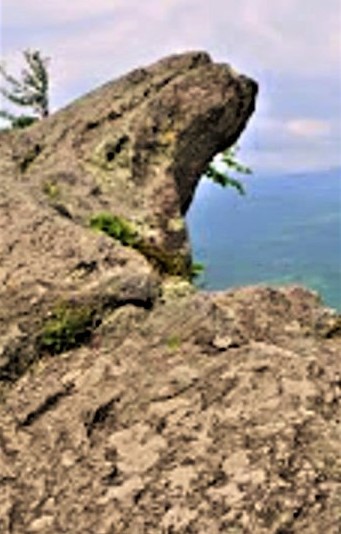
About 30 minutes from our campground, Blowing Rock (MP 219.9 and population  1,500 which balloons to 10,000 during summer), "takes its name from an unusual rock formation that juts over 1,500 feet above the Johns River Gorge. Wind currents from the gorge often blow vertically, causing light objects to float upward into the sky." The town is also host to The Tweetsie Railroad Theme Park built around the only remaining fully functional steam engine train in North Carolina. It takes you three miles into the beautiful Appalachian mountain scenery, gorgeous in fall. 

Day 2: Grandfather Mountain And Linn Cove Viaduct

Grandfather Mountain (MP 307.4), is a UN International Biosphere Reserve because of seven protected environmental habitats for black bears, river otters, cougar, bald eagles, golden eagle, and white-tailed deer. At Linnville Peak, there is a 228-foot Mile-High Swinging Bridge that spans an 80-foot chasm a mile high, offering a  360-degree view of the Appalachians. When you visit the Linn Cove Visitors’ Center (MP 304), you'll view the lovely Linn Cove Viaduct (MP 304.4), the 1,243-foot concrete segmental snaking bridge around Grandfather Mountain.

Day 3: Asheville To Linville Falls

This is the day we headed to Asheville to take a peek at the Biltmore castle. Then we visited the Folk Art Center (MP 382) to see quality craft products from North Carolina. 

"It would have been spectacular had the Catawba rhododendrons been in full bloom, but they were just starting when we went to our next stop: Craggy Gardens at MP 364.6. Here, the parkway is literally lined with walls of the plants that are sometimes as tall as trees. The pinkish-purple blooms are at their peak everywhere from late June to early August. So, aside from fall, this is another good time to visit the Parkway."

At 6,700 feet, Mt. Mitchell (MP349) is the highest peak on the East Coast. We loved the panoramic views from the Observatory Tower and the great hot chili dogs from the diner at the top. Then we hurried to Linville Falls (MP 316.4), to see the waters cascading down the 2,000-foot Linville Peak.

Day 4: Meadows Of Dan To Roanoke, Virginia

We left our base and, just after the Nojrth Carolina border, we reached the the Blue Ridge Music Center (MP 213). "But it was Puckett Cabin (MP 190) that held our interest longer. Orelena Puckett was a famous midwife in the late 1800s. Legend has it that, traveling miles on foot when called, she assisted in giving birth to about a thousand babies in 50 years — she lived to be 102 — and was paid about a dollar for each childbirth. It was sad, however, that none of her 24 children survived beyond infancy."


And then we got to the most photographed scene along the Blue Ridge Parkway, Mabry Mill (MP 176.1) that depicts how subsistence farmers lived and managed water.

We spent the night in the charming mountain city of Roanoke (MP 120.4), population, 300,000. Shining from atop the mountains, the Mill Mountain Star, the world’s largest freestanding illuminated man-made star, stands 88.5 feet tall with 2,000 feet of neon tubing powered by 17,500 watts. It turns red whenever there is a traffic fatality.

Day 5: Beyond Roanoke And Toward The Northern Terminus


A short drive from Roanoke was Peaks of Otter (MP 86): Sharp Top, Flat Top, and Harkening Hill. We did not hike up any because it would have taken around three hours so we just took lovely pictures from the lodge. Then we drove to Poplar Forest, the summer home of Thomas Jefferson, just a short drive from the peaks.

Our next stop was the Natural Bridge near Glasgow, 15 miles from MP 61.4. Cedar Rapids has been continuing to carve it out for the last 500 million years. Look for the letters GW that are inscribed on the rocks about 23 feet from the stream’s surface in the middle below the bridge (said to have been done by George Washington).  1,600 year-old trees are in the process of being petrified all around the grounds. Just don't pay the price for the toy museum and wax factory!

We missed the open hours of the Stonewall Jackson House in Lexington (MP 46) but we visited the Virginia Military Institute, just a few miles away, dubbed the West Point of the South. 

Then we drove the parkway toward its southern terminus at MP 469. This section had so many tunnels, coming one after another and sometimes even back to back. It was an amazingly scenic drive that inspired our next adventure at the nearby Great Smoky Mountain National Park.

FOR THOSE ON MOBILE, SHARE BUTTONS APPEAR WHEN YOU CLICK WEB VERSION AT THE VERY END AFTER COMMENTS.

PREVIOUS POST


Friday, April 23, 2021

TRAVEL AWAITS ARTICLES: 5 North American Island Getaways


Note: This is the second in my series on Travel Awaits Articles. Like the first, it was published in 2019. But this one is still my most widely-read article with around 15,000 views.
If you want to know more about the places highlighted here, please go to the complete and original article where the links are all included. 

We have hesitated to go back to Hawaii because it is truly quite expensive to have an island getaway there. And there are islands -- from the New England coast to the Florida Keys and the Los Angeles coast up to the Pacific Northwest -- much closer to where you may be, each with a distinctive island charm.

1. Martha’s Vineyard


If you live in the New England area, Martha’s Vineyard is a wonderful alternative.. The mainland ferry dock in Wood’s Hole is just an hour and a half from Boston and the Steamship Authority ferry ride takes only 45 minutes. The island has many museums, art galleries, and unique landmarks. In fact, there are four museums right in Wood’s Hole. You may opt to go on a day trip or stay for a weekend at many lodging options. There is a good public transportation system on the island.

Oak Bluffs is famous for the Martha's Vineyard Camp Meeting Association's Giant Tabernacle surrounded by about 300 lovely vacation gingerbread cottages in all colors and designs. There are also four museums, including the Cottage Museum. Edgartown has an old scenic lighthouse is in Aquinnah and five museums. It's connected via a small ferry to the small island of Chappaquiddick (where Ted Kennedy’s car accident led to the drowning of his young female companion). Look for the Giant Pagoda Tree in the middle of town. West Tisbury hosts the most art galleries and Falmouth has the most (nine) museums. 

2. The Outer Banks


Highway 158 cuts through North Carolina and connects to Highway 12, which runs through the Outer Banks. Depending on where you are in the state -- of Virginia -- the drive will take only about three to four hours. Best during late spring, summer, or early fall, the barrier islands jut out 26 miles from the coast. They offer a lot of history and charm rests because of a unique terrain and distinctive weather. 

The whole family will love kiting or hang gliding at the 426-acre Jockey’s Ridge State Park, home to the largest and tallest active sand dune on the East Coast. Movie buffs will be happy to discover the Inn at Rodanthe. The Wright Brothers chose Kitty Hawk for their historic flight and Big Kill Devil Hill commemorates their feat. The Lost Colony on Roanoke Island is where, in 1585, 115 pilgrims preceded those in the Jamestown Colony in Virginia (1607) and the Plymouth Colony in Massachusetts (1620). Finally, there are four beautiful lighthouses, built to help maritime commerce, to see -- the Ocracoke Lighthouse (1823), Bodie Lighthouse (1846), Cape Hatteras Lighthouse (1870), and Currituck Beach Lighthouse (1875). Still ships sank and the Outer Banks became  known as the Graveyard of the Atlantic, as explained at The Ocracoke Museum.

3. Florida Keys


The Florida Keys is made up of about 1,700 islands.  To get there, you drive the "Overseas Highway, a breathtaking narrow highway with water on both sides, punctuated by connecting bridges -- there are 43, with the Seven-Mile Bridge as the longest -- and sometimes patches of swaying palm trees. 

We stayed at the Sunshine Key Resort and Marina on Big Pine Key, one of the islands. It has blue water on all three sides, all kinds of amenities, and lots of activities. There was also key deer roaming around the island. They grow to only a third of the size of regular deer. 

A public bus can take you from Big Pine Key to Key West, the southernmost Key, in 45 minutes, While there, visit Mallory Square for great shopping, stay to celebrate a spectacular sunset, visit Truman's Little White House, explore the Hemingway House and Museum, and dance the night away at Sloppy Joe’s, Hemingway’s favorite hangout. Don't forget the photo-op at the Southernmost Point of the US, only 90 miles from Cuba. 

4. Catalina Island


Catalina is just an hour by ferry from Los Angeles. A hilltop tour reveals a priceless view of the harbor, which is smaller and less luxurious than the one in Monaco but has the same look as a playground of the rich. At the highest point on the hill is Wrigley Mansion who was responsible for creating this island destination. There’s a Wrigley Memorial Tomb down the hill.and the former spring training houses of the Chicago Cubs, previously owned by Wrigley. Deer flourish since there is no predator larger than the small fox on the island. So deer hunting is legal on the island some days of the week.

The island is known for its Old Hollywood charm, especially with Avalon Casino, not a gambling den but a 140-foot-tall circular building that juts out into the harbor. A Ballroom with a 20,000-square-foot dance floor occupies the top floor. The ground floor has the fabulous Catalina Theater with 1,154 seats. It's where the first talking movies in the country were shown. 

Marilyn Monroe used to live in one of the pastel-colored wooden homes that are spread across Catalina’s flats and hillsides. The Square and the commercial buildings are adorned with beautiful colorful tiles, just like those in Mexican, Spanish, and Portuguese towns. Finally, the small pier overlooks a busy beach with lots of water activities. It's also a jumping-off point for side trips to Lovers Cove.

5. Vancouver Island


Victoria on Vancouver Island is less than three hours from Vancouver, including the one-and-a-half-hour ferry ride from Tsawwassen near the U.S. border. It takes roughly the same time via a ferry from downtown Seattle. If you are in the Pacific Northwest, this is a most  charming weekend getaway.

The oldest Chinatown in Canada is in Victoria's two rows of small side shops on a tiny side street called Fan Tan Alley. The beautiful British Columbia Provincial Legislature is across the Victoria Harbor stands because the city is the provincial capital. And, also facing the harbor is the Fairmont Empress Hotel, known for both its grandeur and its upscale afternoon tea.

But the decided highlight is the beautiful Butchart Gardens, north of the city near the ferry dock, It’s composed of five sections -- the Sunken Garden, the Rose Garden,  the Japanese Garden, the Italian Garden, including the private garden of Mrs. Butchart, and the latest addition, the Mediterranean Garden. It's the most beautiful garden I have ever seen and it inspired me to extend the garden in my home.

We were pleasantly surprised with these charming island getaways in North America. I am sure you will not be disappointed with any of these five.

FOR THOSE ON MOBILE, SHARE BUTTONS APPEAR WHEN YOU CLICK WEB VERSION AT THE VERY END AFTER COMMENTS.

PREVIOUS POST


Monday, April 9, 2012

OLA: Being Blown Away by the Outer Banks!


the outer banks, off the coast of North Carolina

Literally and figuratively! Barely the start of the tourist season (April 1-3), we braved those more than 25 mph winds that made it seem colder than the 59 degrees high (we had to dig out our winter wear). The Outer Banks jut out as barrier islands 26 miles from the US continental shores off North Carolina (about 200 miles). I had always wanted to see how people live there. The proper winds, the lights that guide, the shifting sands of time, and the three postscripts are what blew us away in North Carolina's Outer Banks in just three days!

The Proper Winds

This kind of constant wind was what the Wright Brothers lacked in their Dayton, Ohio home. So they selected the winds in Kitty Hawk at the Outer Banks to make history. The Brothers succeeded in making four flights there on Dec. 17, 1903. With the winds just a bit stronger than those we felt, on the fourth try they flew their plane for 852 feet in just 1 second short of a minute. It was exhilarating to walk those grounds.

grand memorial to the Wright Brothers' the conquest of space
Kitty Hawk, Outer Banks, NC

And so it is fitting that a grand memorial is there on 90-foot high Big Kill Devil Hill from where they made the launch, even preserving the cottages from where they lived and engineered the dream. It is even more fitting that a Memorial to a Century of Flight was erected commemorating 100 years of aviation achievement since the Wright’s conquest of air space. There is a monument to each decade laid out as a circle with a 120-ft. circumference. The Memorial holds a time capsule, to be opened in 2103, by the heroes of the next century of achievements. Who knows what and who those might be? 

The Lights that Guide


These barrier islands are so important to maritime history. The very first colony was braved on Roanoke Island by about 115 white settlers led by John White in 1585. Historical distrust between two races, leadership crises among the settlers, or succumbing to natural diseases may have stricken those left behind when White returned to England to ask for more resources. They were all gone when he returned 3 years later. This preceded the Jamestown Colony in Virginia in 1607 and the Plymouth Colony in Massachusetts in 1620. However, it didn’t survive like the other two. It is now fondly called The Lost Colony. Interesting to know,

This bit of history highlights the geographical significance of the Outer Banks. In the 19th century, four lighthouses were built to aid maritime commerce: the Ocracoke Lighthouse built in 1823 and still operating, the Bodie Lighthouse built in 1846 supposedly named after bodies washed ashore from shipwrecks, the Cape Hatteras Lighthouse, also known as the American Lighthouse, built in 1870 and the tallest (160 ft.) brick beacon in the world, and the Currituck Beach Lighthouse, privately owned and built in 1875. The four make for a beautiful collage of important history. Sad to note, however, that so many shipwrecks still happened in the waters there such that it was called the Graveyard of the Atlantic and a museum so-called stands at Ocracoke.

The Sands of Time

Jockey's Ridge State Park, Nag's Head, Outer Banks, NC

The 2-lane Highway 12 that connects the islands of  Outer Banks is separated from the ocean in large stretches by sand dunes. But at the 426-acre Jockey’s Ridge State Park, the highest active sand dune (estimated 30 million tons) in the East Coast of North America lives. It is called a medano—a massive, asymmetrical, shifting hill of sand which the notorious winds cause to continually shift, making the dunes move about one to six feet to the southwest each year. Thus, hang gliding, hiking, and kite flying are great to do there. Bill loved capturing the artistry of the sands on his D5000. I got scared, though...don't know why!

the Inn at Rodanthe, featured in the movie 'Nights at Rodanthe', Outer Banks, NC

The Three Postscripts

Our Lady of the Seas at Buxton, Outer Banks, NC
Three other moments on this short trip are memorable: 1) hearing a Spanish Mass at the Our Lady of the Seas Catholic Church right at the edge of the Sound for Palm Sunday, 2) finding the Inn at Rodanthe where Richard Gere and Diane Lane created for all of us their memorable but tragic love story, and 3) choosing to dine at Carolina Seafood just because it was named after me. There we found Sandra who guided us to a reasonably-priced Carolina Seafood Platter (what else?) the only condition for which was to eat at the bar. What luck. She is the paragon of a gracious host and best of story-tellers in the Outer Banks!

Sandra's Carolina Seafood Sampler at Nag's Head, Outer Banks, NC

In three short days, we truly got blown away by the Outer Banks of North Carolina, literally and figuratively,...its proper winds, the lights that guide, the sands of time, and the three postscripts. We wished we had more time to do some of the activities the unique environment had to offer.    

Monday, September 5, 2011

OLA: Digging into Ohio's History


Santa Maria, the ship Columbus sailed from Spain in 1492 to land on American shores

Staying three weeks in one place affords us some time to get to know it. We could have gone on to visit many historical sites but we also had to take care as Bill was just recuperating from his arthroscopic surgery. So we did a little digging (not the archaeological kind) of the state's history, especially about the two historical contests she has found herself in.

First, there have only been 44 presidents in the US and 8 came from Ohio! William Henry Harrison, his grandson Benjamin Harrison, Ulysses S. Grant, Rutherford B. Hayes, James Garfield, William McKinley, William Howard Taft, and Warren Harding all made Ohio their home or were born there. We enjoy visiting presidents’ homes. Walking where great men walked is one thing; to be where they lived is quite another! So we visited both the Harrison homes.
home of William Howard Taft on Auburn Hill

It also happens that the home of William Howard Taft is right in front of The Christ Hospital.  Taft was the first Governor-General of the Philippines, laying the foundation of the country’s public systems and infrastructure. With a background that is deep into the US judicial system, this gave him the administrative experience for the presidency. And his strong judicial background gave him the unique opportunity to be the only president who later served as Chief Justice of the Supreme Court.

home of Benjamin Harrison in Indiana
But it is a different state which is dubbed the “Mother of Presidents’. 8 US presidents, most of them soon after the 1776 Revolution, George Washington, Thomas Jefferson, James Madison, James Monroe, William Henry Harrison, John Tyler, Zachary Taylor, and Woodrow Wilson, either made Virginia their home or were born there. Two years ago, we visited Washington’s Mt. Vernon, Jefferson’s Monticello and Poplar Forest (his summer home), Madison’s Montpelier, and Monroe’s Ash Lawn-Highland.

William Henry Harrison's Tomb in Ohio
Thus the title that is given Ohio is ‘The Mother of Modern Presidents’. It is interesting to point out that William Henry Harrison is in both lists. He moved to Ohio from Virginia (his grandson Benjamin moved later to Indiana) and his grand tomb rests there. He served the shortest presidential term ever, dying of pneumonia just a month after his inauguration.

Second, Dayton, Ohio is the birthplace of Orville and Wilbur Wright but it was in Kitty Hawk, North Carolina where the brothers succeeded in first flying a plane (a glider).  Thus North Carolina is called ‘The Birthplace of Aviation’. Ohio, on the other hand, carries the title, ‘The Birthplace of Aviation Pioneers’ and it is well deserved! Huffman Field, where the Wright Brothers tested and launched the first practical plane, is called the First Airport in the World.   And John Glenn and Neil Armstrong, pioneer astronauts, were born in Ohio!
Huffman Field, World's First Airport, where the Wright Brothers launched the first practical plane

Ohio's Pride!!!
Because of the tremendous contribution of the Wright Brothers to aviation, the outstanding National Air Force Museum is in Dayton, Ohio, the best flight museum in the country. It boasts of the most comprehensive exhibit of military aircraft (about 300 planes) used in all the wars the US has been involved, from WWI to the Cold War. I was especially moved by the early dirigible, the bomber Bockscar which delivered the 2nd atom bomb dropped on Nagasaki (Enola Gay that bombed Hiroshima is in the Smithsonian), and the collection of missile heads. Bill loved the bombers, fighter jets, and stealths.

Lucius Quinctus Cincinnatus with Big Mac Bridge behind
Third, this is the uncontested part! Ohio has inspired many great works of men (for a time, the state had the highest inventions per capita) and many great men have also inspired the state! Cincinnati is proud to be named after the Roman general, Lucius Quinctius Cincinnatus. He was forced to work on his own small farm after his son was convicted in absentia and condemned to death. In 458 BC, Rome called on him to quell an invasion by rival tribes as its dictator, an office he immediately resigned after achieving victory.

This has been an oft-cited model (Washington’s?) of outstanding leadership, service to the greater good, civic virtue, and modesty. But Cincinnati is not the capital of Ohio. It is Columbus and there we found the most authentic replica of the Santa Maria, the ship Columbus sailed from Spain in August of 1492, arriving on American soil two months after, changing the world forever. A giant statue of him stands in front of the City Hall, a gift from Genoa, Italy, the town from whence he came.
Voice of America Relay Station

Fourth, this is the coolest part! Taft was not the only connection to the Philippines. En route to the Cincinnati Tennis Open we also chanced upon the National Voice of America Museum in West Church, Ohio. It was the relay station of the significant radio of the WWII.  VOA became quite prominent in the Philippines even after the war because it became the country’s most reliable source of foreign news. These little connections to Philippine history were particularly heartwarming for me.


Next Stop: Flying to Las Vegas 

Monday, October 25, 2010

Driving Down the West Coast: Monterrey Bay and Carmel-by-the-Sea


Yosemite and Sequoia National Parks are definite must-sees in anyone’s lifetime.  But I also got excited about our next stops, what Bill says are quite special places, too: Monterrey Bay through the scenic 17-Mile Drive and the famed town of Carmel-by-the-Sea.  And they were.  It is wine country, too, but the wineries and vineyards were not where we spent our time.  Our days were filled with beautiful scenes.
Monterrey Bay is a bay of the Pacific Ocean, along the central coast of California, south of San Francisco, between the cities of Santa Cruz and Monterrey.   The bay features the Monterrey Canyon, one of the largest underwater canyons in the world, which begins off the coast of Moss Landing, exactly in the center of Monterey Bay. Carmel-by-the-Sea, usually called simply Carmel, is a small town of more than 4,000 in Monterey County, California, founded in 1902. 

On the approach to the 17-Mile Drive is the Lover’s Point, an area of rocks reaching out to the sea and a few cypress trees that drape the landscape.  Further on the Drive, which crosses the million-dollar homes of the rich, cypress trees dramatized the sea-drenched coastline.  One particular tree has stood alone on a rock jutting out into the bay waters, hence its monicker, The Lone Cypress.

Harbor seals populate the rocks scattered around the waters while sea otters gaily play in the sparkles. They cavorted with birds and many spots have been designated actual marine life sanctuaries.  A world-class golf course stands proudly beside the quietly rampaging waves, its golfers braving the gusts for the tee of their lives. And homes brave the forces of nature with rocks that make their roofs sturdier.
 
Monterrey Harbor had great shops and Bill and I celebrated our lovely days with a special dinner on a restaurant atop the waters.  But the shopping in Carmel was memorable.  The small town had the most elegant shops and fascinating galleries just after the famous Mt. Carmel Mission.  Luckily, one pretty little group of stores had a quaint courtyard where Bill could relax while I took madly to the shelves. 
  
The Mission San Carlos Borromeo de Carmelo was founded in 1770 in the nearby settlement of Monterrey, but was relocated to Carmel by Father Serra a year later and became the new Mission Carmel. The Mission at Carmel has significance beyond the history of Father Serra, who is sometimes called the "Father of California". It also contains the state's first library. The town of Carmel was built around the mission.

Carmel is known for its natural scenery and rich artistic history. Early City Councils were dominated by artists and the town has had several mayors who were poets or actors, including actor-director Clint Eastwood, who was mayor for one term, from 1986 to 1988. In 1905, the Carmel Arts and Crafts Club was formed to support and produce artistic works. After the 1906 San Francisco earthquake the village was inundated with artists from the bay city. Among those who lived in or frequented the village were: Upton Sinclair, Sinclair Lewis, and John Steinbeck. 

The Monterrey Bay Area is romantic and fascinating.  But the trip through Big Sur was so inviting!

Friday, June 18, 2010

Camping in the Great Smoky Mountains National Park, Part 2

Note.  If you would like to help us in The Morality of Profit essay competition, please click this:   http://www.moralityofprofit.com/the-good-story-an-excerpt-essay/ 
A brief description of the competition is on one of the page titles above. Thank you so much for your support.

The Smokies’ interior was a delight especially with most of the flowers  already in bloom. But there is another reason why it has become the top destination in the country.  All around the park, within a half to one hour drive from where you are camped are interesting towns with varied local attractions: The Biltmore Estates in Asheville and the last great Indian Reservation in Cherokee, North Carolina and the tourist attractions in Gatlinburg, Dollywood in Pigeon Forge, the heart of the Manhattan Project in Oak Ridge, and the city of Knoxville, Tennessee.  

The jewel of Asheville, North Carolina is Biltmore Estate, built by George Vanderbilt II between 1889 and 1895. It is the largest privately-owned home in the country with 175,000 square feet, featuring 250 rooms. It stands today as one of the most admired homes in America with English landscape gardens, vegetable patches, and orchards that cover approximately 8,000 acres. The stables have been converted into a first class restaurant and the winery and vineyards still produce great wines. We brought home cute stemless wine glasses for our evening cocktails!

From Asheville and right before reaching the Oconaluftee Visitor’s Center is Cherokee, North Carolina.  It is within the Cherokee Indian Reservation, headquarters of the Eastern Band. The city has many historical reminders of the Trail of Tears that began there when the Indian Removal Act forcibly relocated them to the west.  Now the city boasts of a bustling tourism industry with the Harrah’s Cherokee Casino lording it over the area. 

Gatlinburg, Tennessee is a beautiful touristy city in the foothills of the Pisquah National Forest.  The Park Headquarters at the Tennessee entrance to the Smokies is a short drive away.  Bill and I were so surprised to find almost all the tourist chains there amidst flowing streams, pretty flower beds, and green hillsides.  It even had a ski resort for winter time.  But guess how much a one-bedroom condo would cost??? $600,000! Quickly, it disappeared from our list of places for us settle down!

Pigeon Forge’s jewel is Dollywood and Splash Country, Dolly Parton’s theme parks! A resort city just 5 miles from the Smokies, it has a population of just over 5,000. Filled with many tourist chains like Gatlinburg, I do not think any child would get bored there.  I, too, would never get bored there!  It has three (yes, 3) outlet malls! And that’s where I found my wonderful ultra light, air-cooled Clark Bostonian sandals (for only $75) that I wear every day now!  I now know why Bill wanted to get out of there fast!

But the most interesting of the border towns to me is Oak Ridge, Tennessee.  Bill’s high school buddy Jim works as VP of Jacob’s Engineering.  The big firm continues to hold major parts of the decommissioning projects of the huge central production facilities of the Manhattan Project.   Los Alamos did the research, design, and final assembly of the A-bomb. But Oak Ridge produced all the materials that finally ended WWII. Jim showed us a building they were working on with a 43-hectare footprint and 5 million square feet in 4 floors.

Oak Ridge was where the biggest buildings in the world were ever built and where the biggest (and most significant) industrial projects in the world were ran.  He also toured us around the historic part of town and described for us how the whole town buzzed with activity during the time.  At the end of the day, he showed us a great documentary film, The Secret City.  It pulled together for us all the facts that we were hearing for the very first time and told us how indeed the secret was kept.

But that was not all.  Jim also brought us to a little lake in Knoxville where he and wife Carol are considering buying a new retirement home.  The sunset was glorious but the fishing was better.  A guy who just came in caught two big catfish in all of two tries!  I could see that Bill wanted to jump in with him but, sadly, he did not have a Tennessee fishing license.  Besides, it was already getting very dark and the next day we leave for the next wonderful stop in our cruise of a lifetime!

Next Stop: Nashville, Tennessee