Cruising Past Seventy: The Inner Journeys: Belgium
Showing posts with label Belgium. Show all posts

Tuesday, April 9, 2024

Would You Rather Go On or Off the Beaten Path?


We have found ourselves amid droves of tourists, all excited about having arrived at a destination like the Eiffel Tower, albeit as older lovers. We have found signs, followed them, and come upon six large charcoal ovens near Ely, Nevada. What gives you more satisfaction: on or off the beaten path? 

A Sense of Accomplishment

Either way, arriving at a destination always gives us a feeling of accomplishment. It is an achievement to have finally reached that place so many others rave about. We may have waited so long to save the dollars we needed to get there, sacrificing plenty. On the other hand, think of the risks we had to take to go off-the-beaten path: driving through a dirt road for miles to reach the Arctic Circle on Canada’s Yukon, suffering temperatures well below zero to catch the Northern Lights, or even climbing Mount Everest at the peril of death.

The Feeling of Amazement

More than this sense of accomplishment, we get the undeniable feeling of amazement when we reach a destination. When I got a glimpse of the Roman Colosseum, I marveled at the engineering feat built to today’s standards 2,000 years ago. At the Arctic Circle, I could not explain the feeling any better than with these words I have that capture the moment: “Sometimes you find yourself in the middle of nowhere. And sometimes in the middle of nowhere, you find yourself.”

The Feeling of Disappointment

Other times, however, I was forced to sigh,” What’s all the fuss about?” When I laid eyes upon the Manneken Pis in Brussels, Belgium, that tiny statue of a little boy taking a pee into a pond below, I was utterly disappointed; even more so when I found out later it was just a replica! But I didn’t say anything aloud. The huge throng was seriously engaged in taking masterpieces of a souvenir photo.

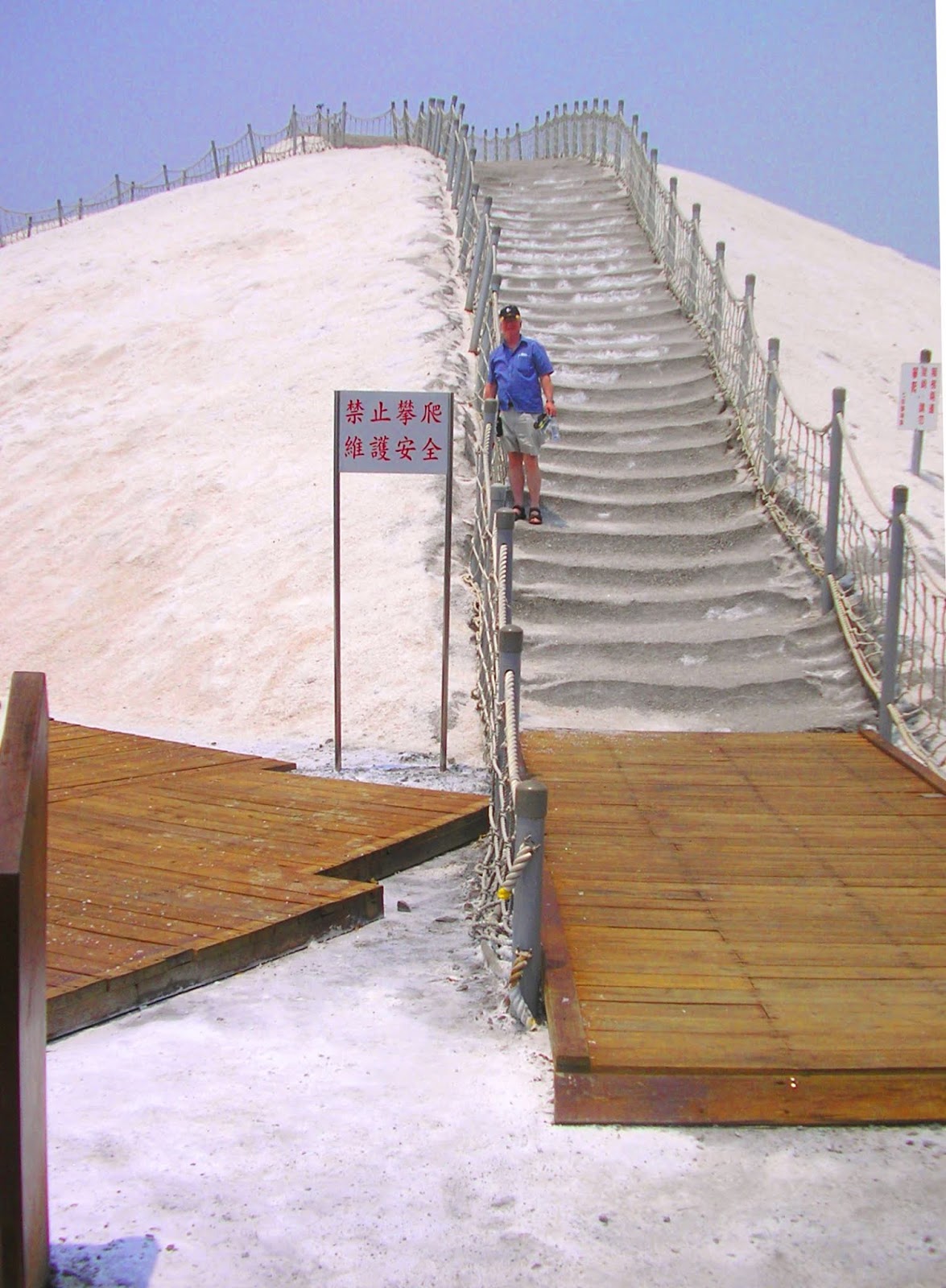
But the disappointment is even much bigger when I go through all the trouble and/or take many risks to reach somewhere off the beaten path. For example, to get to the Chigu Salt Mountain in Tainan City, Taiwan, we had to ride the expensive but fast bullet train from Taipei in the north and then take the only bus, where the driver, conductor, and passengers didn’t speak any English, to the outskirts of Tainan. This same bus went back only once, late in the afternoon.

Comments on its website like this more than express our disappointment: “Honestly! I had to spend 1 hour and 10 minutes on the bus to get there! And the last bus left at 18:10! What for? for a mountain of "salt" black of air pollution...nothing very amazing there! “

Finding a Saving Grace

We didn't want to wait four more hours for that one bus, so we called for a taxi. The driver, noticing we were hungry (the museum only had coffee), stopped, got out, took something out of the trunk, and gave us the most wonderful cookies we have ever tasted. Had we not gone to the Salt Mountain, we would not have met this extraordinary man! In Brussels, Bill’s saving grace was Belgian beer; mine, Belgian chocolates, and ours, waffles.

The question is not whether I would prefer to go on or off the beaten path. I will keep on doing both and you should, too. It doesn't matter how much expense or preparation we need to get to either. We can never guarantee anything in life. What matters most is to always have the right attitude when we get there. Then you may feel a sense of accomplishment, amazement, or a saving grace.

 
Bill climbing the Salt Mountain

PREVIOUS POST
Family Fun at a Farmhouse in Temecula Wine Valley

FOR MOBILES, click "View Web Version at the end of the post past comments and share buttons will appear.


Tuesday, January 2, 2024

Lessons from the Road: It’s All About Attitude


This article was published first in Travel Awaits on Oct. 13, 2019. It was republished in this blog on March 26, 2021. I have updated it today. 

 
Franklin D. Roosevelt once said: “I think we consider too much the good luck of the early bird and not enough the bad luck of the early worm.” Yes, unfortunately, luck has two sides to it. For travelers who put themselves in foreign or new lands and in the middle of many unfamiliar activities, luck comes into play many more times than normal. Sometimes a travel day turns out good. Sometimes it turns out bad. How do we navigate such differing situations?

You Can’t Control Everything

One of the worst days of our life happened in 2018. My husband and I were at Washington Dulles International Airport in Washington DC to board a flight bound for London where we were to catch a connecting flight to Ljubljana, Slovenia. Our tickets had been bought at the unbelievably discounted price of US$250 per person but we ended up paying more than ten times that, even after the refund.

While we were en route from Phoenix, our airline Primera declared bankruptcy. All its flights were immediately canceled. Understandably, I was terribly upset. And you don’t want to be near me when I am! But my husband said, “It’s just money.” When we arrived in London, he immediately looked for an English pub at the airport. The Scottish/Irish fellow delighted in a classic English breakfast he had been missing. Clearly, he had already put everything behind him.

Don’t Be Stymied. Go Ahead with Your Travel Plans

Without hesitation, we went ahead with our travel plans because the Slovenia trip could not be postponed. It was dependent on the schedule of our two hosts whom we met on the road in the Philippines a few years earlier. In fact, we hosted them in the US two years later.

The apartments they had reserved for us were fully booked before and after our visit. Our room at her B&B was at the foot of the Ljubljana Castle, in front of the huge daily farmer’s market in Old Ljubljana. In Bled, his apartment was right on the famous lake with postcard scenes from the balcony. We couldn’t have asked for more. And it was a reunion of great friends. Our week in Slovenia was priceless, even if it cost us $3,000.

Be Easy on Yourself: You Are Allowed to Make Mistakes

From our base in Innsbruck the following week, we wanted to explore more of Austria. We decided to take the four-hour train ride to Vienna, stay overnight, then stop at Salzburg, midway on the way back, the next day. At the Hauptbahnhof, I got a brochure from the ticket counters while Bill bought a bottle of water at the store. Mixed signals gave us almost zero time left when we finally found each other again. That’s how we got on the wrong train, the one going in the other direction. Instead of Vienna, we found ourselves in Munich.

In short, we got to Vienna mid-afternoon instead of before lunch as we had planned.  I was so stressed. And you don’t want to be near me when I am! Dear husband said, “Charge it to experience; we’re allowed to make mistakes.” We made it to St. Stephen’s Cathedral, the Mozart House, the Opera House, Karlskirche, the Hofburg Palace, and the Museum Quartier, missing only Schonbrunn Palace from our Vienna bucket list.

But we had to “run” from place to place. It was great that they were so close to each other. We even ended the day with dinner complete with sacher torte at a Viennese Coffee House. We preferred to go to the Hotel Sacher for the original but, as luck would have it, they have an outlet in Innsbruck, CafĂ© Sacher. 

There Are Many Good People on the Road

Our next base was Oberstaufen, Germany. This is where bad luck started to turn into good luck. After one of our long day trips, we missed the shuttle bus back to our resort. Tired and hungry, I must have looked so desperate when I found out the next one was an hour away. And you should not be near me when my tummy grumbles!

Without being asked, a German couple, who were also waiting at the station, rounded each of the stops, reading each poster (all of them were in German), and looking for an available alternative for us. They didn’t find any, but it didn’t matter. With the gesture, I totally forgot I was hungry.

The following day, we decided to look at Hotel Ludwig with its two rows of unique windows in Steibus, a village close to Oberstaufen.  It turned out that the couple we met were staying at their vacation condo right in front of the RV campground we found next to the Hotel. They invited us in for drinks.

The interesting thing was the man spoke very little English and my husband spoke very little German, so the wives were gesticulating a lot. Before we parted, they extended us an invitation to visit them at their home in Uberlinger, Germany.

The day before we left for France, we found the chance. At their deck overlooking the legendary Bodensee Lake, we enjoyed a typical German lunch. Then we toured the resort city which was hardly touched during WWII because of treaties. An hour of hunger was such a small price to pay for this GOOD LUCK in capital letters.

Let the Good Times Roll

“When it rains, it pours” had turned into “Let the good times roll.”  Bad luck turns into good luck, sometimes as quickly as it comes. And when our hearts fill with gratitude for the good luck, more of it happens!

In Paris, France we were even gifted with a fabulous upgrade from a studio to a one-bedroom apartment. For one romantic week, this elegant Parisian home was the base for many of our day trips to the highlights of Paris. In Brussels the following week, we didn’t expect to add another level to our travel experiences. I was always just for sightseeing. But in this Belgian capital, I turned into a food tripper: beef carbonnade, moules frites, fondues, waffles, chocolates, and beer.

What matters most, and what we can control, is how we react to others, things, and situations.  When bad luck strikes, we should quickly pick up the lesson and move on. And when good luck happens, we should give free rein to express our gratitude. It also helps to travel with people who remain positive. As you can see, I am blessed to have the best traveling companion...and husband.

PREVIOUS POST

5 Things I Lost and 5 I Gained When I Retired


Tuesday, May 9, 2023

TRAVEL AWAITS: 7 Delicious Dishes That Taste Better In Their Native Country


The original article was published in TravelAwaits on Sept. 25, 2022.

Travel usually means marveling at spectacular sceneries. But many of us stepped up to a new level in our journeys when we noticed how food tastes so much better in its country of origin. That they are is quite understandable because outside, the exact ingredients may not be readily available, or the recipes have been modified to cater to local tastes. So, for those who truly love good food—we don’t have to be gourmets or the next Anthony Bourdain—we have to travel to taste the real thing.

Hainanese Chicken Rice

Singapore and Malaysia


This is one of my all-time favorite dishes. I discovered it in Singapore at Hyatt Regency Hotel (now Grand Hyatt Singapore) in the early 1990s, when I was still traveling the world for corporate work. Reports are that the hotel chefs have perfected the recipe over the past thirty years and that it is where they now have the best Hainanese Chicken Rice in the world.

Originating from Hainan in southern China, immigrants brought the dish with them wherever they eventually settled. So the dish is also widely available, for just a song, in hawkers’ centers. In fact, it has become Singapore’s unofficial national dish and Malaysia has also adopted it as a culinary staple.

It’s full of flavor and healthy, especially when served with sliced cucumbers and steamed bok choy. I have a poor man’s version, remaining true to three key secrets: poaching the chicken slowly at low temperature, cooking the rice with the poaching broth, and using the poaching broth as the base for the three sauces (garlicky, sweetened soy, and spicy).

Pro-Tip: The KL International Airport 2 has a branch of the well-known Malaysian chain “The Chicken Rice Shop” that is built around the dish. Don’t miss it on a layover!

Spanish Paella con Chorizo

Spain 


On a week in the Andalusian region of Spain, we took day trips to the historic Alhambra and Generalife in Granada and the Plaza de Espana, the Alcazar, and the Catedral in Seville. But we were based in Malaga right on the beautiful Costa del Sol, relishing the beach and the sun, and building fancy sandcastles for hours.

Every waterfront restaurant was peddling its version of the world-famous Spanish Paella. My husband fell in love with the dish, so I had to learn how to make it! I discovered that the secret ingredients are: 1) Spanish chorizo sausage, 2) expensive authentic saffron, and 3) special short-grain rice. They were cooking them in plain view. I saw that the chorizo slices were first fried to release its savory oil which is then used to cook the rice together with the sauteed garlic, onions, tomatoes, and bell pepper. Lastly, chicken or seafood previously fried with the same oil is used to decorate the top. I have found a special kiosk to buy good Spanish chorizos in Phoenix, use either cheaper imitation saffron or substitute with turmeric, and source the rice (paella, arborio or sushi) from the grocery. Bless my husband. Even if what I make is passable and not the real thing, he loves it.

Pro-Tip: Never use another type of chorizo, especially not the Mexican version. Mexican cuisine is very different from Spanish.

Desserts with Just a Hint of Sweetness

Slovenia


We hosted two friends we met in the island of Palawan in the Philippines in the US and they returned the favor by hostingd us in Slovenia. Our girlfriend’s family owned an Airbnb property at the foot of the castle in the Old Town of the capital Ljubljana. The National Slovenian Cuisine Restaurant was a tenant on the ground floor; we stayed in a unit on the upper floor. At a dinner she hosted there, we had Slovenian sausages paired with special buckeye wheat dumplings. But what we loved best was the prekmurska gibanica,  a layered pastry filled with poppy seeds, cottage cheese, walnuts, apples, and cream. It had just the hint of sweetness we needed. This dessert experience was repeated in beautiful Lake Bled where our other friend had a waterfront condo unit where we stayed. He was also proud of kremna rezina, the famous Bled cream cake, another such kind of pastry.

The secret to Slovenian cuisine is that very little sugar or salt is added. They depend on the natural sweetness or salinity of the ingredients. In fact, every Slovenian house has a small garden where they plant their favorite vegetables and fruits. Water comes from crystalline sources, aplenty in the green country.

Pro-Tip: Usually, dishes have no names at authentic restaurants. Instead, menus list all the ingredients used in a dish.

Vegetable Tempura

Japan


My husband and I are in our 70s, and we have committed to eating as healthy as possible; vegetables are now center stage for us. It is generally believed that Japanese cuisine is one of the reasons for long lives in Japan. Thus, we try to serve delicious and healthy Japanese dishes at home, also a good way to reminisce about the awesome places we have visited in the beautiful country.

One of my favorites is tempura. I always order it at Japanese restaurants because it has this light and soft breading that’s difficult to replicate. The dish usually consists of seafood, meat, and vegetables that have been coated and deep-fried to perfection. It was introduced by the Portuguese (who had settled in Nagasaki and introduced their fritter-cooking technique of the 16th century). The name comes from the Latin phrase quatuor anni tempora, historically the Ember Days, when no meat is supposed to be consumed. Thus, tempura must really have originated as a vegetable dish. And that’s how I choose to make itfrom sweet potato, carrots, broccoli, eggplant, and onions. Here’s my humble version.

Pro-Tip: I can now make it at home, almost like the way they make it in Japan, with this tempura batter mix from Amazon because it is always out of stock at the grocery where I shop. Use the air-fryer for a healthier version!

The Belgian Waffle

Belgium


We were hugely impressed by the absolute grandeur of Grand Place (it was awesome to be among the glittering old buildings) and the Atomium was a spectacle to behold in Brussels, Belgium. But what struck us most was how food is celebrated on every corner with Belgian culinary specialties. Beer and chocolates can be easily packaged to reach our homes in their original distinct flavors.

But you have to celebrate Belgian waffles in Belgium. I am a waffles (instead of pancakes) girl; it has a better texture. But our waffle maker at home makes the traditional kind, much thinner. At first, we had a tough time deciding which waffle place to enter and which ones to order. But soon we learned to choose the least sinful. The waffle itself is a treasure, made with a yeasted batter that makes it extra light and fluffy yet crisp on the outside. Baking powder and/or baking soda have been used of late but it’s better the original way. Larger than regular waffles, they are made in a special iron with a deeper grid pattern and finished with crunchy sugar. Choose to load up with healthy toppings.

Pro-Tip: If you are in Belgium, don’t forget to sample moules-frites or fried mussels. I do not normally eat them, but this dish I do!

Cornish Pasty

England


When we are in England, my husband usually looks for Cornish pasties. I soon learned how different they are from meat pies. This British pastry was associated with the mining industry and Cornwall. It is made by placing an uncooked fillingof beef, potato, and the buttery vegetable swede (yellow turnip or rutabaga), seasoned with salt and pepperon one half of a flat pastry circle, folding the pastry in half, and crimping the curved edge to form a seal before baking. There are variations in Australia, the US, and elsewhere. Pasties are different from the meat pies from other cuisines and cultures like the Spanish empanadas, pirogis of Eastern Europe, Indian samosas, etc.  They are much larger and has more veggies. 

Pro-Tip: The West Cornwall Pasty Company is the UK’s largest pasty maker and is #51 of the UK’s top 100 Companies. Their pasties are available in UK groceries and cafes. 

Dim Sim

Australia 


My daughter’s first home was just a ten-minute walk to the South Melbourne Market, whose Food Hall delighted me no end. I was there at least once a week, food items like Hot Jam doughnuts. But I also loved the famous Australian dim sim, a snack that dates from 1928. Like dim sum, it’s also a Chinese-inspired dumpling-style snack food. Popularized by a Chinese immigrant in Melbourne, it consists of minced meat, cabbage, and seasoning encased in a rectangular wrapper. It’s very much larger than the traditional dim sum but also served deep-fried or steamed and dipped in soy sauce.  I have not seen them outside Melbourne so this one, you may have to go there to taste it! 

Pro-Tip: The South Melbourne Market is the birthplace of the even larger circular version, commonly known as the "South Melbourne Dim Sim.”

FOR THOSE ON MOBILE, THE SHARE BUTTONS APPEAR WHEN YOU CLICK WEB VERSION AT THE VERY END AFTER COMMENTS.

PREVIOUS POST

My 6 Favorite Islands to Visit in the World

Thursday, January 17, 2019

You Must Travel to Discover Great Food

"20 Best Examples from our Recent European Tour"


During our all-inclusive three-month stay in El Cid Resorts of Mazatlan, Mexico with its ten restaurants in four hotels featuring Mexican, Argentinian, Italian, Japanese, and International food, I cannot help but think, feel, breathe food. I will write about this later but I had promised to write about Slovenian cuisine. In this post, I write not only about that but all the twenty-two best examples we discovered during our tour of five European countries last October 2018.

Slovenia

Katrina treats us to a great Slovenian dinner
We were so lucky our friend’s mother owns the national Slovenian cuisine restaurant in Old Town Ljubljana. Katrina treated us to dinner there. That’s when we found out about the secrets to Slovenian cuisine: all natural ingredients. In fact, very little sugar or salt is added because natural sugars and salts are used to flavor dishes. In fact, all Slovenian households have small gardens in their lots where they plant their favorite vegetables and even fruit trees. In addition, water is so naturally good because crystalline water sources abound in the very green countryside. One thing to note, usually, dishes have no names. Menus list all the ingredients used instead.

Slovenian meat dishes and sides


kremna rezina
During the dinner, Bill especially liked Slovenian sausages paired with those special buckeye wheat dumplings. But it is the cake called prekmurska gibanica that stole my heart. It is a layered pastry cake with fillings including poppy seeds, cottage cheese, walnuts, apples, and cream. It has just a hint of sweetness. This dessert experience was only topped by the kremna rezina which another friend Jure introduced to us when we visited him in Lake Bled. It is what every tourist looks for: a vanilla pie made out of vanilla custard, whipped cream, and two very thin puff pastry layers. If you are a lover of sweets, Slovenia is definitely the place for you!

Austria

dumplings in soup

As soon as we arrived in Innsbruck, we went to the grocery and found astringent persimmons in season. They were so soft, mushy and sweet! But the next day, I was downed by intestinal flu. I starved myself until I discovered the dumplings in soup one can buy from the rail bar as we were traveling on a train between Salzburg and Vienna. What a great comfort food! When we were in Salzburg, I found it again at a Viennese restaurant in Salzburg while Bill relished his wiener schnitzel. Before that, Bill relished the home-cooked apple strudel at the street market in front of the Mirabella Palace and Gardens where some scenes of the Sound of Music were filmed. And in Vienna, Bill had a sample of the famous sacher torte, of course!

apple strudel from the street market


Dieter and Ingga preparing to feed us
Germany

We were lucky to meet a couple, Dieter and Inga when we missed our bus at a station in Oberstaufen. They were so concerned and “adopted” us. The next day we happened to see them again when we were checking out the RV campground. We had drinks at their vacation home in the building just across the street. So they invited us to their maisonette in Uberlinger, two hours away, fronting Lake Bodensee. The liverwurst they served us, among all the sausages and cheeses Bill loved, was the mildest and best-tasting I have ever had. 

France

pannetone


French macarons
Our most wonderful discovery in France is a bread we found it in the street market near our apartment at Royal Vincennes Hotel in Vincennes, a Parisian suburb. I used to love fruit cake, then I took to the German stollen. Now, I am all for the Panetonne which is actually an Italian bread! But we also loved the French macarons my friend Yogi gifted us with some after our breakfast at Laduree. Bill and I each had great French twists to Eggs Benedict (headline photo). No wonder there are long lines at the Champs-Elyssee for both the breakfast AND the macarons!

Belgium

Belgian waffles

It is in Belgium, however, that we went all out for great food. That’s where we were greeted by displays of colorful Belgian waffles with all kinds of toppings. I also had a heyday with lots of premium chocolates, especially the dark ones of the Leonidas variety. Bill vouches for Belgian beer, too, especially the Duvel brand whose exclusive bar was right in front of the famous Maniekin Pis. A Visitor Center staff also advised us to have the best cheese fondue and beef raclette dinner at the restaurant of the same name. The, at one of the famous guild houses of the Grand Place of Belgium, we discovered the beef carbonnade, beef stewed in dark Belgian ale and the moules soup (instead of the more popular moules frites).

cheese fondue and beef raclette

From now on, I will pay attention to food during all our travels. It is a side of culture I had not focused on before. Now I am gung-ho about discovering great food. It just makes travel more satisfying, literally and figuratively!


Thursday, December 20, 2018

6 Things You Won't Forget about Brussels, A Cold but Cool City


We did not settle in Arizona because of the cold. So, when we found out that the weather forecast for Brussels would hover around the low 40s with light rain showers and some wind, we wanted to skip the city. If only our lodging voucher, train ticket, and flight back home were not nonrefundable, we probably would have! We thought It would be anticlimactic to go to this city of 2.1 million, after the high of romantic Paris. Little did we know, we would find six things in Brussels that will be hard to forget.
Mannekin Pis

A sense of the Comic and Independence

The location of our Hotels.com find was excellent. It was right at the edge of Old Town Brussels. Mannekin Pis, meaning "Lil' Piddler" in Dutch, a small bronze sculpture measuring 61 cm tall depicting a naked little boy urinating into a fountain's basin, was only two short blocks away. I photographed him from near and far. So were dozens of others crowding into the little plaza. The current statue is only a copy and it only dates from 1965 while the original, built in 1618/19, is at the City Museum. I thought, "What the fuss?" Nonetheless, they say it embodies the sense of comic and independence of the people. In fact, sculptures of a little girl and a little dog urinating have also appeared nearby. In addition, Tintin and the Smurfs which originated in Brussels are front and center at the Belgian Comic Strip Center.

Grand Place

Grand Place, daytime

Another two short blocks away in the opposite direction is the Grand Place or Groat Market. The central square of old Brussels is a glittering medieval square, surrounded on all sides by opulent guildhalls, the city's Town Hall, and the King's House now containing the City Museum and the Tourist Information Center. Considered one of the most beautiful squares in Europe, it is recognized as a UNESCO World Heritage Site. They say that the best time to be at Grand Place, measuring 68 by 110 meters, is in August when a carpet of flowers covers the entire ground. We went back at night when it turns Christmas-like with lights. We were so inspired we chose to have dinner at the Cave du Roi, the cellar of a guildhall dated 1698.

Belgian Food
@ Cave du Roi

And this started our love affair with Belgian food. Bill had Boef Carbonnade, Belgian beef stewed with Belgian brown ale, and I, Crème du Moule (mussels) Souppe (mussels are commonplace in Brussels; they even rhyme). All around the area, little shops displayed colorful tempting varieties of Belgian waffles, mouth-watering Belgian chocolate concoctions, and all kinds of fine-flavored Belgian beer, all three contributing to the city’s culinary fame.

Belgian waffles galore

fondue and raclette
Bill didn’t want to eat the richly topped waffles standing so we chose a restaurant that served them for breakfast one day. There are two kinds: the rectangular Belgian and the octagonal Liege. We both had the Belgian and I chose dark chocolate and Bill, strawberry and maple syrup, as toppings. I was frustrated because I know I can never reproduce the light and airy but crispy and crunchy waffles when I get back home. And the chocolates are yum! We chose the Leonidas variety. As for beer, Bill tried Duvel, the brand advised by our taxi driver.

But the highlight of our culinary tour of Brussels was another special dinner. We enjoyed a small beef fondue in Paris but we wanted the whole nine yards. The Tourist Information Center directed us to the La Fondue et La Raclette, only two blocks from our hotel. We found it closed, open only from 7-10:30 pm,d and require reservations. We asked the hotel to make them for us and we were given an 8pm slot. We arrived very hungry and quickly ordered Savoyard (cheese) Fondue and Le Boef Raclette. We must have devoured a pound of cheese that night. It was the best comfort food for a cold, cold night!
St. Michael Cathedral

St. Michael Cathedral

About four blocks away stands the Cathedral of St. Michael and St. Gudula, a Roman Catholic Church. What was different was that there was the young children’s choir practicing inside. The acoustics were awesome and the choir sounded divine.  The church was given cathedral status in 1962 and has since been the co-cathedral of the Archdiocese of Mechelen-Brussels. It is a beautiful house of worship upon a hill. There are so many others in Brussels. We just didn’t have the time.

European Parliament

Cinquantanerie Park in front of the European Commission

House of European History
The next day, even though it was again cold, damp, and windy, we ventured out and used the highly efficient and new subway system. I wanted to see the European Parliament, the directly elected parliamentary institution of the European Union. Together with the Council and the European Commission, it exercises the EU’s legislative function. Its 751 members comprise the second-largest democratic electorate in the world (after India). Although the European Parliament has three places of work – Brussels (Belgium), the city of Luxembourg (Luxembourg) and Strasbourg (France), Brussels is considered the capital of the EU.

Right after the subway exit, we found the Cinquantanerie Park, built to celebrate the 500 years of Belgium, in front of the European Commission. About three long blocks away, tucked in a quiet park, sits the European Parliament. In front of it is the House of European History, an ultra-modern six-floor museum with all the conveniences provided all visitors, free of charge. It described the history of Europe from its beginnings in the Greek, Roman and Ottoman times, to the industrialized and colonial ages, the revolutions that spawned the nation states, the world wars that tore the region apart, the resulting Cold War, and the beginnings of the Council of Europe. It ends with the current issues confronting the Union.  We spent a total of three hours there. We could have spent many more.

 Atomium

After the visit, we went to the other side of town to see the most unique building in the world, l’Atomium. It was originally built for the Brussels World Fair in 1958, but is now a museum, standing 102m tall. It has nine stainless steel spheres of 18 m diameter each, all connected. The design forms the shape of a unit cell of an iron crystal magnified 165 billion times. Tubes of 3 m diameter connect the spheres housing stairs, escalators, and a lift to allow access to the five habitable spheres which contain the exhibits. The top sphere is a restaurant with a panoramic city view.  It would have been nice to go inside, but there just wasn’t enough time!
the Aromium


We are so glad we didn’t skip Brussels! Despite the cold, the city is so very chic. It has the old and the modern, the comic and the sublime, the history of Europe all rolled into one, and a place where eating is sheer delight. Even as the bistro where I wanted to have foie gras was closed when I was ready for it, we found so many bottled ones for sale at the airport! Travel bloggers tell me that the fine things to remember about Brussels will become 7 when I experience its Christmas markets. A fine reason to go back!


pinnable image
pinnable image