Cruising Past Seventy: The Inner Journeys: Italy
Showing posts with label Italy. Show all posts

Tuesday, April 9, 2024

Would You Rather Go On or Off the Beaten Path?


We have found ourselves amid droves of tourists, all excited about having arrived at a destination like the Eiffel Tower, albeit as older lovers. We have found signs, followed them, and come upon six large charcoal ovens near Ely, Nevada. What gives you more satisfaction: on or off the beaten path? 

A Sense of Accomplishment

Either way, arriving at a destination always gives us a feeling of accomplishment. It is an achievement to have finally reached that place so many others rave about. We may have waited so long to save the dollars we needed to get there, sacrificing plenty. On the other hand, think of the risks we had to take to go off-the-beaten path: driving through a dirt road for miles to reach the Arctic Circle on Canada’s Yukon, suffering temperatures well below zero to catch the Northern Lights, or even climbing Mount Everest at the peril of death.

The Feeling of Amazement

More than this sense of accomplishment, we get the undeniable feeling of amazement when we reach a destination. When I got a glimpse of the Roman Colosseum, I marveled at the engineering feat built to today’s standards 2,000 years ago. At the Arctic Circle, I could not explain the feeling any better than with these words I have that capture the moment: “Sometimes you find yourself in the middle of nowhere. And sometimes in the middle of nowhere, you find yourself.”

The Feeling of Disappointment

Other times, however, I was forced to sigh,” What’s all the fuss about?” When I laid eyes upon the Manneken Pis in Brussels, Belgium, that tiny statue of a little boy taking a pee into a pond below, I was utterly disappointed; even more so when I found out later it was just a replica! But I didn’t say anything aloud. The huge throng was seriously engaged in taking masterpieces of a souvenir photo.

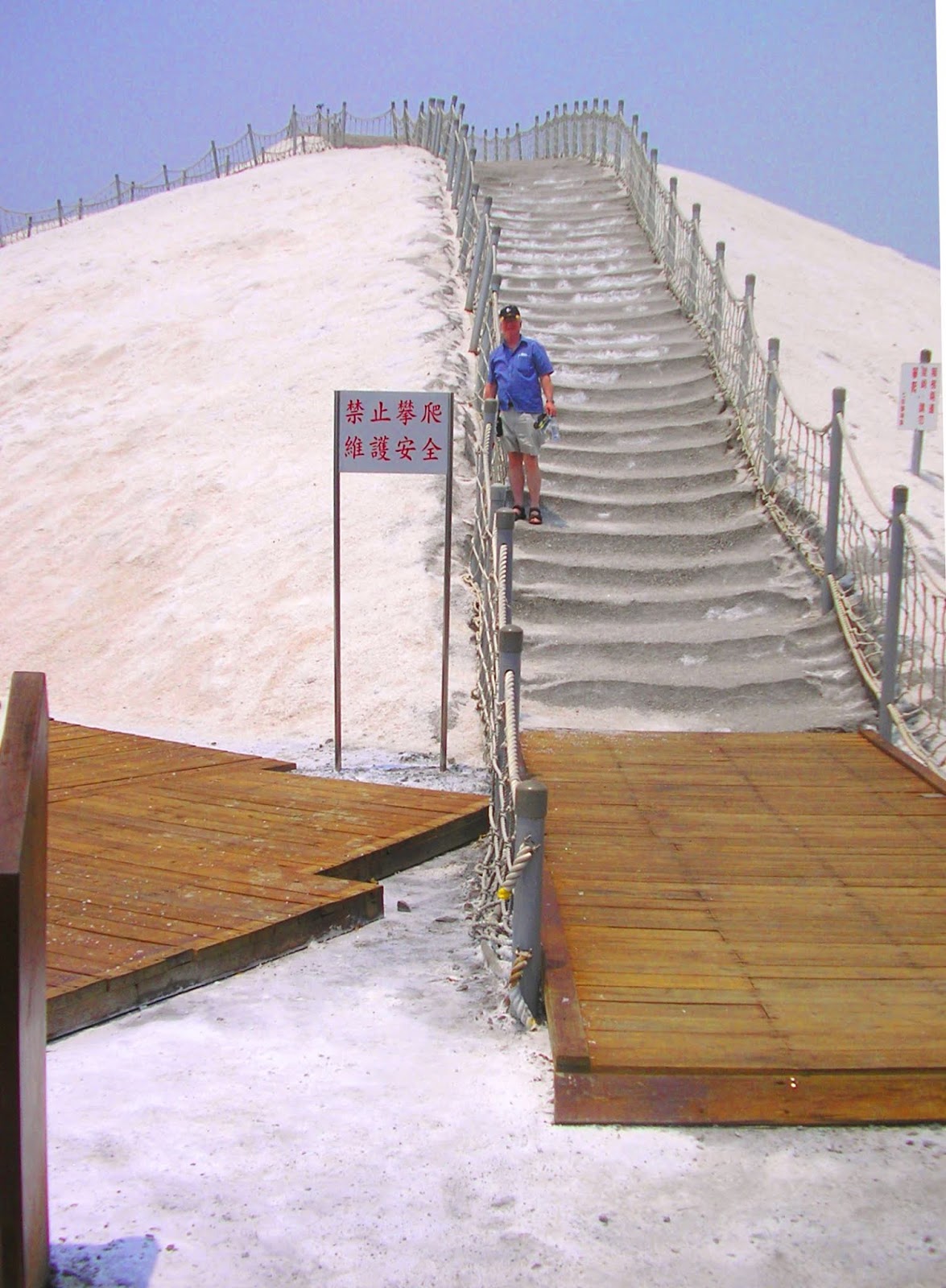
But the disappointment is even much bigger when I go through all the trouble and/or take many risks to reach somewhere off the beaten path. For example, to get to the Chigu Salt Mountain in Tainan City, Taiwan, we had to ride the expensive but fast bullet train from Taipei in the north and then take the only bus, where the driver, conductor, and passengers didn’t speak any English, to the outskirts of Tainan. This same bus went back only once, late in the afternoon.

Comments on its website like this more than express our disappointment: “Honestly! I had to spend 1 hour and 10 minutes on the bus to get there! And the last bus left at 18:10! What for? for a mountain of "salt" black of air pollution...nothing very amazing there! “

Finding a Saving Grace

We didn't want to wait four more hours for that one bus, so we called for a taxi. The driver, noticing we were hungry (the museum only had coffee), stopped, got out, took something out of the trunk, and gave us the most wonderful cookies we have ever tasted. Had we not gone to the Salt Mountain, we would not have met this extraordinary man! In Brussels, Bill’s saving grace was Belgian beer; mine, Belgian chocolates, and ours, waffles.

The question is not whether I would prefer to go on or off the beaten path. I will keep on doing both and you should, too. It doesn't matter how much expense or preparation we need to get to either. We can never guarantee anything in life. What matters most is to always have the right attitude when we get there. Then you may feel a sense of accomplishment, amazement, or a saving grace.

 
Bill climbing the Salt Mountain

PREVIOUS POST
Family Fun at a Farmhouse in Temecula Wine Valley

FOR MOBILES, click "View Web Version at the end of the post past comments and share buttons will appear.


Tuesday, April 11, 2023

TRAVEL AWAITS: Why Soriano Nel Cimino Is One Of My Favorite Places in Italy


The original article was published in Travel Awaits o Aug. 21, 2022

After a night in Sorrento and a day in Pompeii, we drove to Soriano Nel Cimino, our favorite base in Italy. As a small, picturesque charmer with lots of history, the town not only gave — and gives, as we have a timeshare space there — us the chance to experience Italian life but also to explore the province of Viterbo in Central Italy. It helps that our room is in an old castle! Furthermore, it allows us to revisit Rome and Florence in just one trip.

Soriano is one of my favorite places in Italy. Here are the reasons why.

1. It Is A Small, Idyllic Italian Town


Imagine a town overlooked by one of the highest peaks in the Monti Cimini range. Breathtaking! Down the valley, before dining at the excellent restaurants around (we found one where we had to return a second night), you can walk around the Fontana Vecchia (“Old Fountain”), built in the 15th century, and the Porta Romana, a replica of the Porta Pia in Rome. You will be surprised to find three lovely places of worship for its 8,000 residents: the small Romanesque Chiesa di San Giorgio, built in the 11th century; the Chiesa di Sant’Eutizio, built in the 15th century; and the Cathedral of San Nicola di Bari, built in the 18th century.


One afternoon we wanted to get the best vantage point for an iconic picture. When we found it, we realized we did not bring our tripod with us. Luckily, a sweet old man walked by. He spoke no English but understood our dilemma and gladly took our picture. We went on to peek at lovely Italian homes and gardens, found winding cobbled alleys on hills, and spotted one of the tiny sidewalk gas stations Italy is known for. The flowers about town reminded us that it was still spring, and the small fruit and vegetable shops, as well as the little grocers and bakers, gave us a good taste of life in Italy. We even discovered a small eatery (just four seats) behind one of the stores and loved their homemade meatballs and spaghetti. And, of course, a local gelato was easy to find afterward.

Pro Tip: It would be good to schedule your visit during Sagra delle Castagne, or the Chestnut Festival, that Soriano is known for. It runs from the end of September until the beginning of October.

2. It Has A Long And Eventful History


At the town’s highest point stands the Orsini Castle. Built by Orso Orsini in the 13th century, the castle was the summer residence of Pope Nicholas III, Orsini’s uncle. It became a high-security edifice until the 1990s, and today it is managed by the University of Viterbo as a tourist attraction.

After imagining the past splendor of Orsini Castle’s courtyard and great room, as well as visiting its dim prison cells, we navigated a small circular stone staircase fit for one. From the castle top, we saw the town’s history expanding outward.

Soriano nel Cimino’s history can be traced back to the Etruscans, a pre-Roman civilization first mentioned by the Roman historian Livy — who wrote that in 443 BC, the Etruscans were “easily defeated” by the invading Romans. The area, especially near the neighboring town of Bomarzo, is full of Etruscan inscriptions, tombs, and medieval ruins connected by trails in a 4-hour hike.

3. You Can Sleep In A Castle


We stayed in a castle called Palazzo Catalani, part of our timeshare network of 300 resorts worldwide. It’s a small 14th-century castle of marvelous architectural design and delightful decor that blend Renaissance style with Roman elements. To get there, we could walk up either of two winding cobbled pathways from parallel streets to the top of the small hill where the castle is located.

Our room was an astonishing studio with original murals, large antique furniture, and more period decor. It was conveniently located right beside the reception office and the well-appointed bar. We even had a small kitchen where we prepared breakfast in the mornings and cocktail food some nights. (We had our first evening’s dinner at an a la carte restaurant serving delicious Italian specialties and other European dishes.) The sauna and heated pool soothed us in preparation for our night’s rest. But it was the excellent customer service from the highly experienced staff that we cherished most.

4. It Is A Great Base For Exploring Viterbo

Soriano is also a great base for exploring the province of Viterbo, which, being so close to Rome, is a great place to see the deep influence on Italian life the Roman Catholic Church has always had and will continue to have. Here are three fanciful old-world towns worth visiting — as well as the provincial capital, Viterbo, once a Papal Seat.

Civita


Civita di Bagnoregio is 75 miles north of Rome and 45 minutes from Soriano. Its striking position will amaze you: atop a small plateau of volcanic tuff overlooking the Tiber River valley. Its edges began to fall (and continue to fall) when a major earthquake happened at the end of the 17th century. As the pace of erosion quickened two centuries later, it became a spectacle of an island hill, leaving buildings on its edges to crumble.

Its population is now just 12 during winter (about 100 during summer), but it is so wonderful to explore because its relative isolation has left its non-edge architecture unaltered. In 2006, it was placed on the World Monuments Fund’s Watch List of the 100 World’s Most Endangered Sites.

Civita and Bagnoregio used to be parts of the same town until the bishop and the municipal government relocated to the village in the valley after the earthquake.

Montefiascone


Montefiascone lies around Lake Bolsena, a caldera (or large volcanic crater) that formed in the Vulsini Volcanic Complex. Fifty-nine miles north of Rome and 30 minutes from Soriano, the town has numerous camping sites and bed and breakfasts. But its crowning glory is the Montefiascone Cathedral, also known as the Basilica of Santa Margherita, which has the fourth largest dome in Italy, behind the Pantheon, St. Peter’s Basilica, and Florence’s Duomo. It really looked like the whole church was under the dome.

Caprarola


The third town we visited was Caprarola, just 31 miles northwest of Rome and 25 minutes from Soriano, also sitting in the Cimini range of volcanic hills. I wanted to see the massive pentagonal-shaped Villa Farnese (not to be confused with the Palazzo Farnese in Rome). The Rennaissance villa was planned in 1530 to be a fortress to protect Cardinal Alessandro Farnese, but construction was discontinued when he was elected Pope in 1534 as Paul III. His grandson commissioned the construction of an estate on the completed pentagonal base.

Villa Farnese dominates the entire town, and everything was rearranged so that the main road leads directly to it. Each room is filled with oversized murals, and I was happily surprised to find that the Philippines (identified as Philipina) was on the Asian map in the Room of World Map. The maps were painted in the 1570s and depict cartographers’ understanding of the Earth at the time.

Viterbo


The capital, Viterbo, lies 50 miles north of Rome and 20 minutes from Soriano. Its historic center is surrounded by medieval walls, still intact, with ancient gates as entrances. They were built during the 11th and 12th centuries. In the 14th century, Viterbo became a Papal Seat and part of the Papal States. In fact, four Popes were elected in Viterbo. But when a foreigner got elected, the townsfolk invaded the Papal Palace while the longest conclave in history was being held. Two Cardinals were arrested. After this incident, Popes began to avoid Viterbo, and the city fell to secondary importance.

5. Florence And Rome Are Easily Accessible

Saving the best for last. Because Soriano is just 8 miles from the A1 Motorway, right smack in the middle between Rome and Florence, it was convenient to visit the two must-see cities of Italy. Rome is just an hour away by train, and Florence is two hours away by car. While it’s always fun to see the Roman Forum, the Colosseum, Trevi Fountain, the Pantheon, the Vatican, and the Spanish Steps, there are still many piazzas and attractions to discover. And although we have been to Florence’s Accademia, the Duomo, Santa Croce, and the Leather School, we still have the Uffizi, Palazzo and Ponte Vecchio, wineries, and more to explore.

We hope to go back to Italy when we resume flying. We have missed our room in Palazzo Catalani, and there are always new things to discover in Viterbo. Besides, this is truly the best base from which to revisit Rome and Florence in one trip.

FOR THOSE ON MOBILE, THE SHARE BUTTONS APPEAR WHEN YOU CLICK WEB VERSION AT THE VERY END AFTER COMMENTS.

PREVIOUS POST

11 Fantastic Things in Scenic Seaside, Oregon

Thursday, July 5, 2018

MAKE YOUR ONCE-IN-A-LIFETIME DREAM LUXURY RETREAT A REALITY


Ever dreamed of a vacation that would give you a once-in-a-lifetime experience? For me, it would be a family reunion in a luxury dream house at a wildly extraordinary setting. We are an international family. My eldest daughter, her husband, and three children are in San Francisco; my second, her hubby, and three boys make Calgary their home; and my youngest, her husband, and a toddler-son have just migrated to Melbourne.  My husband and I live in Phoenix so when it gets too hot, I visit my daughters. On the other hand, when it gets too cold for them, they visit us.

Sometimes, when our schedules conflict we get together somewhere else in the world. Once we rented a 4 BR home in Calgary. Another time we spent in two 2 BR units at our Phoenix timeshare. Most recently, we booked four rooms at a Las Vegas Hotel. We like to step our reunions up a notch each time. This year, turning seventy, I am reminded of the average lifespan of an Asian-American female in America is eighty-nine. It’s absolutely time for an unforgettable upgrade.  

That’s when this link to twenty-one exclusive villas gave me a great idea.  I am sure my family would love a well-deserved holiday in one of these grand homes at the fabulous Lake Como in Italy. I have been to Italian vineyards, coastal towns, and culture hubs but not to the Italian Lakes District that stretches across Northern Italy in the Lombardy Region. I heard it is quite spendy so I previously thought it may be out of our league.

The most famous of the lakes is Lake Como which begins relatively flat at its southern end, becoming more mountainous as you head northwards into the Alpine foothills. Views are dramatic with some peaks towering slightly above the tree-line. It is one of the deepest lakes in Europe since its bottom is more than 660 feet below sea level. The absolutely charming town of Bellagio is at the intersection of the three branches of the upside-down Y that is the shape of the lake.

Bellagio at nighttime

Lake Como’s beauty has been loved since Roman times when Europe’s privileged few started setting up castles and villas. These are now the settings for films like Casino Royale, Star Wars, Julia & Julia, Ocean’s Twelve, and Man on Fire. Many of them are now owned by heads-of-state, wealthy businessmen, and celebrities like George Clooney, Brad Pitt, Helen Mirren, Woody Allen, and Donatella Versace.

Villa Oleandra, George Clooney's villa

In 2014, The Huffington Post called Lake Como the most beautiful lake in the world for its microclimate and environment with prestigious villas and villages. The poet Percy Bysshe Shelley wrote in 1818: "This lake exceeds anything I ever beheld in beauty, with the exception of the arbutus islands of Killarney. It is long and narrow, and has the appearance of a mighty river winding among the mountains and the forests." Indeed this is the extraordinary setting I have been looking for.

Bellagio at daytime

I imagine the whole family going up the funicular in Como, marveling at the spectacular view, going up to the beautiful mountain town of Brunate, and hiking over to the Volta Lighthouse for an even better view. The men will have a round of golf at the Monticello Golf Club, play tennis at the Villa D'Este, engage in other water sports or even rent boats to fish. My pilot husband can even fly a seaplane over the scenic lake. The women can take a leisurely walk on the 10km walkway on the west side, stopping for outstanding mountain vistas, fabulous lake views, and picturesque hillsides covered with elegant villas. I see us stopping at every little town to sample each gelateria we find (and every shop, of course).

Villa Carlotta

Old villas like the Carlotta in Tremezzo are must-sees with their views, sculptures, and artworks. They have admirable gardens that thrive in a climate that can even host tropical plants. But of all the twenty-one luxury retreat villas I looked at, Villa Bianca is ideal for my family. It is 60 minutes from the airport, a short drive to Bellagio, and a 3-minute walk to the local Catholic Church. Como, Lecco, Milano, and other resort towns are within an easy 90-minute drive or less. Superb location.

Villa Bianca

The formal dining table seats twelve so the three kiddos can just have their meals at the small table nearby. There is an ensuite master bedroom for my husband and me. Three other bedrooms with double beds would be perfect for the three couples, sharing three bathrooms with the three rooms equipped with twin beds for the grandkids, except for the two-year-old who'll sleep with Mom and Dad. There is a heated pool on the large terrace with fantastic views of the lake. We can also gather in the living room with a fireplace and a large satellite TV with Sensurround sound. Wifi is available throughout the house. There's a fitness room with a treadmill, ping pong, and billiards tables.

Surprisingly, it is affordable at five thousand dollars for 3 days and two nights.  This luxury retreat in Lake Como is only a couple of hundred dollars more than the regular increases we have convinced ourselves to pay each time we stepped up our reunions from the Calgary house to the two 2br timeshare condos in Phoenix, and then to the four Vegas hotel rooms. This time, however, the step up in quality would be huge. We will become an aristocratic family for once!

It was Mark Twain who said, “Twenty years from now you will be more disappointed by the things you didn’t do than by the things you did do.” I may not even have twenty years left in me. It is time. Whether you are a couple, classmates, officemate, friends, or a big family like us, it is time to make your dream come true. The luxury retreat you've been dreaming of is out there. Realizza i tuoi soani!

Note: Photos lifted out of Wikipedia and Wikitravel


Friday, August 25, 2017

4+ More Hidden Gems of Melbourne, on our 4th Deeper Look

Melbourne Museum, largest in the Southern Hemisphere
Bill and I were just going to sample more of the great cuisine available in Melbourne. But between lunch and dinner, we found more hidden gems in the city that you must include when you visit.


Little Italy

Little Italy is also referred to as the "Italian Precinct"(just like another area known as the Greek Precinct) where the city’s Italian community is centered. Victoria has the largest Italian-Australian population (around 200,000) and most of them in the suburbs of Carlton where the precinct occupies a number of blocks. Towards the center, on the corner of Lygon Street and Argyle Place, there is a small Italian-inspired plaza named Piazza Italia,  a joint project of Melbourne and its sister city, Milan, in Italy.
Little Italy on Lygon Street

And the large concentration of Italian restaurants is on Lygon Street. After going around and “analyzing menus, Bill and I chose the one where almost every seat was taken, Universal Italian Restaurant and ordered a combo of spaghetti and meatballs paired with red wine (a Shiraz) for just $13.99. For such a reasonable price (in Melbourne) we had a heck of a great Italian meal!

Carlton Gardens

The major landmark in the Carlton suburb, however, is the Gardens, a few blocks away. That is where Bill and I went after our hearty Italian meal. The Carlton Gardens is a World Heritage Site located to the north of the Central Business District whereas the Royal Botanic Gardens and King’s Domain are to the south. The 64-acre site contains the Royal Exhibition Building, Melbourne Museum and Imax Cinema, an award-winning children's playground, and tennis courts.

Carlton Gardens, Royal Exhibition Building,
children's playground, largest IMAX, and the first computer
The Melbourne Museum is the largest museum in the Southern Hemisphere. The post-modernist building is designed both as a single building and as a network of buildings. An IMAX Theatre with the world’s largest 3D-screen is part of the complex. Aligned with the Italianate Royal Exhibition Building next door, two long high sloping blades rise up from the central entrance opposite the north door of the Royal Exhibition Building. A larger blade-like roof, like its neighbor’s Florentine dome, is a landmark.

Melbourne Gaol

Also a few blocks away from the Carlton Gardens and Little Italy is the Old Melbourne Gaol on Russell Street. It consists of a bluestone building and courtyard and is located next to the old City Police Watch House and City Courts buildings. First constructed in 1839, it was a prison between 1842 and 1929, holding and executing Australia's most notorious criminals, 133 of them by hanging.
Old Melbourne Gaol

Though it was used briefly during World War II, it formally ceased operating as a prison in 1924; with parts of the jail being incorporated into the RMIT University, and the rest becoming a museum. Paranormal enthusiasts claim the museum is haunted, with claims of ghostly apparitions and unexplained voices near cells. At its completion, the prison occupied an entire city block and included exercise yards, a hospital in one of the yards, a chapel, bath house and staff accommodation.

Several blocks to the west of the Carlton Gardens stands the Queen Victoria Market. On the way to the market, we encountered several interesting places which I will mention here but not discuss at length since we did not stop at any one for a long time. We were in a hurry to get to the Winter Night Market for its opening and our dinner! There was another street full of graffiti and art, a Christmas store, a fish and reptiles store, and a public bath!
street art, Christmas store, fish, and reptiles store, and a public bath
Queen Victoria Market

With 17 acres, the Queen Victoria Market is the largest open air market in the Southern Hemisphere. It has been listed on the Victorian Heritage Register as the only surviving 19th century market in the Melbourne central business district and is on its way to being named a UNESCO World Heritage Site. The Eastern and Western Markets, both opened before the Queen Victoria Market, closed in the 1960s. Another two Victorian markets have survived, however: the inner suburban Prahran Market and the South Melbourne Market that is near April’s apartment.

Today, the Market is a major Melbourne tourist destination, offering a variety of fruit and vegetables, meat, poultry and seafood, gourmet and delicatessen foods as well as specialty delicacies. It also has a large non-food related market, selling a diverse range of clothing, shoes, jewelry and handmade arts and crafts. The doughnut van, known for its hot jam donuts, has become part of its tradition

Queen Victoria Market and the Winter Night Market, inside and out
On Wednesday evenings in summer, there is a night market which offers dining, bars, live entertainment and a variety of other stalls. Last June 7, a Winter Night Market opened (up to August 30) with “an exciting new lighting concept, quirky entertainers, live music, 30 global food traders, 50 specialty and design stalls, warm drinks, cold beers and raging open fires” all under one huge tent. 
Bill fell in love with the Sri Lankan chicken curry. I, on the other hand, could not resist ordering the porchetta. It is the Italian version of the Filipino Lechon and the Scottish hog roast!

It is at this night market where Bill and I chose to end our walking day with special fast food that titillated our palates. We began it with Italian food in Little Italy. Melbourne is truly a food lover's delight. 

Thursday, January 7, 2016

Our Lifestyle Adventures: The Best 22 Hours You Can Ever Have in Rome

the Apostles at St. Peter's Basilica


Our next destination should have been Malta, but trips there pass by Rome. What I did not notice was that the layover in Rome was 22 hours! When Jingjing pointed that out to me, we hurriedly booked a studio near the Vatican, again recommended by Marisella, so we could, at least, visit St. Peter’s Basilica. But what was supposed to be a non-event became my best 22 hours ever in the eternal city.

The Vatican

St. Anne's Chapel at the Vatican

Mass at the Vatican

We got to our studio at around 4 pm, and as soon as Marisella arrived, we hurried to the Vatican’s St. Anne’s Gate just two short blocks away. At the lovely small chapel there, Jingjing lighted candles for dear friends and family. A few more steps away, the massive pillars of The Colonnade greeted us, opening to the magnificent Vatican Square, the central fountain, and the historic buildings that surround it.

After numerous photos had been taken, we discovered there were no more lines into St. Peter’s Basilica. It seems that sundown is the best time to visit the Vatican! Just as the bells were chiming, we were inside and felt utmost glee as we found out that a concelebrated mass had just started in honor of a Bishop being installed. There must have been sixty priests officiating in various capacities, and a large choir sang such melodious Latin mass hymns. We felt very blessed.

And when we stepped out, the rows of empty chairs waiting for the usual Papal blessing the next day were already arranged and cordoned off. Lots more photos were taken while Marisella explained the significance of all the buildings around, including all the statues of the Apostles guarding the Square. She also showed us where the Pope descends to bless the faithful who visit him every Wednesday.

ready for the Papal Blessing next day


The Spanish Steps and Shopping

Bill and I were in Rome just last March, but we did not go to the Spanish Steps. So Marisella took us there for an obligatory photo. Unfortunately, the place was not as lively and decorated as we thought it would be. But Jingjing wanted to buy some clothes and luggage for the rest of our trip. So Marisella took us to the Remova store that was just closing. Three ladies pleading by the door must have been too difficult for them to turn down and Jingjing walked away with a much-wanted model.

Jingjing and I at the Spanish Steps


shopping at Via Coronari
Then Marisella hailed a cab and took us to Via Dei Coronari where she lives. Jingjing indeed was blessed as some shops were still open and she was able to buy some clothes. After taking photos at the massive entrance door to her apartment, we quickly proceeded to her favorite restaurant, the Osteria del Pregno, just a few steps away. As we sat down, Jingjing magnanimously announced it was her treat!

The Italian Meal that Tops all Meals

And this, for me, became the second highlight of our 22-hour layover. What unfolded during our couple of hours there was the best Italian meal I have ever had in my years of traveling. First of all, the bread was not just freshly baked, some were infused with olives, others with lots of herbs, and still others with lots of cheese. How I wished I could take them home! Then the three of us shared a large salad and pasta with fungi that tasted heavenly as appetizers.

Then came the piece de resistance for each of us. Jingjing loved her lamb chops, and I had the best Osso Bucco I 
have ever had. I could not believe it. Bill and I had it once, and I liked it. I tried to cook it once, and it 
with Prime Minister Mateo Renzi
was edible enough. But this was delicious, the beef shank just melting in your mouth. As if that was not sufficient, the tiramisu was out of this world, extra moist with traditional ladyfingers distinctly part of the concoction. Bill, who once tasted a tiramisu he can never forget, has always been disappointed with later versions he had tried. But I am sure he would drool over this one.

Marisella called for the chef/owner so we could have a photo with him and he proudly showed off his kitchen and a few of the creations they were making. But, do you think that was all? Heavens, no. Suddenly, Marisella noticed that right behind me at the next table was the Italian Prime Minister Mateo Renzi, having dinner with five other colleagues. And she ingeniously took a couple of shots of him and me!

After dinner, we passed by the beautiful Piazza Navona. Although 14 of my 22 hours in Rome were spent in our Vatican studio sleeping, Facebooking, settling in and preparing to go, chancing upon a mass inside St. Peter’s Basilica plus that fine Italian meal with the Italian Prime Minister made those hours the best I have ever had in Rome! What more could a little old lady ask? Nothing, except the wish that Bill was with m.! Thank you Marisella and Jingjing for this fabulous time in Rome. Ciao!

Piazza Navona


Wednesday, May 6, 2015

Our Lifestyle Adventures: Spending Time at our Home Base in Italy

the picturesque town of Soriano Nel Cimino, our Home Base in Italy
After a night in Sorrento and a day in Pompeii, we drove to Soriano Nel Cimino, which was our home base in Italy. It was from there we were able to tour the province of Viterbo in the Lazio region of central Italy in two days. On one of the other days, we took the train to Rome and on another drove the rental car to Florence. The picturesque town is built on a hill, overlooked by the highest peak in Monti Cimini.

the small spiral staircase could fit us!
At the highest point in Soriano stands the Orsini Castle. You can see the town’s history expanding outward from the castle.  Built by Orso Orsini in the 13th century, the castle was the summer residence of Pope Nicholas III, his uncle. Then it became a high-security castle until the 1990s and today, it is managed by the University of Viterbo as a tourist attraction. After visiting prison cells and imagining the past splendor of its courtyard and great room, we found a lovely view of the town and Mount Cimini from the top of the castle. It was accessible through a small circular stone staircase.

the small town square
a delicious Italian meal!
There are also two squares in town that come alive come late afternoon when people mingle and then fill the good Italian restaurants. We found one where we dined two nights in a row! Then we found another which featured an Etruscan underground! The small town even has three places of worship for its 8,000 residents. One is the small Romanesque church of San Giorgio built in the 11th century; the Church of Sant'Eutizio in the 15th century and the Cathedral of San Nicola di Bari in the 18th century. 

Etruscan underground dwellings
"bigger than usual" roadside gasoline station
One day Suzanne and her family went to Rome while Bill and I stayed behind for a walk about town. We went to the best point to take the iconic picture of the town. An old man who did not speak English took our picture! The walk also gave us a view of lovely Italian homes and gardens, colorful alleys, the unique sidewalk gas station Italy is known for, and flowers about the town that signaled it was still spring. It was so interesting to see the small fruit and vegetable shops, little grocers and bakeries. We even found a small eatery for simple spaghetti. And, of course, there was a place to get gelato. 

our bedroom
the path to our home
Now let me describe the hotel we stayed in called Palazzo Catalani. We had purchased a Diamond Resorts membership in March of 2014. The company boasts of a network of 300 resorts worldwide. The Palazzo was our first booking of one of those resorts. Palazzo Catalani is a 14th-century establishment of marvelous architectural design and delightful décor blending Renaissance style with Roman elements. It is accessible from two narrow streets by walking up winding cobbled pathways.

Bill and I were housed in an astonishing studio with original murals, large antique furniture, and other period decors. It was conveniently right beside the reception office and the well-appointed bar. Our studio even had a small kitchen where we prepared breakfast in the mornings and some cocktail food for a few nights. Suzanne and her family were in a one bedroom suite one floor above the gorgeous sitting room that looked out at Orsini Castle.

the Sitting Room
The resort had a glamorous à la carte restaurant that served delicious Italian specialties and European dishes. We relished our first evening’s dinner there. It was a little cold so we did not get a chance to enjoy the little garden. But Bill got to use the sauna and pool (and laundry). It is worth noting that it was our first experience at amazing customer service from the experienced staff.


the road to our home
We loved our room in Palazzo Catalani and the little town of Soriano Nel Cimino. It was just a little far removed from the bigger cities. But, as we did, you can still explore many of them from this base. And if you want the small Italian town feel, then this is the kind of place for you. Soriano is still unspoiled by mass tourism, has incredible beauty and charm and offers a taste of real Italian life. 
a home garden 

Wednesday, April 29, 2015

Our Lifestyle Adventures: Revisiting the Glory that Was Rome


the controversial statue of Pope John Paul II

From our base in Soriano Nel Cimino, Suzanne and her family and Bill and I took the bus to Orte (16 minutes) and then the train to Rome (1 hour 10 minutes). The bus was full of high school students going to school and the train was packed with people traveling to work in the city. Bill and I were flying to Spain the following day, so we had our luggage with us. Mine became my seat on the train from which I pondered about the birthplace of Western civilization. We quickly deposited our luggage at our hotel and walked to Rome’s historic center, a UNESCO World Heritage Site.

the Trajan Forum, beside the Roman Forum

Rome is the capital of Italy and with 2.9 million residents (4.3 million in the metropolitan area), the country's largest and most populated comune. Roman mythology dates the founding of the city to 753 BC. After the fall of the Empire and the beginning of the Middle Ages, Rome slowly fell under the political control of the Papacy until 1870. Almost all the popes focused on making it the world's cultural center, creating masterpieces throughout the city. Rome became the center of the Renaissance.

Basilica di Santa Matia Maggiore

Both Bill and I had been to Rome before when we focused on the glory of the Vatican. During this visit,  Suzanne led us to the Basilica di Santa Maria Maggiore. It is a Papal Major Basilica, only five blocks southwest of Stazione Termini where our hotel was located. It is within the Italian territory but is owned by the Holy See, one of only five that hold the title of "major basilica", like St. Peter's plus the title of "Papal Basilica." It is one of the traditional Seven Pilgrim Churches of Rome.

mosaic on triumphal arch


The fifth-century mosaics of the triumphal arch and nave are incredibly beautiful and feature one of the oldest representations of the Virgin Mary in Christian Late Antiquity. They became the definition of impressionistic art during the period, also providing a model for future depictions of the Blessed Mother. Six Popes and two Saints are buried in the Basilica: Pope Clement VIII, Pope Honorius III, Pope Clement IX, Saint Jerome, Pope Nicholas IV, Saint Pope Pius V, and Pope Sixtus V. 

where Caesar was publicly burned at the Roman Forum


Rome has the status of a global city, the 18th-most-visited city in the world, and the 3rd most visited in the European Union. One of the most visited attractions is the Roman Forum, a rectangular plaza between the Palatine and Capitoline Hills. For centuries, it was the venue for triumphal processions, public speeches, and criminal trials. In 44 BC, perhaps the most famous event ever to transpire there was Marc Antony's funeral oration for Caesar (immortalized in Shakespeare's famous play) and the public burning of Caesar's body. The Temple to the Deified Caesar was subsequently built on the site.

the grandeur of the Colosseum inside

Other important ancient government buildings surround the Forum; the Colosseum is just to the east. Built of concrete and stone, it is still the largest amphitheater in the world, one of the greatest works of architecture and engineering, built 2,000 years ago to today's standards! Construction was done in two decades, beginning in 72 AD under the Flavian Dynasty of  Vespasian, Titus, and Domitian. It is estimated that the Colosseum could hold between 50,000 and 80,000 spectators. It was used for gladiatorial contests and other public spectacles re-enacting dramas of Classical mythology. We saw a huge cross and people with crosses; the Colosseum will be the start of the Pope's annual "Way of the Cross" on Good Friday.

Arch of Constantine as seen from the Colosseum

Between the Colosseum and the Palatine Hill is the triumphal Arch of Constantine, erected by the Roman Senate to commemorate Constantine I's victory over Maxentius in 312. It spans the Via Triumphalis, the way taken by the emperors when they entered the city in triumph. To the west of the Forum are other Forums, like the Trajan Forum and the marketplace, and other important ancient buildings. The National Monument to Victor Emmanuel II occupies a site between the Piazza Venezia and the Capitoline Hill. It is a monument built in honor of the first king of a unified Italy, completed in 1925.

the Marketplace, part of the Trajan Forum


Of course, we had a hearty Italian lunch and threw in gelatos and pizzas for snacks, too, completing the whole splendid experience! At the end of a glorious day, Suzanne and her family took the train back to Soriano Nel Cimino. Bill and I walked back to our hotel, encountering the statue of Pope Paul II near the Spanish Steps and the Stazione Termini. A rainbow was shining over it, eclipsing the controversy of its being placed in a not so edifying place. We then relished our last Italian meal and rested for the night. It was all we could fit into a day, but it was a good peek at the glory that was Rome.

National Monument to Emmanuel