Cruising Past Seventy: The Inner Journeys: France
Showing posts with label France. Show all posts

Tuesday, April 9, 2024

Would You Rather Go On or Off the Beaten Path?


We have found ourselves amid droves of tourists, all excited about having arrived at a destination like the Eiffel Tower, albeit as older lovers. We have found signs, followed them, and come upon six large charcoal ovens near Ely, Nevada. What gives you more satisfaction: on or off the beaten path? 

A Sense of Accomplishment

Either way, arriving at a destination always gives us a feeling of accomplishment. It is an achievement to have finally reached that place so many others rave about. We may have waited so long to save the dollars we needed to get there, sacrificing plenty. On the other hand, think of the risks we had to take to go off-the-beaten path: driving through a dirt road for miles to reach the Arctic Circle on Canada’s Yukon, suffering temperatures well below zero to catch the Northern Lights, or even climbing Mount Everest at the peril of death.

The Feeling of Amazement

More than this sense of accomplishment, we get the undeniable feeling of amazement when we reach a destination. When I got a glimpse of the Roman Colosseum, I marveled at the engineering feat built to today’s standards 2,000 years ago. At the Arctic Circle, I could not explain the feeling any better than with these words I have that capture the moment: “Sometimes you find yourself in the middle of nowhere. And sometimes in the middle of nowhere, you find yourself.”

The Feeling of Disappointment

Other times, however, I was forced to sigh,” What’s all the fuss about?” When I laid eyes upon the Manneken Pis in Brussels, Belgium, that tiny statue of a little boy taking a pee into a pond below, I was utterly disappointed; even more so when I found out later it was just a replica! But I didn’t say anything aloud. The huge throng was seriously engaged in taking masterpieces of a souvenir photo.

But the disappointment is even much bigger when I go through all the trouble and/or take many risks to reach somewhere off the beaten path. For example, to get to the Chigu Salt Mountain in Tainan City, Taiwan, we had to ride the expensive but fast bullet train from Taipei in the north and then take the only bus, where the driver, conductor, and passengers didn’t speak any English, to the outskirts of Tainan. This same bus went back only once, late in the afternoon.

Comments on its website like this more than express our disappointment: “Honestly! I had to spend 1 hour and 10 minutes on the bus to get there! And the last bus left at 18:10! What for? for a mountain of "salt" black of air pollution...nothing very amazing there! “

Finding a Saving Grace

We didn't want to wait four more hours for that one bus, so we called for a taxi. The driver, noticing we were hungry (the museum only had coffee), stopped, got out, took something out of the trunk, and gave us the most wonderful cookies we have ever tasted. Had we not gone to the Salt Mountain, we would not have met this extraordinary man! In Brussels, Bill’s saving grace was Belgian beer; mine, Belgian chocolates, and ours, waffles.

The question is not whether I would prefer to go on or off the beaten path. I will keep on doing both and you should, too. It doesn't matter how much expense or preparation we need to get to either. We can never guarantee anything in life. What matters most is to always have the right attitude when we get there. Then you may feel a sense of accomplishment, amazement, or a saving grace.
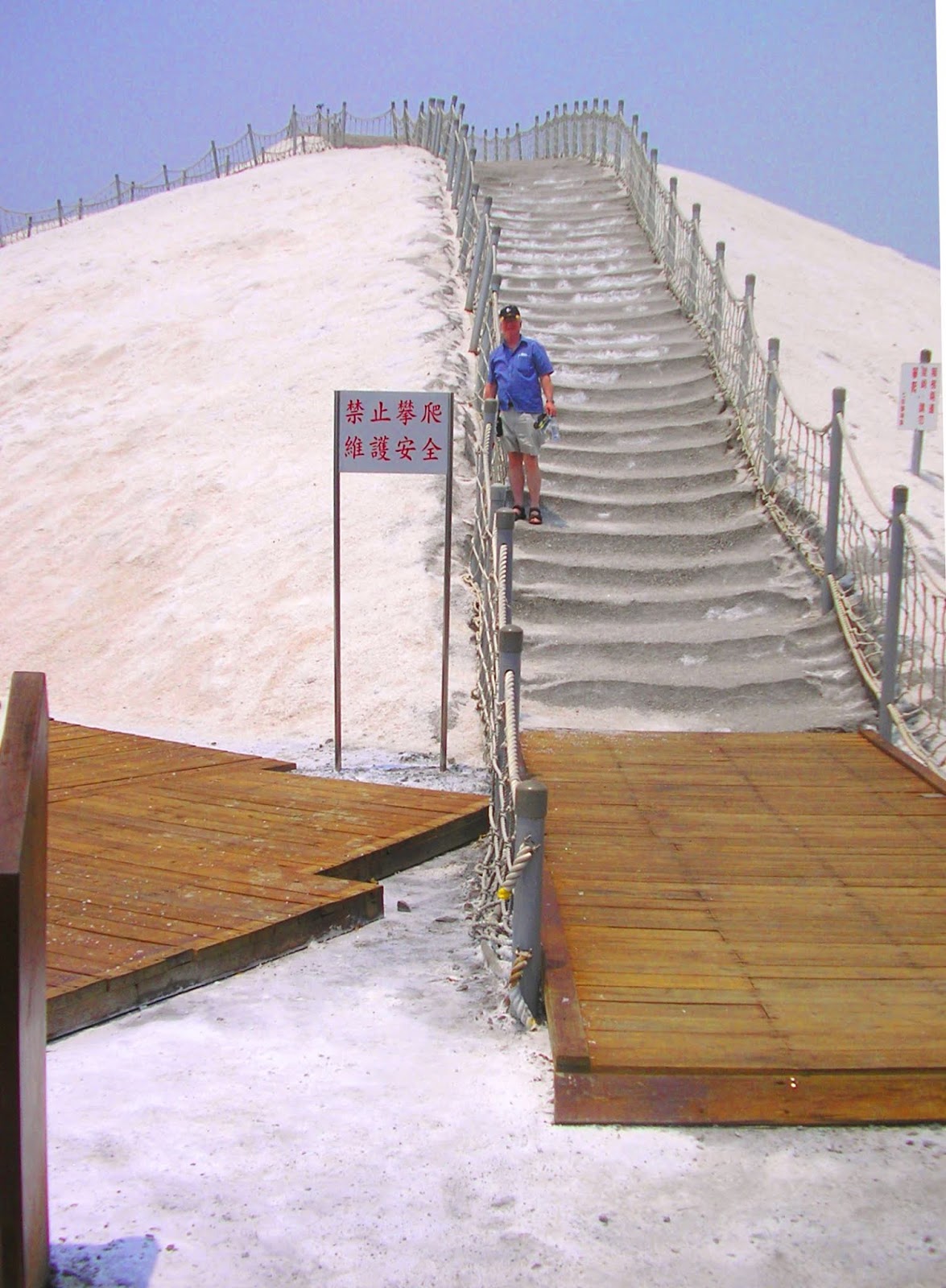
 
Bill climbing the Salt Mountain

PREVIOUS POST
Family Fun at a Farmhouse in Temecula Wine Valley

FOR MOBILES, click "View Web Version at the end of the post past comments and share buttons will appear.


Tuesday, January 2, 2024

Lessons from the Road: It’s All About Attitude


This article was published first in Travel Awaits on Oct. 13, 2019. It was republished in this blog on March 26, 2021. I have updated it today. 

 
Franklin D. Roosevelt once said: “I think we consider too much the good luck of the early bird and not enough the bad luck of the early worm.” Yes, unfortunately, luck has two sides to it. For travelers who put themselves in foreign or new lands and in the middle of many unfamiliar activities, luck comes into play many more times than normal. Sometimes a travel day turns out good. Sometimes it turns out bad. How do we navigate such differing situations?

You Can’t Control Everything

One of the worst days of our life happened in 2018. My husband and I were at Washington Dulles International Airport in Washington DC to board a flight bound for London where we were to catch a connecting flight to Ljubljana, Slovenia. Our tickets had been bought at the unbelievably discounted price of US$250 per person but we ended up paying more than ten times that, even after the refund.

While we were en route from Phoenix, our airline Primera declared bankruptcy. All its flights were immediately canceled. Understandably, I was terribly upset. And you don’t want to be near me when I am! But my husband said, “It’s just money.” When we arrived in London, he immediately looked for an English pub at the airport. The Scottish/Irish fellow delighted in a classic English breakfast he had been missing. Clearly, he had already put everything behind him.

Don’t Be Stymied. Go Ahead with Your Travel Plans

Without hesitation, we went ahead with our travel plans because the Slovenia trip could not be postponed. It was dependent on the schedule of our two hosts whom we met on the road in the Philippines a few years earlier. In fact, we hosted them in the US two years later.

The apartments they had reserved for us were fully booked before and after our visit. Our room at her B&B was at the foot of the Ljubljana Castle, in front of the huge daily farmer’s market in Old Ljubljana. In Bled, his apartment was right on the famous lake with postcard scenes from the balcony. We couldn’t have asked for more. And it was a reunion of great friends. Our week in Slovenia was priceless, even if it cost us $3,000.

Be Easy on Yourself: You Are Allowed to Make Mistakes

From our base in Innsbruck the following week, we wanted to explore more of Austria. We decided to take the four-hour train ride to Vienna, stay overnight, then stop at Salzburg, midway on the way back, the next day. At the Hauptbahnhof, I got a brochure from the ticket counters while Bill bought a bottle of water at the store. Mixed signals gave us almost zero time left when we finally found each other again. That’s how we got on the wrong train, the one going in the other direction. Instead of Vienna, we found ourselves in Munich.

In short, we got to Vienna mid-afternoon instead of before lunch as we had planned.  I was so stressed. And you don’t want to be near me when I am! Dear husband said, “Charge it to experience; we’re allowed to make mistakes.” We made it to St. Stephen’s Cathedral, the Mozart House, the Opera House, Karlskirche, the Hofburg Palace, and the Museum Quartier, missing only Schonbrunn Palace from our Vienna bucket list.

But we had to “run” from place to place. It was great that they were so close to each other. We even ended the day with dinner complete with sacher torte at a Viennese Coffee House. We preferred to go to the Hotel Sacher for the original but, as luck would have it, they have an outlet in Innsbruck, CafĂ© Sacher. 

There Are Many Good People on the Road

Our next base was Oberstaufen, Germany. This is where bad luck started to turn into good luck. After one of our long day trips, we missed the shuttle bus back to our resort. Tired and hungry, I must have looked so desperate when I found out the next one was an hour away. And you should not be near me when my tummy grumbles!

Without being asked, a German couple, who were also waiting at the station, rounded each of the stops, reading each poster (all of them were in German), and looking for an available alternative for us. They didn’t find any, but it didn’t matter. With the gesture, I totally forgot I was hungry.

The following day, we decided to look at Hotel Ludwig with its two rows of unique windows in Steibus, a village close to Oberstaufen.  It turned out that the couple we met were staying at their vacation condo right in front of the RV campground we found next to the Hotel. They invited us in for drinks.

The interesting thing was the man spoke very little English and my husband spoke very little German, so the wives were gesticulating a lot. Before we parted, they extended us an invitation to visit them at their home in Uberlinger, Germany.

The day before we left for France, we found the chance. At their deck overlooking the legendary Bodensee Lake, we enjoyed a typical German lunch. Then we toured the resort city which was hardly touched during WWII because of treaties. An hour of hunger was such a small price to pay for this GOOD LUCK in capital letters.

Let the Good Times Roll

“When it rains, it pours” had turned into “Let the good times roll.”  Bad luck turns into good luck, sometimes as quickly as it comes. And when our hearts fill with gratitude for the good luck, more of it happens!

In Paris, France we were even gifted with a fabulous upgrade from a studio to a one-bedroom apartment. For one romantic week, this elegant Parisian home was the base for many of our day trips to the highlights of Paris. In Brussels the following week, we didn’t expect to add another level to our travel experiences. I was always just for sightseeing. But in this Belgian capital, I turned into a food tripper: beef carbonnade, moules frites, fondues, waffles, chocolates, and beer.

What matters most, and what we can control, is how we react to others, things, and situations.  When bad luck strikes, we should quickly pick up the lesson and move on. And when good luck happens, we should give free rein to express our gratitude. It also helps to travel with people who remain positive. As you can see, I am blessed to have the best traveling companion...and husband.

PREVIOUS POST

5 Things I Lost and 5 I Gained When I Retired


Thursday, January 17, 2019

You Must Travel to Discover Great Food

"20 Best Examples from our Recent European Tour"


During our all-inclusive three-month stay in El Cid Resorts of Mazatlan, Mexico with its ten restaurants in four hotels featuring Mexican, Argentinian, Italian, Japanese, and International food, I cannot help but think, feel, breathe food. I will write about this later but I had promised to write about Slovenian cuisine. In this post, I write not only about that but all the twenty-two best examples we discovered during our tour of five European countries last October 2018.

Slovenia

Katrina treats us to a great Slovenian dinner
We were so lucky our friend’s mother owns the national Slovenian cuisine restaurant in Old Town Ljubljana. Katrina treated us to dinner there. That’s when we found out about the secrets to Slovenian cuisine: all natural ingredients. In fact, very little sugar or salt is added because natural sugars and salts are used to flavor dishes. In fact, all Slovenian households have small gardens in their lots where they plant their favorite vegetables and even fruit trees. In addition, water is so naturally good because crystalline water sources abound in the very green countryside. One thing to note, usually, dishes have no names. Menus list all the ingredients used instead.

Slovenian meat dishes and sides


kremna rezina
During the dinner, Bill especially liked Slovenian sausages paired with those special buckeye wheat dumplings. But it is the cake called prekmurska gibanica that stole my heart. It is a layered pastry cake with fillings including poppy seeds, cottage cheese, walnuts, apples, and cream. It has just a hint of sweetness. This dessert experience was only topped by the kremna rezina which another friend Jure introduced to us when we visited him in Lake Bled. It is what every tourist looks for: a vanilla pie made out of vanilla custard, whipped cream, and two very thin puff pastry layers. If you are a lover of sweets, Slovenia is definitely the place for you!

Austria

dumplings in soup

As soon as we arrived in Innsbruck, we went to the grocery and found astringent persimmons in season. They were so soft, mushy and sweet! But the next day, I was downed by intestinal flu. I starved myself until I discovered the dumplings in soup one can buy from the rail bar as we were traveling on a train between Salzburg and Vienna. What a great comfort food! When we were in Salzburg, I found it again at a Viennese restaurant in Salzburg while Bill relished his wiener schnitzel. Before that, Bill relished the home-cooked apple strudel at the street market in front of the Mirabella Palace and Gardens where some scenes of the Sound of Music were filmed. And in Vienna, Bill had a sample of the famous sacher torte, of course!

apple strudel from the street market


Dieter and Ingga preparing to feed us
Germany

We were lucky to meet a couple, Dieter and Inga when we missed our bus at a station in Oberstaufen. They were so concerned and “adopted” us. The next day we happened to see them again when we were checking out the RV campground. We had drinks at their vacation home in the building just across the street. So they invited us to their maisonette in Uberlinger, two hours away, fronting Lake Bodensee. The liverwurst they served us, among all the sausages and cheeses Bill loved, was the mildest and best-tasting I have ever had. 

France

pannetone


French macarons
Our most wonderful discovery in France is a bread we found it in the street market near our apartment at Royal Vincennes Hotel in Vincennes, a Parisian suburb. I used to love fruit cake, then I took to the German stollen. Now, I am all for the Panetonne which is actually an Italian bread! But we also loved the French macarons my friend Yogi gifted us with some after our breakfast at Laduree. Bill and I each had great French twists to Eggs Benedict (headline photo). No wonder there are long lines at the Champs-Elyssee for both the breakfast AND the macarons!

Belgium

Belgian waffles

It is in Belgium, however, that we went all out for great food. That’s where we were greeted by displays of colorful Belgian waffles with all kinds of toppings. I also had a heyday with lots of premium chocolates, especially the dark ones of the Leonidas variety. Bill vouches for Belgian beer, too, especially the Duvel brand whose exclusive bar was right in front of the famous Maniekin Pis. A Visitor Center staff also advised us to have the best cheese fondue and beef raclette dinner at the restaurant of the same name. The, at one of the famous guild houses of the Grand Place of Belgium, we discovered the beef carbonnade, beef stewed in dark Belgian ale and the moules soup (instead of the more popular moules frites).

cheese fondue and beef raclette

From now on, I will pay attention to food during all our travels. It is a side of culture I had not focused on before. Now I am gung-ho about discovering great food. It just makes travel more satisfying, literally and figuratively!


Thursday, December 13, 2018

Paris, Lovelier with Someone You Love Who Loves You, Too


I had been to Paris a long time ago. It was a business trip. I was alone. Everything I did was perfunctory.  And it was understandable. At the time, I had no love in my life, long been separated from my husband who had replaced me with a younger woman. I had been father and mother to my three children for many years until I migrated to America and met Bill. So when he told me he had not been to the City of Love, I was excited to show it to him. After celebrating our tenth anniversary in August this year, we included it on our month-long October vacation in Europe.

Arc de Triomphe
Champs Elysees and Arc de Triomphe

We started our week with a memorable eggs benedict breakfast, Parisian-style, and chaud chocolat at the landmark Laduree on the Champs-Elysees. My friend Yogi from our University of the Philippines Corps of Sponsor days met us there. She even gifted us with those famous French macaroons people line up for at this legendary French luxury bakery and sweets maker. Yogi, a crowned Binibining Pilipinas-International, still radiates beauty, especially because she makes Paris her home for six months a year. After breakfast, she took our photo at the nearby Arc de Triomphe, copied the world over as a symbol of military success (even if it was not). 

Sacre Coeur
Sacre Coeur 

Then she took us to Montmartre, the Hill of Martyrs, with a foggy, mysterious, and romantic view of the city. At the top of the hill stands the gleaming Sacre Coeur, both a political and cultural monument. It was built as a national penance for the defeat of France in the 1870 Franco-Prussian War and the socialist Paris Commune of 1871. After all, Montmartre has been known as the city’s most rebellious neighborhood. The Cathedral was publicly dedicated to the Sacred Heart of Jesus, an increasingly popular vision of a loving and sympathetic Christ.

Down Montmartre

Walking down the hill, she showed us the Artist’s Village, where painters were busy having breakfast, painting some scenes of gay Pareee, and selling their finished canvasses. At the foot of the hill, we wandered into the Moulin Rouge, the famous arisian cabaret, another world model for eventful nightlife. Hopping into the Metro once again, our last stop was at the Galleries Lafayette, the mammoth luxury department store whose domed roof and high floors are richly decorated and whose rooftop gave us our first view of the Eiffel Tower. Before parting, we had snacks at the Galleries’ Food Court.

Moulin Rouge

The Eiffel Tower
Eiffel Tower

Yogi taught us how to navigate the Metro and from that first day on, we ventured on our own. We spent a wonderful afternoon around the Eiffel Tower on the Champs de Mars, constructed as the entrance to the 1889 World's Fair. It has become one of the most recognizable structures in the world and the most-visited paid monument with more than 7 million people a year ascending it. The ticket to the summit was sold out and Bill convinced me to just walk around the 324-foot landmark from the Trocadero to the Peace Wall. Our photos will show you how much we loved this lovely afternoon, walking hand in hand and stopping for the Eiffel’s different angles for romantic poses to remember our union by.

The Louvre

The next morning was a visit to the Museum de Louvre which was originally built as the Louvre Castle in the late 12th to the 13th century under Philip II. When Louis X!V built the Palace of Versailles in the 17th century, he transferred the royal household there and the Louvre became the depository of the nation’s masterpieces. It would have been a massive undertaking to tour this, the world's largest art museum, and we opted to romanticize about the grounds and its distinctive modern entrance and its fountains instead. That in itself took so much time that we had to have a French brunch at a Brasserie in front of the Louvre immediately after.
Notre Dame


Notre Dame

Then we made our way to the Notre Dame de Paris, crossing the River Seine from its right to its left bank. The Cathedral is widely considered to be one of the finest examples of French Gothic architecture. The rib vault and the flying buttress, the beautiful rose windows, and the many sculptural decorations set it apart from earlier Romanesque architecture. Built in the 12th century and completed in the 13th, much of its religious décor was damaged during the French revolution but interest in the building was revived soon after Victor Hugo's novel The Hunchback of Notre Dame was published. It is now the most visited monument in Paris with 12 million eager to witness its beauty every year.

Around Notre Dame

Hotel de Ville

The day was so wonderfully romantic that we finished it with an early cheese and beef fondue dinner at the Latin Quarter. After this satisfying meal, we chanced upon an old and seemingly uncared for Cathedral of St. Servin with its unique buttresses behind the altar, yes, behind. Then we did some shopping for souvenir items, finding my now oft-used inexpensive but elegant red shawl. Before going home, we also passed by the Hotel de Ville. It is not a hotel. It is the richly decorated City Hall
Musee d'Orsay

Musee d’Orsay

We devoted an entire day to tour the famous Musee d’Orsay, romantically housed in the former Gare d'Orsay, a Beaux-Arts railway station built between 1898 and 1900. The museum holds mainly French art from 1848 to 1914, especially the largest collection of impressionist and post-Impressionist masterpieces in the world, by Monet, Manet, Degas, Renoir, CĂ©zanne, Seurat, Sisley, Gauguin, and Van Gogh. We spent hours there and could easily have spent even more time, alternately admiring the beautiful masterpieces and dreaming about how to launch my own journey to painting.

Les Invalides

Les Invalides

Then we walked to the Les Invalides, just to make sure we got a photo of the largest and most glittering dome in all of Paris. We saw a glimpse of it when we were walking around the Eiffel Tower. It is the roof over Napoleon’s tomb at the Musee de l’Armee, the military museum of France. It helped us complete our view of the history of France with this tribute to the general who was supposed to build the French empire. But we were not in the mood for touring another large museum, not on the same day.  

Le Mur de Je t’aime

Instead, we trooped to the Le Mur de Je t’aime, the Wall of I Love You, a 40 square meter wall in the Jehan Rictus garden square in Montmartre, Paris, France. It is composed of 612 tiles of enameled lava, on which the phrase 'I love you' is written 311 times in 250 languages. Of course, the Tagalog “Iniibig Kita” is there just like its English version, “I Love You”! We found out that the station Abesses on Line 12 is just between Sacre Coeur and the Moulin Rouge. We could have visited it on our first day with Yogi! But it completed our circle and neatly wrapped our Parisian gift box of romance.

the Love Wall

Vincennes

Royal Regency at Vincennes
Where we stayed contributed to all the good feelings we had in the city. We had been upgraded to a one-bedroom apartment at the Royal Regency in Vincennes, at the end of Line 1 of the Metro. It is part of our Diamond Resorts timeshare collection. It was about 350 square meters, including a patio, complete with a kitchen, a dining area, a living area, a bedroom, a bath suite, an enclosed toilet suite, and a foyer. Every Sunday, Tuesday, and Friday, there is a market around the city suburb’s own Hotel de Ville. The old Chateau de Vincennes is the city’s claim to fame. Around our neighborhood are a boulangerie, a U Express grocer, a pharmacie, an affiliate gym, and even an old cemetery.

We have never returned to any place we visited. With little time left on this earth, we always opt for a new place to visit except for Mazatlan which we have made a second home. But we want to return to Paris, maybe for another major Anniversary like our 15th  in 2023. And I bet it would be even lovelier the third time around!
pinnable image


Thursday, November 16, 2017

6 Gems in the Old-Fashioned Euro-Asian City of Vientiane, Laos


Pha That Luang, the Golden Stupa

chicken rice
My trip to the Philippines from Australia before going back to the US was dedicated to my friend Jingjing who was recovering from breast cancer. Her goal was to complete 65 countries when she turns 65 in January 2018. In 2015, we traveled together to 8 European countries in 14 days. This time, we scheduled 4 in 5 days in Asia! Two of them were layovers, the first one, overnight at the KL International Airport, Malaysia's main international airport, the world's 24th-busiest by total passenger traffic.

Two other friends, Ann and Tess, joined us. We booked at the Sama-Sama Express Hotel at the airport’s modern Transit Center. Each room was big enough for two, so conveniently located among the gates! The Center had all the shopping and food we wanted…durian products, other Malaysian goodies, and a branch of Chicken Rice, the chain of the Hainanese chicken rice fame, one of my and Jingjing’s favorite dishes. Who needs to go out into the city when you can get it right there at the Food Court?

 
Buddha Park


The next day we were in Vientiane, the capital and largest city of Laos. Actually, Jingjing wanted to go to Luang Prabang, the Laotian cultural capital. But I chose Vientiane because the name sounded classier! The capital since 1563, the city was the administrative center when the French ruled the country and is now Laos’ economic core with an estimated population of 760,000. Still spared from tourist industry commercialization, it lies between mountains and the low lands of Mekong River and is refreshing to visit with touches of both European and Asian cultures. We contracted a taxi driver to drive all four of us for a day.

Xieng Khuan

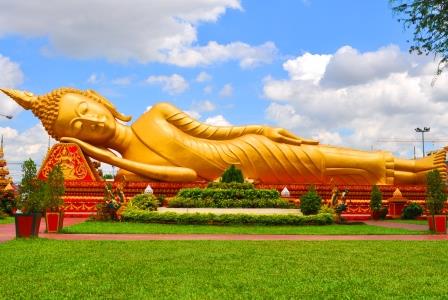
First stop was the Buddha Park (aka Xieng Khuan) with more than 200 religious statues including a huge over 131-feet high reclining Buddha, about 30 minutes from the city center. The best spot for photography was on top of the giant pumpkin, standing about three stories high, whose entrance is a demon’s mouth that leads to an internal stone ladder to the top with a bird's eye view of the Park.

In 1958, it was built by a monk who studied both Buddhism and Hinduism, the park has Buddha images, Hindu gods, and demons and animals from both beliefs. The most outstanding ones include Indra, the king of Hindu gods, riding a three-headed elephant, a four-armed deity sitting on a horse, and an artistic god with 12 faces and many hands. They are all impressive because of their size and interesting details. It was a great first stop.          

Pha That Luang
also found on the grounds of Pha That Luang
Patuxai

But it was the next stop that left us deeply amazed. Pha That Luang is beautiful to behold. A historic gold stupa, it is over 144 feet high with multiple levels, a walled enclosure, and a green grassy courtyard. This Great Stupa is the most sacred monument in the country. Every November, the Boun That Luang Festival, the most important Buddhist celebration, is held there with thousands of Laotians congregating there from all over the country.

Looking more like a fortress surrounded by high walls from the outside, Built by King Setthathirat in 1566 on the site of a 13th century Khmer ruin, it was greatly damaged during the Burmese, Chinese and Thai invasions in the 18th and 19th centuries but was restored by the French in 1900 and 1930. It features two temples with the main stupa’s top covered with gold leaf. The architecture is Lao in style, finely-gilded with red-lacquer doors, pointed lesser stupas, many Buddha, flower and animal images.

Patuxai

Our taxi driver brought us next to the Patuxai Victory Monument that is the centerpiece of Patuxai Park at the end of the capital’s grand avenue. The Park is a popular place to stroll around in the afternoons with the palm trees, lotus ponds, a musical fountain donated by China, and the peace gong given by Indonesia when Laos was named the world’s most peaceful country.

Wat Si Saket

Dedicated to the Laotians killed in the fight to gain independence from France, as well as from its earlier occupiers, Thailand and Japan, Patuxai is the best example of European influence, reminiscent of the Arc de Triomphe in Paris. But its exterior embellishments and interior decorations are of Laotian style. At the top, you will enjoy a panoramic view of Vientiane. Built between 1957 and 1968 using funds from the U.S. government, it features 4 arches, facing North, South, East, and West. The 5 towers symbolize the Buddhist principles of amiability, flexibility, honesty, honor, and prosperity.

Wat Si Saket

Near our hotel, we spent a lot of time at Wat Si Saket, famous for a cloister wall housing more than 6,800 tiny Buddha images and seated Buddhas that date from the 16th and 19th centuries. They come in all sizes and are made of wood, stone, and bronze. In beautiful Lao architecture, it is the country’s oldest Buddhist monastery, right across the Presidential Palace, with vast grounds filled with structures.

Wat Ho Phra Keo

Across the street and beside the Presidential Palace is Wat Ho Phra Keo, originally constructed in 1565 as the royal family’s personal chapel. It was the home of the Emerald Buddha after it was snatched from northern Thailand (reclaimed by the Thai in 1778 and now in Wat Phra Kaew in Bangkok). The temple is now a museum, richly adorned with a 16th century lacquered door with Hindu carvings. 

Wat Ho Phra Keo
Presidential Palace

The Presidential Palace was started in 1973 on the former royal grounds. Because of the takeover by the communist Pathet Lao in 1975, the building was not completed until it finally opened its doors in 1986 for government functions and ceremonies (the President resides elsewhere). Closed to the public, the beau arts-style architecture features tall colonnades and shaded balconies. Well-manicured lawns and gardens surround the palace, fenced off by tall walls and a wrought iron gate.

Presidential Palace

This is the 65th country Jingjing visited. To celebrate, we all heard mass at the Catholic place of worship in this Buddhist and Hindu nation. We also feasted at a 5-star hotel a few blocks from our cute Ibis Hotel. A Laotian dish, meat with lots of vegetables and fragrant herbs, caught our fancy because, just like Vietnamese cuisine, we relished its French influence. We were absolutely charmed by old-fashioned Euro-Asian Vientiane. But we still have to visit Luang Prabang!


Thursday, October 22, 2015

Our Lifestyle Adventures: How to Introduce Fragrance into your Honeymoon!

at the garden of the Musee d'Art d'Histoire de Provencal
The day before we were to leave Mougins, Bill and I decided to take the bus to the north, opposite of the bus to Cannes, to Grasse, just thirty minutes away.  We didn’t have time to visit the Fragonard Factory in Eze. We had so many other places to go, and the company’s current factories, museum and shops are in Grasse. The town bills itself as the Perfume Capital of the World. When we got there, we gushed, “What a great decision!”
wisteria blooms everywhere
Fragonard Museum
It is perfect for a honeymooning couple! The fragrance is not only exuded from pretty perfumery places but also from spring’s remaining flowers. We were too early for the Expo Rose in May and the Fete du Jasmin in August. And we were too late for the blooming of the yellow fields of mimosa. The town of 50,000 grows the flower, like Narcissus, broom, and lavender, for the perfume industry. Aromatic and medicinal plants like thyme, mother-of-thyme, savory, juniper and boxwood are grown for the cosmetics industry.

a captivating mural down the alleys of Old Town
New Town
After getting out of the bus, we walked to New Town where we saw a car rally getting ready at the town plaza in front of the Palais des Congres and the Hotel de Ville. Most of the village people had congregated there. There were yellow buildings galore, wisteria vines blooming, glistening olive trees, and dramatic plane trees. So as Bill became preoccupied with the varied and colorful rally cars, I was entranced by the colors and flowers around.

Old Town
Little did I know that the walk through the Old Town would mesmerize me more! Its winding cobbled streets are on the lowest level of town while New Town is higher (the bus station level is even higher). We lost ourselves in the many alleys that seemed to have all the colors in the world, sometimes even made brighter by the murals painted on the walls. A variety of shops, perfumeries, apparel boutiques and bake shops entertained us for an hour.Old Town

The Museums
We also found four museums. First, of course; is Internationale Musee du Parfum at the outskirts of New Town.  At the other side of the perimeter of Old town stands the Fragonard Museum which was conducting tours of its perfume-making process. Then we got entranced inside the Musee d’Art d’Histoire de Provence that displayed the rooms, furniture, dinnerware, etc. of a provencal home. The backyard garden was lovely with wisterias blooming from the balcony. Beside it was the Musee Provencal du Costume et du Bijou which displayed many types of provencal attires.
Musee Provencal du Costume
World War II Memorial
Cathedral and Crepe!
A little further down we chanced upon the Cathedral dedicated to Notre Dame du Puy. It dates back to the 11th century. Inside is a painting of Jean-Honore Fragonard, a French painter native of Grasse who was the inspiration for the name of the perfumery giant.  In front of the cathedral is the WWII memorial of Grasse. It was actually the third memorial we found around town. By this time our tummies needed some input. Wandering the cobbled streets of Old town, we found a crepe vendor among the shops!

Notre Dame du Puy

Indeed visiting this town was the fourth good decision we made in France. First was staying in Mougins, second spending a day in Cannes, and third hiring a driver and car for a custom tour of the French Riviera. Finding the time to visit Grasse gave our nth honeymoon its best ending. We got lost in the fragrant world of flowers and perfumes among the ancient cobbled streets, the bright yellow buildings, and the memorable monuments and memorials. C’est la bonne vie!

Thursday, October 8, 2015

Our Lifestyle Adventures: 6 Quick-Sees during a Brief Rendezvous with Nice

Beach Scenes in Nice
Besides Cannes, the two other destinations no one should miss on the French Riviera are Nice and Monaco. They are just 30 minutes away from each other but are worlds apart.  This article is about Nice where, after the four small towns I wrote about in my last post, we had late lunch.

Nisa La Belle, meaning Nice, the Beautiful, enjoys the mild Meditteranean climate, with the high 80s in summer and mid-50s in winter, and hardly any rainfall in spring or fall. Aristocrats from Britain have come to enjoy this weather since the 18th century. The city’s main coastal road is called the Promenade des Anglais, Walkway of the English. It is second only to Paris in terms of tourism and is the second largest city in the French Riviera, with a million in the urban area, just behind Marseille.

Coeurs Saleya
part of  Coeurs Saleya
The pizza place we chose for a light lunch had an entry rug that said “L’Americano Gusto Italiano.” What a welcome! But, since we were in Nice for just a little more than a couple of hours, we quickly finished our meal to get to as many sights as we could. Fortunately, the famous French flower market, Coeurs Saleya was just outside. No wonder it is famous; the flowers were either fragrant, colorful or both! 

Place du Palais
Palais de Justice on the Place du Palais
A few steps away stood the Place du Palais, often the site for concerts, films and major public events. The Palais de Justice is located there. On the steps of the buildings around the Place are youths hanging out.  Towards the other direction, we were led through an alley of colorful buildings to the Place Massena, Nice’s vast central square that lies between the Old and New Towns.

Place Massena
Fontaine du Soleil in Place Massena
The tramway runs through the center of the plaza but otherwise, the whole area is pedestrian-only. The old buildings around are painted in red and decorated with blue shutters. At one end are statues depicting Greek mythology with a 22-foot Neptune at the center. He overlooks the entire plaza and the Fontaine du Soleil (Fountain of the Sun), an excellent place to sit and engage in people-watching.
     
Esplanade Georges-Pompidou
Esplanade Georges Pompidou and the landmark sculpture
With just about an hour left of our time in Nice, we walked back towards the Promenade des Anglais and the beach, retracing our steps through the Coeurs Saleya and the Place du Palais. Just before reaching the Promenade, we walked through the Esplanade George-Pompidou. It is the square in front of the Centre Pompidou, the avant-garde building that houses the National Museum of Modern Art, library and music center of Nice. A modern landmark stands by the Promenade.

Plage Beau Rivage
Plage Beau Rivage
I don't have a name for this landmark. It is a large red monument and I have researched about it. I could not find what it is and how it is called. As soon as when we crossed the Promenade, we were facing the Meditteranean Sea. There we found the playful having fun and the famous blue beach umbrellas on the Plage Beau Rivage, one of many the beaches on the French Riviera. We had time for just sniffing the ocean breeze and taking a photo of each other.

Monuments Aux Morts
Monuments aux Morts
And then I made a mad dash to the souvenir shops around where we were going to meet our driver. After almost giving up, I found my go-to memento, a tank top that said I “heart” Nice. I was looking for one that said, ”I am a NICE girl!” That would have been apropos! I only ran out of time. Then, just as we were leaving the city, the driver pointed to a War Memorial dedicated to the 4,000 residents of the city who perished in World War I and others who died in later wars. That was our sixth quick-see of our brief rendezvous with Nice, the epitome of the French Riviera!