Cruising Past Seventy: The Inner Journeys: RV expenses
Showing posts with label RV expenses. Show all posts

Friday, November 6, 2020

A Handy Booklet on the Basics You Need to Know about RVing


When coronavirus hit the US, traveling by recreational vehicles (RVs) became a preferred mode of travel. It was not surprising since with RVs you can have more control over what happens on your trip. You can keep an RV as sanitized as you want and not let anyone inside except for those in your safe bubble. Depending on the places you choose to go, you can minimize your exposure to just filling up at a gas station. And that may be a small risk compared to the benefits of the open road, the great outdoors, and absolutely no unpacking.

You must have wanted to get started right away. And you must have been looking for a short, sweet, and simple source of information to help you do just that. Well, I hope I have come to the rescue. We RVed for eight years across North America and reached forty-nine American states, nine Canadian provinces, and six Mexican states.  Carolina: Cruising to an American Dream is the book I published in 2015 about the RV odyssey. This year, I have put together a little booklet that is meant to show you that there are an RV and a campground suited for the way you want to go. This little book comes in five easy-to-read short chapters: Cruising in an RV: the basics you need to know.


Chapter 1 outlines the three ways to RV:  escaping for short periods, making longer seasonal travels, and making it your home on wheels. We have done the second and third. Now that we are settled in a base, we can do the first. The chapter then goes to describe two general classifications of RVs: motorized, with A, B, C, and smaller models, and non-motorized that are either trailers or fifth-wheels. The chapter ends with recommendations on the RVs best suited for a particular way of RVing.


Chapter 2 lists the four types of campgrounds that arise based on two factors. The first is where it is located, whether it is near a city or is actually out there in more rural places. The second is whether a campground has a lot or few or even no amenities or activities. So I have listed the Nature Resort or Nature Park, those that are out there in the boondocks where a Resort means many amenities and Park means few or none. The other two types are City Resort or City Park, those that are in a city or just on the outskirts. We hope you make sure that the campground you choose is the right one for what you want to do.


In Chapter 3, I have outlined the different resources one can find around a locale. When we stayed long in a place, we found public, educational, or religious institutions as excellent resources for things we can borrow or activities we can tap into. There are also the commercial establishments that are unique to places outside city centers, places that have, in fact, become more popular during these times. And we had been amazed at the many things government and non-government organizations offer. Lastly, I have mapped out creative campground substitutes.


Chapter 4 compares the costs we experienced among the seasonal RV travel we had in the first eight months, living at our condo in Seattle, and making the RV our home. You would be surprised to find that the last one, full-time RVing, was the least costly. Imagine being able to visit all the beautiful places America has to offer and saving dollars at the same time!


And the last Chapter asserts the “Ten Commandments of Fulltime RVing.” These are the ten big recommendations we have put together for an RV life that is well spent and better managed. It goes from where to go to, how to go, how to buy, where to get services, how to take care of health, when and how to use technology, how to cut costs, and when and how to work or volunteer, etc. As a matter of fact, it adds two other tips that did not rise to the level of a commandment.

Even if you don’t RV or go but only part-time, you may find principles in these chapters that will be useful for any way you want to travel. If you are already RVing, gift this to a friend. Otherwise, it may inform your preparation and enrich your forthcoming RV trips. After you finish reading this booklet, you will know how to start RVing. And pretty soon you will be enjoying the open road, the great outdoors, and travel without having to unpack in the safety of your own “home

HOW TO BUY THIS BOOK (AND TWO OTHER BOOKS OF MINE) :


Middle: This ebook is now available for $0.99 and the paperback, $3.99. Just click Cruising in an RV. the basics you need to know 

Left:  My first book that is all about RVing is also still available on Amazon for $3.99.  Simply click Carolina: Cruising to an American Dream

Right: Another book is now available for preorder at $1.99.  Please click Cruising Past Seventy. It's Not Only about Outer Journeys. It's Also about Inner Ones

FOR THOSE ON MOBILE, SHARE BUTTONS APPEAR WHEN YOU CLICK WEB VERSION AT THE VERY END AFTER COMMENTS.

PREVIOUS POST

The Sequel to My First Travel Book is Now Available for Preorder 


CLICK THIS TO PIN THE IMAGE BELOW             


CLICK THIS TO PIN THE IMAGE BELOW


Thursday, January 31, 2019

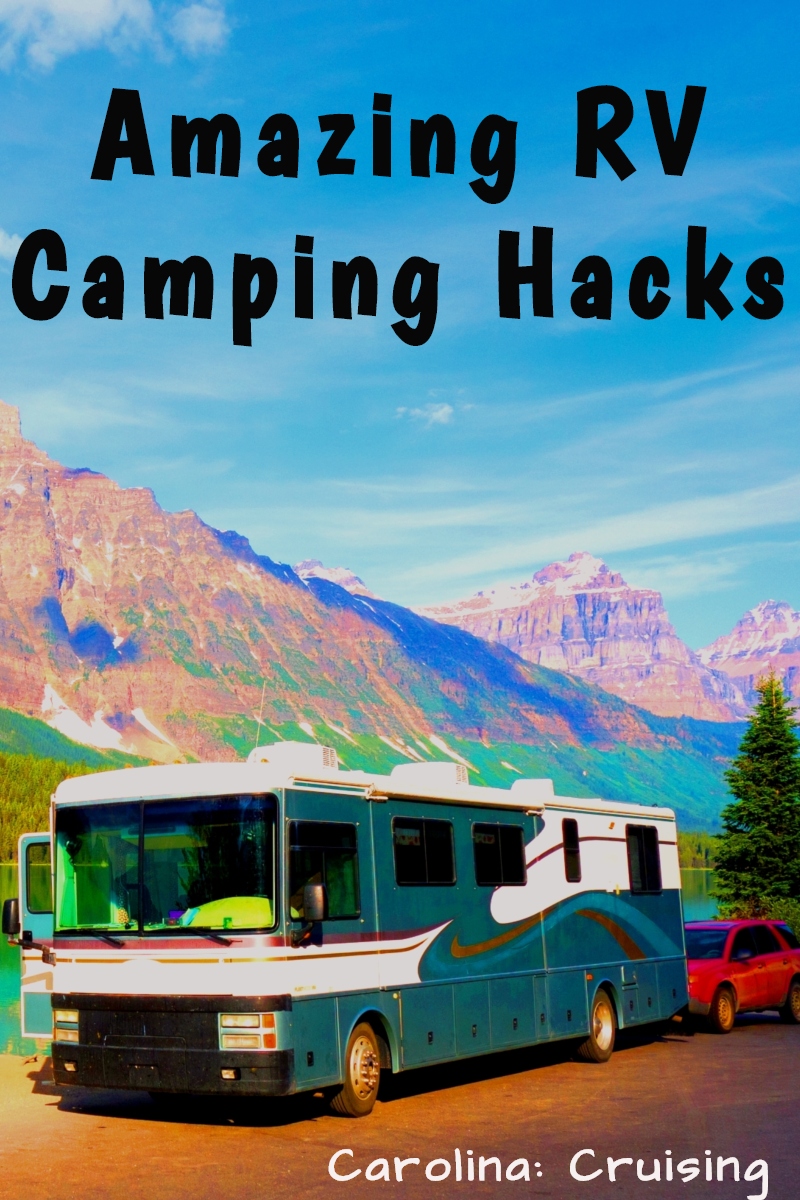
Amazing RV Camping Hacks to Give You an Unforgettable Camping Experience


This week, I go back to lessons we learned in RV cruising (which we did for eight years, five of them full-time)! This post was written for my blog by Outdoorsy.com. 

"If you are also an RV owner, you know that space in your RV and movement of items when you are traveling are two big problems. Whether you are parking somewhere for an extended stay or hitting the road for multiple destinations, you want ideas to make it a trip to remember. These 5 hacks will blow your mind when it comes to saving your sanity so that you can spend your time enjoying your favorite camping experience.   
     

In the Bathroom


Use a closet organizer or mesh shoe holder to hold your bath products or wet towels. Either option will maximize the amount of space you have in the bathroom. You can also use suction cup holders in the shower for your shampoos, soaps, and conditioners. This makes them easy to access and keeps them from falling when you’re are driving. While the mesh shoe holder will hold more items, the closet organizer will keep them securely in place. Both have little drying time, as well. Choose the option that will work best for your family’s needs.

In the Refrigerator


This hack is one of my favorites when tent camping and works just as well when camping in an RV. Crack all your eggs, ahead of your trip, into a wide mouth water bottle. You can add measured lines on the outside to know how many eggs you are cooking with each use. This will help to minimize the amount of space you use in your fridge, keep your eggs from cracking in transport and make just the right amount of eggs for each meal with a quick pour. 

In the Pantry


Canned foods take up a lot of space. One hack that you can use to minimize the amount of shelf space your canned goods take up is to use a magazine holder for storing your cans. A magazine holder can keep over a half dozen cans in the same amount of space that just a few would take standing up. The holder will also keep the cans from falling over when you are driving and keep them organized.

In the Cabinets


Unless you want to use all plastic cups and paper plates, you will need a way to keep your glasses from clanking together and breaking when you are driving. One good bump and you could have an entire set of wine glasses shatter. By using a can koozie on each glass, it will cushion them from cracking and breaking making them easy to store safely. While glass is not the best space saver, a glass of wine just tastes better than drinking it out of a plastic cup.

All Over the RV


Anywhere you have extra space, placing a rack or organizer can help you to maximize space. Don’t get caught up on the name of the device. Just because an item is called a desk organizer, does not mean it can only be used on a desk. The same goes for bathroom carriers and shoe organizers. Hang an organizer on the inside of cabinet doors, use suction cups to put them on your windows, and attach a shoe organizer along any blank space (like around a bed frame) to utilize every inch of your RV. The amount of storage space you gain will be mind-blowing and will help to ensure you have everything you need on your road trip.

Whether you are taking a short RV road trip or if you plan on cruising all winter, set your self up for an amazing adventure that will keep you traveling in comfort and convenience. A little advance planning following these amazing camping hacks and you will find every RV experience is more relaxing and stress-free."

See this post for more RV cruising tips. (10 Commandments of RV Cruising)


Thursday, April 26, 2018

There Are No Hidden Costs, Only Hidden Benefits, in Full-time RVing


In my previous post, I talked about the three kinds of RV cruising one might choose as part of his lifestyle.  The common feedback I got was “We want to RV but it’s too expensive.” I wrote a piece about the subject of The Economics of the RV Cruising Lifestyle in 2011 but it was mainly to justify our upgrade to a Class A from our Class C. Fortunately, it also compared full-time RV cruising to living in a home base and using a car for road trips. Here’s my update on the topic to see if, in hindsight, we still arrive at the same conclusion-that RVing full-time is cheaper! 

Fuel Expenses

It was shocking to see that our fuel expenses were so high when we galloped around the country every three or four days using our Class C motorhome. Clearly, we had to stay at a campground longer, like two or three weeks at a time. This is logical because we were covering a lot more miles in shorter periods of time. Besides, driving around an area using the smaller RV costs a lot. This eased a little when we got the scooter but I found it a very inconvenient way to go for longer trips. I was surprised to find out that a bigger RV, with an even lower mpg, plus a car for driving around, was a cheaper way of full-time RVing. And I was ecstatic about the bonanza of a 350-sq.ft. living space! Obviously, keeping a home base and using a car for road trips is the cheapest option, however.

Vehicle Ownership and Maintenance

Unlike houses, RVs do not appreciate in value. They are homes on wheels that are regularly subjected to the rigors of the road.  Like cars, their values take a deep dive in the first year or two. Buying a brand-new RV, therefore, does not make sense. Bill thought it would be smarter to let other people take that hit. We bought a 10-year old Newmar Mountain Aire, one of the better quality brands. Besides, owning an RV at late in life also made perfect sense because investing in properties was, and still is, no longer high on our agenda.

All in all, our monthly cost of ownership (depreciation + maintenance) for a used home on wheels was around $500 per month, computing the life of our motorhome to be ten years. Not bad for a space of about 350 square feet, translating to less than $1.50 per month per square feet, just slightly above the cost of rented living space in Kent, Washington, from where we came, at the time. However, the condos that we own and are rented out will be there even after we pass on while the rig will most probably last only as long as we live or even shorter (we actually sold it after 8 years).

Campsite Fees/Utilities

When we started RVing, we joined groups that gave 50 percent off for camping fees, which ranged anywhere from $10 a night for parks to $70 for resorts. Camping this way, we averaged $450 a month. When we committed more to the fulltime RV cruising lifestyle and bought the Class A, we also bought a Thousand Trails membership. This allowed us to use their network of campgrounds around the US.  The membership resulted in camping expenses of a little over $6 a day or $200 per month over the more than four years we used it. It was a smart move. We saved on campground fees. 

Furthermore, included in the membership were power, water, and sewer. Sometimes even cable and wifi were included. Thus, the major expense for utilities turned out to be just for mobile phones. You may also need to maintain lawns when you own homes, stuff nonexistent with RVs. Plus association dues can be as high as $350 a month for homes. These are all included in campground fees.

Taxes and Insurance

An RV is a second home, or if you are full-timing, it is the primary home. Sales/excise tax on the purchase of the RV and interest on future payments are just like those on a traditional home or second home. However, since an RV is not real property, property tax is nil. Insurance on the trailer/fifth wheel is lower than on home insurance; but, since a motorhome is a motorized vehicle, insurance expense is higher and may equal that of a home.

Recreation and Entertainment

Entertainment and recreational expenses are not huge while RV cruising because cruising takes you to new places and new things to do all the time. Thus, this type of expenses while living in a home would be a lot more. There would be more out-of-town trips which would mean fuel costs for the car (or even airfare), lodging costs, and other charges associated with the place.

Food and Household Supplies

Food and household supplies can be considered the same for all the columns. Although, of course, food may be more for living in a home base because you may tend to eat out more often. In an RV, you actually feel like you are eating out all the time because grilling outdoors is so much fun and picture windows create a great ambiance. Household supplies may be less in an RV if it is compared to a larger footprint for a home base.

Health Maintenance

Although costs can be considered the same for health maintenance, it is definitely better, however, if you are at home, and more preventive in nature. You tend to postpone visits to doctors, dentists, or ophthalmologists when you travel so costs may be higher when serious health issues arise. This is the main reason we shifted to snow birding first, then getting back to a home base.

If cost were not an option, the best is to have a home base and escape with an RV. But, for most people, the cost is a major consideration. If you do not gallop around the country every three or four days, use a second-hand RV, and join a network of campgrounds, then full-time RV cruising is cheaper than living in a home and using a car for road trips. We have arrived at the same conclusion. We carved out several years from our life to cruising fulltime in an RV. We ended up having a home (the RV), financing our adventure with the rental of our condos, and getting to discover all of North America as a bonus. 

Here's a pinnable image: