Cruising Past Seventy: The Inner Journeys: small towns
Showing posts with label small towns. Show all posts

Monday, December 19, 2022

TRAVEL AWAITS: 5 Diverse and Colorful Towns around Mazatlan


The original article was published in Travel Awaits on April 1, 2022.

We drive down every year to Mazatlan and having a car here has been handy for quick trips for shopping, eating out, and even going to the dentist. But it has also enabled charming day trips to diverse towns around the city. Since the resort where we stay also arranges tours discounted for “owners” like us, we have been to five towns in four winters here. And there are five more to discover.

El Quelite


El Quelite
, north of Mazatlan and only about 30 minutes away, is one that many people rave about. Approaching it, large bougainvillea bushes of many colors and a bright yellow arch mark the entry to the lone street. Colorfully painted homes line both sides and at a plazuela, a statue of a man playing the game ulama, an ancient sport being revived, stands out.

We found all the vehicles parked around El Meson de Los Laureanos. We soon discovered why it is the town! You won’t believe the art and decor, the roosters and horses, all the colorful nooks and corners, all the thriving plants, and the warmth of the people inside. It was the energy of Mexico in a nutshell, including some of the best Mexican food you can have.

We were immediately served the traditional Sinaloan snack, coyotas. After the barbacoa de res (beef), carnitas de puerco (pork), and cordoniz (quail) a la parilla (grill) with arroz, tortilla, frijoles, salsa, and pico de gallo, we were also served with a selection of Sinaloan deserts like candied papaya, squash, and sweet potatoes and leche quemada (burnt milk).

Pro-Tip: Don’t forget to visit the small chapel to the right of El Meson!

El Rosario


El Rosario
, just an hour south of Mazatlan and with a population of about 16,000, is a Pueblo Magico, one of 132 selected by the Ministry of Tourism for exemplary beauty, history, and/or culture. It’s the hometown of María Lucila Beltrán Ruiz (1932–1996), the acclaimed Mexican singer of Ranchera (popular Mexican genre) music, movie, and TV personality, best known for "Cucurrucucú Paloma."

There is a Museo dedicated to her. Just across from it, you will find Las Ruinas, what remains of the parochial temple that crumbled circa 1931 when Minas del Tajo started to mine a large silver belt they discovered right under it. The town’s faithful painstakingly transferred the beloved church, stone by stone, to this present site. A lagoon was created by flood waters from the 1935 Super Cyclone at the old entrance to the mine and near the former site of the temple. Today it’s a recreation area called Isla del Iguanero.

A visit to the Church of Our Lady of the Rosary, built from 1758 to 1771, will be a delight. See its elaborate baroque style and behold its intricately gilded altar. You will also enjoy taking souvenir photos at the colorful town sign, with the pair of huge golden wings, and the monument to Lola Beltran at her plaza!


Pro-Tip:  Have lunch at the House of Lola Beltran and do a quick trip to the Museum of Regional History of El Rosario, built in what was formerly the Municipal Prison.  You will find out that the town was one of the wealthiest in Mexico and that its mining industry led to the founding of the port of Mazatlan.

Stone Island

Technically, Stone Island is a small peninsula jutting off the southern part of Mazatlan, created in 1936 as an ejido, a communal land for cooperative farming. A road connects it to the airport road but we were told it is very bad. So we drove to the last stop of the Green Bus and boarded a panga from the Playa Sur Embarcadero for a short ferry ride.

The lack of irrigation systems ended the agricultural project so the townsfolk turned to fish. Soon they discovered that the island’s beaches were calmer and warmer because of its protected location.  Enterprising residents constructed ramadas and palapas, and today there are about 50 food establishments, four hotels, and about 8,000 residents.


As soon as we were let off from the panga, all forty of us were brought to the Playa Sur Ramada by a three-carriage contraption pulled by a tractor. My husband and I immediately rented an ATV. We were having a ball until our vehicle stopped dead in its tracks almost at the limits of where we were allowed to go. While waiting to be rescued, we marveled at the miles and miles of glorious beach running alongside a seemingly endless coconut grove, said to be one of the largest in the world.

Upon our return and after lunch, there were many things to do besides swimming and snorkeling: horseback riding, jet skis, banana boats, and kayaks, napping in hammocks, snacking on fresh oysters, shopping for local crafts like bags, jewelry, clothes, or colorful ceramic art, hiking the inner island or the coconut grove, playing volleyball or soccer, or having a massage. But at 2:30 pm a horn signaled the trip back home.

Pro-Tip: Don’t forget to play with the large iguanas. They are, they say, harmless.

La Noria

Last month we won two seats at the Tequila Tour that goes to the small town of La Noria, population 725, just 35 minutes away. On the way there, we stopped at a very small village called Puerto de Canoas where the fascinating Mexican dancing horses are housed, trained, and taken care of. They belong to the Azteca breed and have become mainstays of the Carnaval de Mazatlan.

This was followed by a trip to La Vinata de Los Osuna, the 130-year-old and only tequila and mescal distillery (with the largest blue agave plantation) in the state of Sinaloa. Its product is labeled “100% Blue Agave” because the term tequila is legally reserved for the nearby state of Jalisco where the plant grows best.


Our last stop was La Noria, a lovely colonial village founded in 1565. Some mines are still operating; but it is better known as home for many traditional crafts, most especially pottery-making and leatherwork, including saddles, sandals, and belts. A plazuela features the colorful town sign and the antique church of San Antonio.

Pro-Tip: If you want to bring home a bottle of “tequila,” take the Extra-Aged one. It is so smooth.

Durango


Of the many discounted tours offered by the resort, we chose to buy the tour to the city of
Durango even though we had to wake up at daybreak and return long after sundown. The driving time to the mountain city, at an elevation of 6,168 feet, is two and a half hours. With a population of almost 600,000, it is the capital and the largest metropolis in the Mexican state of Durango.

The trip goes through the Carretera Interoceánica (Interoceanic Highway) that begins at Reynosa, just west of the Port of Brownsville, Texas, and ends near Mazatlán, connecting the Gulf of Mexico and the Pacific Ocean. It shortens the time between Durango and Mazatlan by 6 hours, crossing the Sierra Madre Occidental through 63 tunnels and over 115 bridges. The Baluarte Bridge, a cable-stayed bridge stretching 3,688 feet with a span of 1,710 feet at the center, is the most spectacular. With the road at 1,322 feet above the valley below, it is the highest cable-stayed bridge in the world, the highest bridge in the Americas, and the third-highest bridge overall. It opened to traffic in 2013.

A hospital designed in 1899 was restored and transformed into the Bicentennial Convention Center, and a series of huge murals were created by 20 artists depicting moments in the history of Durango on its grounds.  At the entrance are two statues: one of Pancho Villa and the otherof John Wayne! He is their other folk hero who filmed many Western classics in two villages with dusty streets, teeming with cowboys, saloons, sheriffs, and dancers.


With close to one thousand historic buildings, in architectural styles ranging from neoclassical to Baroque to Gothic,
Durango’s Old Historic District is like a huge open-air museum, earning the distinction of being a World Heritage Site of UNESCO. The Plaza de Armas at the center leads to the Catedral Basílica de Durango built from 1685 through 1787 in a blend of architectural styles and with many outstanding features, making it one of the most beautiful landmarks in northern Mexico.

But the highlight of our tour was the Pancho Villa Museum. The Museum gives an ample peek into the abandoned child born in Chihuahua, Mexico, who became a mountain bandit and then a revolutionary hero, robbing the rich to give to the poor. The Museum is housed in a magnificent 18th-century building which was the Government´s Palace in the mid-19th century.

Pro-Tip: If you have the time, ride the Telerifico, a cableway (one of only four in Mexico) that connects two hills, at a length of 750 meters and a height of 82, for a stunning view of the city’s mountainous terrain.

We have been treated to a variety of amazing experiences around Mazatlan and we have yet to visit five others. La Concordia, Copala, Cosala (another pueblo magico), and the villages of Chicayota and Barras de Piaxta. They will be the subject of a sequel to this article.

FOR THOSE ON MOBILE, THE SHARE BUTTONS APPEAR WHEN YOU CLICK WEB VERSION AT THE VERY END AFTER COMMENTS.

PREVIOUS POST

6 Best Events in One of the Largest Carnivals in the World

Friday, September 9, 2022

TRAVEL AWAITS: 6 Charming Small Towns to Visit in Southern Alaska


 The full article was published in Travel Awaits on Dec. 30, 2021

On our first trip to Alaska, we made a detour to Valdez in the southeastern corner. Then from Anchorage, we did day trips to the towns of Whittier and Homer. And on the way back to the Lower 48 through British Columbia, we found the tiny town of Hyder. The next year we went to the towns of Kenai/Soldotna and Seward. This is the second of two articles on my favorite small towns in Alaska, covering the south. The northern towns were featured previously in 6 Quaint Small Towns To Visit North of Anchorage, Alaska.

1. Valdez

We completed navigating the famed Alaska Highway in a week. After a night at a campground in Tok, Alaska, we woke up to a day covered with smog from the forest fires that were raging all around. Quickly we postponed seeing my husband’s youngest in Anchorage for a few days and drove to Valdez in southeastern Alaska first.


There were a few showers on the way there; the air was damp and a lot of fog hovered around. Soon we lost our cell signals and broadband communications. Suddenly, as our RV negotiated a bend, a large white mountain appeared before us: It was Worthington Glacier, and one could walk to it from the roadside! My husband was gone in a jiffy, bringing back a chunk of blue ice that I quickly deposited into our freezer.

Thirty minutes from Worthington is the quaint little fishing town of Valdez (population of almost 4,000). Low-lying clouds encircled the town and the lovely marina. The “longest boat ramp in the world” reached far out into the waters teeming with pink salmon spawning nearby. Eager fishermen lined the banks around Allison Park where we camped.

Up in the hills where the trails wound, we came across a section of the Alaska gas pipeline. But more remarkably, we saw three young men in flip-flops hauling a canoe, heavy with provisions and equipment, up the steep trail to camp in the mountains. And the hiking trails were filled with berry bushes that the bears had clearly ravaged earlier.

Pro Tip: On the way back, if you have time, visit Wrangell-St Elias National Park, which hosts the Canadian Rockies’ highest point, or, nearer to Anchorage, walk on the 27-mile-long Matanuska Glacier.

2. Homer


Anchorage was the neat city we expected it to be. From there, our extended family group took a trip to Homer, Alaska, the “halibut fishing capital of the world,” at the southwestern tip of the state, with over 5,000 in population. It has a famous spit jutting out into the cold blue waters of Kachemak Bay.

There, my husband and his eldest grandson fished to their hearts’ content. At night we let a chef serve us a fish fest. The next day we went hunting for souvenirs and good eats at the quaint shops and restaurants perched in colorful entrancing huts above the waters along the shore. Afterward, I could not resist having my photo taken with the largest halibut (almost 200 pounds) caught in a derby that day.

Pro Tip: On that second night we had a few drinks at the Salty Dawg Saloon on the spit, famous for its ceiling and walls covered with currency. I posted my Philippine peso 100 bill, and my husband and his daughter put up a U.S. dollar.

3. Whittier

When the grandson left to go back to his job in Hawaii, my husband, his daughter, and I proceeded to experience the famous four-hour Inland Passage. A number of cruise lines use Whittier, the charming gateway to Prince William Sound nestled between glacier-draped mountains, as a departure port for these cruises. Only about 60 miles southeast of Anchorage, Whittier is a very pretty town on the western edge of south-central Alaska. Its population is about 200 people in the off-season, which doubles during summer. It is separated from Alaska’s road system by a 2.5-mile-long tunnel that is shared by alternating one-way auto and railroad traffic. Quite an experience.


Our cruise took us to see 26 glaciers up close, some rising to 1,700 feet above sea level. We rode in a high-speed catamaran with huge picture windows inside two enclosed decks (there are extensive outside viewing areas, too). The voyage visits Resurrection Bay and the College Fjords. There were lots of sea otters, seals, porpoises, sea lions, and whales. We were fittingly surprised as we approached Surprise Glacier, a very blue tidewater glacier, pieces of which were floating on the icy waters around the vessel (think shades of Titanic). When the crew served glacial blue margaritas from ice they harvested, we had a party!

4. Hyder

On the way down to the Lower 48, we took the Stewart-Cassiar Highway through northern British Columbia. I did not see a glacier-topped mountain until the turn to the town of Stewart, British Columbia, toward the coast, where there was supposed to be good fishing.

There was nothing commercial about the town of Stewart/Hyder. No one wanted to take Bill out fishing because it was already a day after the season. I was so disappointed until we found out that, only two miles away, was the intriguing tiny town of Hyder. The little town of about a hundred people surprised us with two unplanned and unforgettable experiences: Salmon Glacier and Fish Creek.


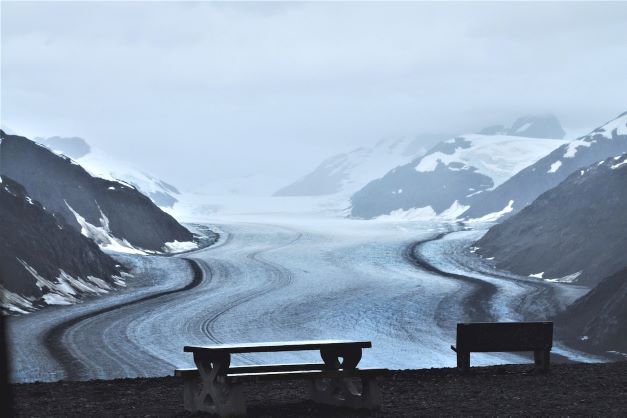
Salmon Glacier is the fifth largest glacier in North America, and as we went up the hill (15 miles) from downtown Hyder and Stewart, it slowly made its appearance. The pictures I took could not capture the entire extent; they could not do it justice. And the price we paid was high. The road was dirt-gravel all the way; and since it was also raining, it was muddy dirt/gravel! I can only imagine the brutal punishment we gave our small Class B motorhome. But there was no other way to get there.

Fish Creek Bear Viewing Site, on the other hand, right at the foot of the hill, had a sideshow waiting for us. A good-sized black bear showed up, and for about 39 minutes hunted for and devoured all the salmon he could find. My husband and I were clicking our cameras non-stop. At times he was a mere 20 feet away. Good thing we were hidden; he put on quite a show!


5. Kenai/Soldotna

The following year, we went back to Alaska for the wedding of my husband’s daughter! When the couple went on their honeymoon, we tried to replicate with the grandson the fun times we had the previous year. We drove to the twin towns of Kenai (population 7,000) and Soldotna (population 5,000) at the mouth of the famous Kenai River on the Kenai Peninsula, just slightly off the same road we took to Homer the previous year.


 Being late in the summer, however, it was already colder, wetter, darker, and windier. There was not much fishing to do in this renowned fishing area of Alaska. Even the snow-capped mountains seemed farther away, hidden by haze so that the pictures we took were not as bright. In Soldotna, the only thing that caught our attention was that the local Fred Meyer, where we camped for the night, had a complimentary dump and potable water stations.

But we discovered an entrancing and historic church built at the turn of the 19th century when the land was still under Russian rule. Alaska only became a state in 1959 after Russia sold it to the U.S. The Holy Assumption Russian Orthodox Church in the Old Town of Kenai was so endearing. We even found a set of wedding crowns we could don for a picture.

Pro Tip: On the way to Kenai/Soldotna, you can get the best-smoked salmon chowder you will ever find at the historic Gwin’s Lodge in Cooper Landing.

6. Seward

The next morning, sensing my disappointment in the weather, my husband headed off to the other side of the peninsula, to the town of Seward (population 3,000) at the mouth of the Kenai Fjords National Park instead of going back to Anchorage. Another lovely cruise ship town nestled between the mountains and the fjords, I felt that Whittier was prettier though smaller. It was already off-season, however, so there was hardly a soul on the Seward waterfront. But the boats were all still moored in the marina, and the shops were still open. And tours to the Kenai Fjords were still available.


Upon leaving town, a sign led us to a certain Exit Glacier only eight and a half miles west. Of course, we took the detour. We found out it is part of the 500-square-mile Harding Ice Fields and is so named because it has been receding slowly since the earliest recorded terminus in 1815. There were recordings all along the way; the last about two miles from the present one. You could imagine the former size of the glacier from the marshland it was creating at its feet. And I got a second chance to walk on the glacial ridge. I finally summoned the courage. But it was so cold; it felt like I was inside the freezer. I turned back after the quick photo op!

Such are the charming discoveries we continue to make all over beautiful Alaska. It’s a place where disappointments don’t last long!

Friday, July 30, 2021

TRAVEL AWAITS: 5 Off-the-Beaten-Path Arizona Towns You Should Visit


The complete article was published in Travel Awaits in April 2020.

Each of these five truly small Arizona towns gives visitors a distinct experience. We discovered them on short side trips from the larger towns we were considering as places to settle in Arizona. 

1. The Burro Town Of Oatman, Arizona


Oatman, Arizona, a rugged former gold mining town in the Black Mountains, is only 2,700 feet in elevation, an hour from Lake Havasu City or 40 minutes from Bullhead City. Today its population is only 128 from its 1915 mining heyday of 3,500. 

I love shopping for unique items in small towns but what made it most enjoyable were "the many wild burros — white, grey, brown, or spotted — that walked all around town." We bought alfalfa available from any store and fed them bits when they gather at storefronts. One even blocked me from entering the door and the owner sprayed him with water to give way.

2. The Mountain Town Of Jerome, Arizona


This town (population, 450) is at the top of Cleopatra Hill between the mountain cities of Prescott and Sedona, overlooking Verde Valley at 5.000 ft. in elevation. "An old mansion still stands tall, an old solitary jail hangs at the outskirts, and a grand old wheel lords the middle of town, reminding locals and visitors of the town’s mining heyday. And, of course, there is a mining museum that tells Jerome’s story in detail." The historic copper mining town has transformed itself into an artist and tourist hub. Today it’s known as the largest ghost town in America and was designated a National Historic Landmark in 1967. 

3. Tortilla Flat In The Middle Of Nowhere


The old stagecoach trail called Apache Trail on the Superstition Mountains starts in Apache Junction 40 minutes east of Phoenix. "At the end of the trail lies Tortilla Flat, a small unincorporated community built on the last surviving stop. With a population of just six, the Flat is the smallest community in the country that has a U.S. Post Office and a voter’s precinct. It was once a camping ground for gold prospectors and later a freight camp during the construction of the nearby Theodore Roosevelt Dam. Many hiking trails in the area start in Tortilla Flat." In 
1998, an Indiana farmer bought the town. "Today, there is a small country store with great ice cream for sale — including the world-famous prickly pear cactus ice cream — plus a souvenir shop....but the center of town is the middle-of-nowhere Superstition Restaurant and Saloon. It oozed the Old West, from the hanging man and the saddle bar stools to an old jukebox. $1 bills covered every inch of the walls." But the restroom should not be missed. The stall art will show you how "we could have looked as voluptuous saloon ladies of the West’s glorious past."

4. The Gunfight At Tombstone, Arizona


Tombstone, only a little over an hour from Tucson, receives approximately 450,000 visitors each year because it is the site of the famous gunfight at O.K. Corral. It has been declared a National Heritage Site with daily reenactments of the fight on Fremont Street. On Allen Street are many pretty saloon ladies and many incarnations of Wyatt Earp in diners and drink stops. Tombstone’s Boot Hill is where those who died from the O.K. Corral gunfight are buried.

"But what also fascinated us was the world’s largest rosebush — according to Guinness — that was planted in Tombstone in 1885 and still flourishes today. Brought in from Scotland, the Lady Banksia rose now covers 5,000 square feet of the roof of the Arcade Boarding House with a trunk of 12-foot circumference." One must go in April to see the spectacle in bloom.

5. The Art And History Of Tubac, Arizona


Only 45 minutes from Tucson is Tubac, Arizona, population of nearly 1,200. Known for its Luminaria Nights in December, the Festival of the Arts in February, and as an artist colony with 100 art galleries, home decor shops, jewelers, potters, and artists of all kinds, you are bound to enjoy going about town in winter. "It was also a pure delight to dine at Elvira’s, the town’s fine dining Mexican restaurant since 1927. It is bedecked with thousands and thousands of colorful lights. And it is where we discovered what has become our favorite flank steak molcajete — Mexican beef stewed with cactus and served on a volcanic pot that remains hot throughout the meal keeping the dish simmering."


And the oldest Spanish mission on American soil, founded by the Jesuit Eusebio Francisco Kino, is only seven minutes away. "It was in 1691 when he established the San Cayetano de Tumacacori, and a day later, 15 miles away, Mission Los Santos Angeles. In 1756, San Cayetano de Calabazas was also founded nearby. Now, the three missions are all protected in an area called the Tumacacori National Historical Park. It is easy to see the Tumacacori Mission. The two others are by appointment only."

FOR THOSE ON MOBILE, SHARE BUTTONS APPEAR WHEN YOU CLICK WEB VERSION AT THE VERY END AFTER COMMENTS.

PREVIOUS POST

CLICK THIS TO PIN THE IMAGE BELOW


Friday, May 21, 2021

TRAVEL AWAITS ARTICLES: How to Spend a Perfect Day in Bisbee, Arizona


The full article was published in Travel Awaits on June 4, 2020.

One of my husband’s favorite authors, J.A. Jance, set most of her books in Seattle, Washington, where she lived most of her life (also where we lived before we started RVing). But the Brady series is set in the town of Bisbee, where she was raised. 

Bisbee is less than 12 miles north of the Mexican border, founded as a copper, gold, and silver mining town in 1880. It grew to its highest population of over 9,000 in 1920 but today, just 5,000 people make it home. In the middle of the 1970s, it transformed itself into a tourist and artists’ haven. That was when, just like in other mining towns in Arizona, companies stopped their mining operations. 

Phelps Dodge Corporation worked with the local government to create a mine tour that was part of the town’s bid to become a tourist destination. The federal government also provided federal aid to complete the flagship tour of the Copper Queen Mine, one of many things that make a perfect day in Bisbee.

The Queen Mine Tour

from the Queen Mine Tour

Bisbee’s Queen Mine was one of the richest copper and one of the largest mines in history. In 1976 it reopened as a tourist destination less than 100 years after the mine originally opened. A high-quality turquoise known as Bisbee Blue was a by-product of its copper mining days and today is a regarded and priceless collectible. 
About 50,000 people a year, outfitted with a hard hat and a miner’s headlamp, take the Queen Mine Tour. For about an hour, you will see how miners worked, going down to 1,500 feet below ground. Temperature down there remains at 47 degrees year-round. 

The Lavender Pit

Lavender Pit Photo Credit: Lynn Libert Andrews of the Arizona Photography Group

Near this Queen Mine is the former open-pit copper mine called Lavender Pit. Jeep tours are available if you want to see it up close. It's not colored purple; it got its name from Harrison M. Lavender, who, as vice-president and general manager of Phelps Dodge Corporation, proceeded to make the previously unprofitable low-grade copper-bearing rock in the area into commercial copper ore. 

The Copper Queen Hotel

The Copper Queen Hotel, Facebook

Bisbee’s development as a tourist destination spurred artist Stephen Hutchison to purchase and redevelop the famed Copper Queen Hotel. Today, it is the most iconic lodging place in town. In 1898 the Queen Consolidated Mining Company provided the hotel with a comfortable place for the executives and dignitaries when they visited.  

"John Wayne, Lee Marvin, Lee Remick, Michelle Pfeiffer, Julia Roberts, Kiefer Sutherland, Ollie North, Nancy Reagan, Gabby Giffords, Jake LaMotta, and Linda Ronstadt are some of the famous people who have stayed in this historic hotel. John Wayne’s favorite room is up the main staircase on the second floor, and it is the most requested room today. But the Copper Queen Hotel is even better known for those who checked in but never checked out. It is said there are 16 spirits haunting the hotel, and this is why I will never stay the night!" The former Copper Queen Cafe and Saloon are both still in their original locations but are now known as 1902 The Spirit Room and The Overlook Saloon. It's the same saloon where John Wayne and Lee Marvin once had a disagreement that ended with Marvin being thrown out a window by the Duke.

"It is also interesting to know that the large boiler in the basement of the Mercantile Building across the street (owned by Phelps Dodge) was used to heat the Copper Queen Hotel through a tunnel, while The Palm Room on the first floor was used as air well to provide cool air to the rooms during the area’s hot summers. The swinging double doors that do not lock and open to the lobby are still there, reminiscent of the good ol’ doors of the Western days. In fact, the Queen Copper Hotel is the longest continuously operated hotel in Arizona" and the only full-service hotel in town. 

Old Bisbee


Old Bisbee has a thriving cultural scene with Victorian-style houses and an elegant art deco county courthouse. Compact and walkable, downtown is quite hilly so there are a lot of stairs from which you can discover little stores or artists’ places. The best example, however, is the old four-story-high school that has a ground-level entrance for each floor given the way it’s built into the hillside.

Erie Street

Dave Corby, Facebook

You should not miss Erie Street, dubbed a living snapshot of a different time. It's like stepping into a Western movie set. It's the only thing left of Lowell, Arizona, a former mining town that was incorporated into Bisbee in the early 1900s. There are only three real stores on the street; the rest are empty. Each year in March, the entire street turns into a festival with live music, cars and motorcycles on display, and lots of food and drinks. In December when we visited, the Western Christmas decor was priceless.

Museums

from Facebook

If you have more than a day, there are three museums that would you could visit. The Bisbee Council on the Arts’ Mining and Historical Museum was once the headquarters of the Queen Consolidated Mining Company. It is Smithsonian Institution’s first-ever rural affiliate. And there is the Bisbee Restoration Museum run by volunteers and the Muheim Heritage House Museum whose restored interior and precious period furnishings have made it a National Historic Site.

FOR THOSE ON MOBILE, SHARE BUTTONS APPEAR WHEN YOU CLICK WEB VERSION AT THE VERY END AFTER COMMENTS.

PREVIOUS POST


CLICK THIS TO PIN THE IMAGE BELOW